A Taste of Home in the Theater of War: The Century-Old Military Logistics Behind Thanksgiving on the Front Lines

In November 1966, twelve American soldiers stationed at an isolated, vulnerable outpost deep inside a hostile Vietnamese war zone experienced a holiday ritual that seemed logistically impossible. Separated from their families, traditional dining rooms, and the domestic comforts of home, these members of a 5th Special Forces detachment faced a Thanksgiving devoid of the customary pageantry. However, the United States military apparatus was determined to bridge the vast geographic divide. Relying on sheer resourcefulness, a mess sergeant at Bien Hoa prepared a complete turkey dinner with all the traditional trimmings, packed the provisions securely into insulated containers, and loaded them onto a helicopter. The aircraft successfully navigated hazardous airspace to War Zone D, where three officers and nine enlisted men sat down to a hot Thanksgiving meal, preserving a vital morale-boosting tradition recorded in National Archives documents.
This high-risk delivery was not an isolated anomaly, but rather a single thread in a massive, complex logistical tapestry that the U.S. military has woven across generations of conflict. From the smoke-filled encampments of the American Civil War to the remote, wind-swept valleys of Afghanistan, the Department of Defense and civilian volunteers have consistently mobilized extraordinary resources to ensure that service members in combat zones receive a traditional Thanksgiving dinner. This enduring effort underscores a core military philosophy: sustaining the psychological well-being and morale of fighting forces is just as critical to mission success as supplying ammunition and medical gear.
Historical Roots: Thanksgiving Forged in the Crucible of War
The intertwining of the Thanksgiving holiday with American military operations is deeply historical. Paradoxically, Thanksgiving became an official national holiday during the nation’s most catastrophic internal conflict. In October 1863, as the American Civil War entered its third brutal year, President Abraham Lincoln issued his historic Thanksgiving proclamation. Amid staggering casualties at battlefields like Gettysburg and Vicksburg, Lincoln called upon all Americans to observe the final Thursday of November as a day of national "Thanksgiving and Praise."
By the following year, the home front mobilized to translate presidential sentiment into tangible support for Union troops on the front lines. Former War Department official Charles A. Dana later documented the "great turkey movement" of November 1864, which stands as the historical prototype for modern military holiday logistics. In New York City alone, civilian organizers reported having 20,000 dressed turkeys prepared for shipment to the front. Concurrently, a Philadelphia committee coordinated the transport of another 4,000 turkeys destined specifically for troops serving under General Philip Sheridan. These early civilian-led efforts demonstrated the profound public desire to maintain a connection with soldiers through the medium of holiday food.
World Wars and Rationing: The 20th Century Escalation
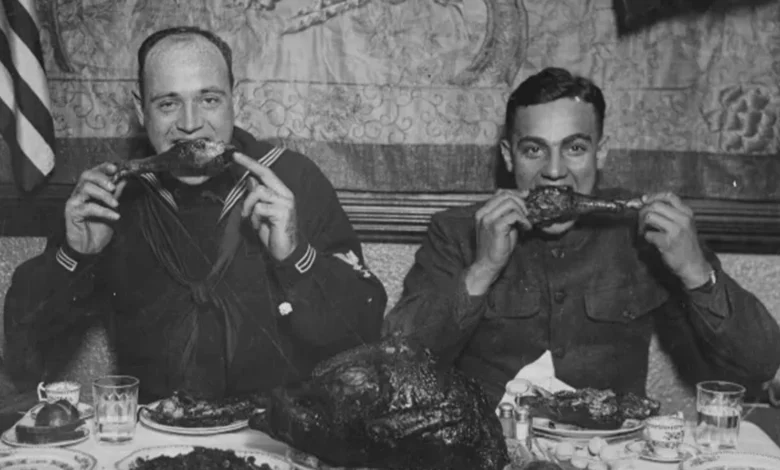
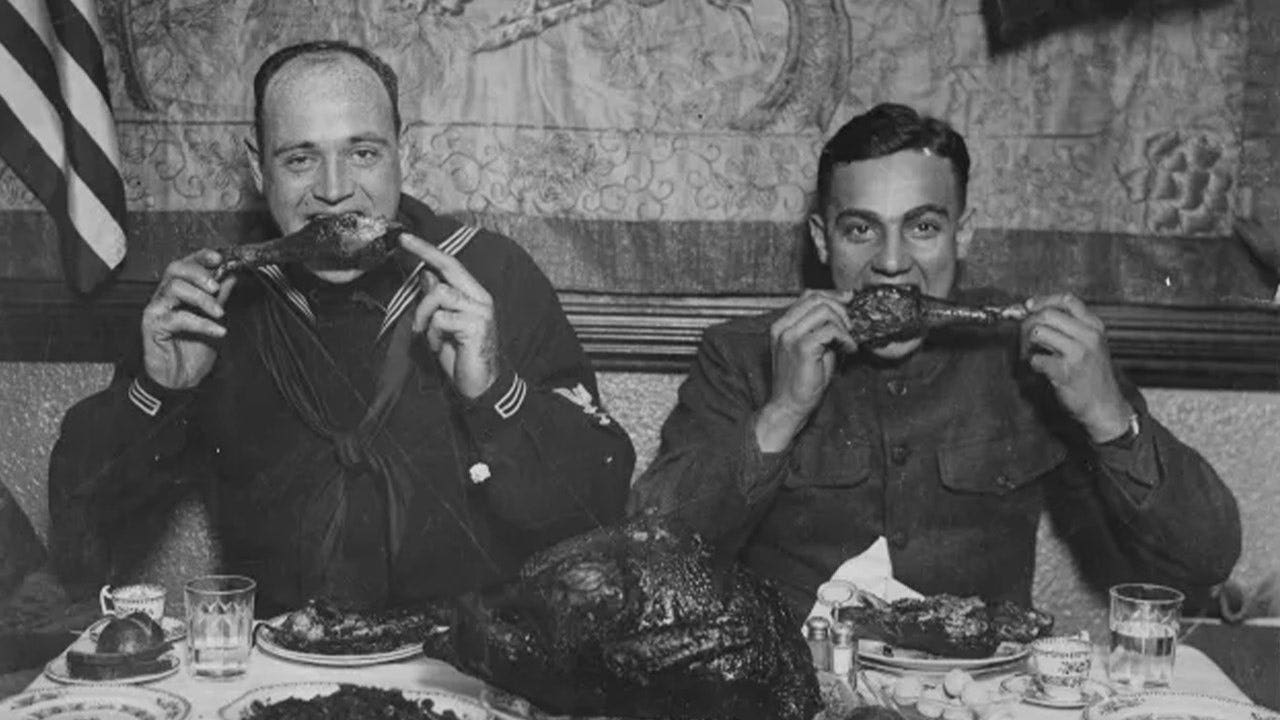
As the scale of global warfare expanded dramatically in the 20th century, the informal holiday care packages of the Civil War evolved into state-managed, industrial-scale military logistics. During World War I, despite severe supply chain strains across the European theater, the American Expeditionary Forces made concerted efforts to provide turkey dinners to troops in the trenches, turning the holiday into a brief respite from the horrors of trench warfare.

By the time the United States entered World War II, the logistical challenge of feeding millions of service members globally reached unprecedented heights. The sheer volume of poultry required for the armed forces profoundly impacted the domestic economy. In August 1943, the federal War Food Administration took the extraordinary step of restricting most civilian turkey sales across the United States. The government sought to secure millions of pounds of poultry exclusively for military consumption.
Initially establishing a procurement goal of at least 10 million pounds for troops stationed overseas, the administration quickly expanded the mandate to include military installations within the continental United States. By the time the restriction was lifted in October 1943, wartime government records indicate that the military had successfully acquired roughly 30 million pounds of turkey.
Yet, procuring the food was only the first step; delivering it safely to troops near active combat lines often involved grave peril. In November 1944, during the grueling European campaign in Germany’s Hürtgen Forest, Lt. Paul Boesch of the 121st Infantry Regiment received word that hot turkey dinners had arrived for his battalion. Recognizing the tactical vulnerability of the position, Boesch protested that sending soldiers to retrieve the food would expose them directly to German artillery fire. The command directive to distribute the meal remained unchanged. Boesch’s tactical concerns were tragically validated when German artillery struck the gathering area as troops moved to collect the rations, resulting in multiple casualties.

Subzero Logistics: The Korean Conflict
Just six years after the conclusion of World War II, American service members found themselves confronting both hostile enemy forces and punishing environmental extremes during the Korean War. On Thanksgiving Day in 1950, Marines positioned around the Chosin Reservoir were served a holiday menu featuring turkey, cranberry sauce, candied sweet potatoes, fruitcake, and mince pie. However, the subzero temperatures presented an immediate, physical challenge: the food began to freeze almost the moment it was plated.
This surreal holiday meal occurred amid a brief window of tactical optimism. U.S. commanders hoped the conflict might soon reach a conclusion, prompting General Douglas MacArthur to launch the "Home-by-Christmas" offensive the very next day. Instead, this optimism was shattered when Chinese forces intervened on a massive scale. Within days of their Thanksgiving meal, the Marines at Chosin were completely surrounded, fighting for their survival in one of the most brutal and legendary engagements in modern military history.
A year later, on November 22, 1951, chow lines were established just 200 yards from the main line of resistance in Korea. Despite the proximity to active combat, logistical personnel successfully distributed turkey legs and traditional sides, offering a fleeting moment of normalcy to frontline infantrymen.

Modern Deployments: Iraq, Afghanistan, and High-Tech Supply Chains
Entering the 21st century, operations in Iraq and Afghanistan introduced modern technological capabilities—such as advanced GPS routing, rotorcraft transport, and satellite communications—to the time-honored tradition of holiday logistics. These conflicts also witnessed high-profile gestures from the nation’s civilian leadership.
In November 2003, President George W. Bush executed a heavily classified, high-security mission to visit troops in Iraq. Air Force One approached Baghdad International Airport under strict blackout conditions, its cabin shades drawn and interior lights dimmed to mitigate anti-aircraft threats. President Bush surprised approximately 600 service members gathered in a dining facility, famously joking, "I was just looking for a warm meal somewhere," before helping serve Thanksgiving dinner. Seven years earlier, in November 1990, his father, President George H.W. Bush, similarly celebrated Thanksgiving by sharing a holiday meal on the hood of a Humvee with U.S. troops stationed in Saudi Arabia during Operation Desert Shield.
For troops stationed at remote combat outposts far removed from major logistical hubs, however, the delivery of a hot Thanksgiving meal required intricate tactical maneuvers. On Thanksgiving Day in 2007, military planners utilized helicopters to transport turkeys and traditional fixings from Bagram Airfield directly to soldiers positioned at isolated firebases in Afghanistan’s Tagab Valley. For many recipients, it marked their first hot meal in months. Because the outposts remained active combat zones, units had to rotate personnel between the dining area and active defensive fighting positions. Pfc. Matt Lorimer of the 82nd Airborne Division captured the sentiment of many deployed soldiers, remarking simply on the exceptional quality of the meal under adverse conditions.

At other remote outposts, the logistical chain stretched to its absolute limits. In 2009, troops stationed at a high-elevation observation post in Afghanistan spent a month caring for five locally purchased turkeys in anticipation of the holiday. Recognizing that the small flock was insufficient to feed a company of roughly 150 soldiers, the command chain initiated a multi-tier resupply operation. Additional turkey was flown from the United States to Bagram Airfield, trucked across rugged terrain to a regional base, and finally loaded onto a helicopter for a vertical ascent to a mountain observation post situated nearly 6,900 feet above sea level.
Strategic Implications and Psychological Impact
Military historians and defense analysts emphasize that these massive logistical undertakings are far more than sentimental gestures. Maintaining morale through cultural touchstones like Thanksgiving directly correlates with operational resilience. In protracted counterinsurgency campaigns and conventional deployments alike, the psychological weight of isolation and danger can degrade combat effectiveness.
By executing complex resupply operations under threat of enemy action—such as the helicopter flights into War Zone D in 1966 or the Tagab Valley supply runs in 2007—the military leadership communicates a powerful message to the rank and file: the nation and its armed forces recognize their sacrifice and remain committed to their well-being, no matter how remote or hazardous their duty station may be.

As these historical archives illustrate, whether crossing snow-covered valleys in Korea, navigating hostile forests in Europe, or flying through contested skies in Southeast Asia and the Middle East, the U.S. military’s commitment to delivering a taste of home has remained an unwavering constant through more than a century of armed conflict.
Related posts: