Steelers dominate Broncos 27-5 in Black Friday upset as Aaron Rodgers controversy looms large

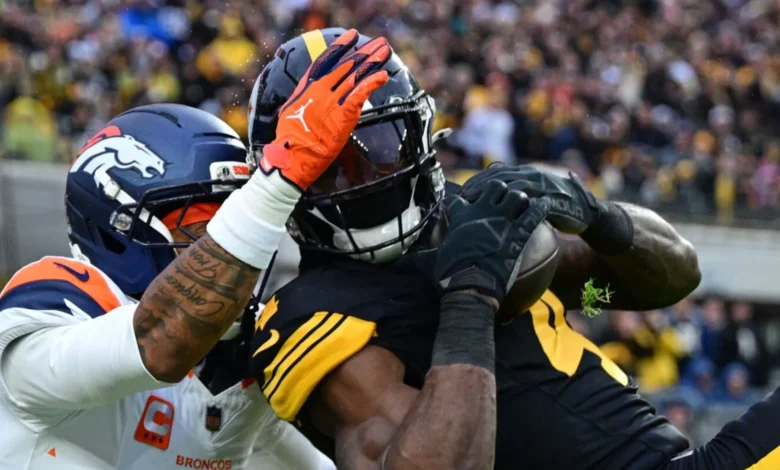
The Pittsburgh Steelers delivered a resounding statement of intent on Black Friday, dismantling the Super Bowl-contending Denver Broncos in a 27-5 victory that served as both a tactical masterclass and a defiant response to a week defined by organizational turbulence. While the headlines leading up to the matchup were monopolized by the explosive departure of veteran quarterback Aaron Rodgers, the Steelers’ defense and an efficient, if unspectacular, offensive performance ensured the focus remained firmly on the gridiron. For the Broncos, the loss was a sobering reality check, as their offense withered against a suffocating Pittsburgh front, while the Steelers successfully navigated a period of intense scrutiny to improve their postseason prospects to 7-4.
A Masterclass in Defensive Dominance
The game was effectively decided in the trenches during a calamitous first half for the Broncos. Pittsburgh’s defensive unit, long considered the team’s emotional and tactical heartbeat, stifled Denver’s playmakers from the opening whistle. The tone was set early in the first quarter when T.J. Watt capitalized on a chaotic sequence, recovering a fumble forced by the pressure on Broncos quarterback Bo Nix within the end zone.
The momentum shifted decisively toward the hosts as the Steelers’ secondary capitalized on Nix’s inability to manage the pressure. Jalen Ramsey, orchestrating the defensive backfield with veteran poise, intercepted a Nix pass and returned it 36 yards for a touchdown, a play that effectively drained the remaining life from the Denver sideline. By the time the halftime whistle blew, the Broncos had been held to a staggering 58 yards of total offense—a statistical rarity that placed this performance among the most ineffective offensive showings by a playoff contender in the last three decades. Only three teams since 1991 have managed fewer than 60 yards while surrendering two defensive touchdowns in the opening two quarters, placing Denver in an unenviable historical bracket.
The Rodgers Saga: A Backdrop of Turmoil
The narrative surrounding the Steelers’ organization this week was undeniably colored by the exit of Aaron Rodgers. Following a controversial appearance on the Pat McAfee Show, the four-time MVP’s tenure in Pittsburgh came to an abrupt, unceremonious end. Rodgers’ public allegations—which included claims that head coach Mike McCarthy frequently slept through team meetings and exhibited a lack of situational awareness, such as the accidental "Go Pack Go" chant during a team talk—created an environment of significant distraction.
The situation escalated further during the game broadcast when veteran commentator Al Michaels revealed a text message allegedly sent by Rodgers, in which the quarterback claimed he had been barred from accessing team facilities following his demotion to backup behind Mason Rudolph. This friction, which had threatened to derail the Steelers’ locker room cohesion, appeared to have the opposite effect on the field. Instead of folding under the weight of the controversy, the team channeled the external noise into a disciplined defensive performance.
Rudolph, stepping into the starting role, managed the game with pragmatic efficiency. Finishing nine of 15 for 142 yards and a touchdown, he leaned on the ground game, where Rico Dowdle and Jaylen Warren combined for 117 rushing yards. The performance was not flashy, but it was effective enough to provide the cushion necessary for the defense to operate with freedom.
Chronology of the Collapse
The timeline of the game reflects a steady degradation of Denver’s offensive rhythm. After the early defensive scores, the Broncos managed to scrape together a marginal response when Alex Singleton stuffed Jaylen Warren in the end zone for a safety. However, the ensuing field goal exchange—a 44-yarder from Denver’s Wil Lutz and a 47-yarder from Pittsburgh’s Chris Boswell—served only to highlight the vast gap in efficiency.
The second half offered little respite for the visitors. It took until 9:23 remaining in the third quarter for Denver to record a first down, a 22-yard connection between Nix and Jaylen Waddle that ultimately resulted in nothing. Despite a brief glimmer of hope when Zach Allen forced a fumble from Dowdle—recovered by Riley Moss—the Broncos were unable to convert, missing a 53-yard field goal attempt.
The final nail in the coffin arrived early in the fourth quarter. Rudolph connected with Roman Wilson on a 37-yard strike, setting up a 33-yard field goal by Chris Boswell that pushed the score to 27-5. Bo Nix’s afternoon ended on a sour note, intercepted by Daylen Everette at the Pittsburgh seven-yard line, sealing a lopsided result that will force the Broncos to re-evaluate their offensive scheme ahead of the final stretch of the season.
Statistical Breakdown and Team Performance
While the scoreboard reflected the dominance of the Steelers, the individual performances underscored a collective effort. For Pittsburgh, the receiving corps was anchored by D.K. Metcalf, who recorded a touchdown catch and notably signaled the number eight with his fingers in what was widely interpreted as a gesture of solidarity with the departed Rodgers.
The Broncos, conversely, struggled to find any rhythm. Bo Nix’s performance was statistically hampered by his two interceptions and a lost fumble. The inability of Denver’s offensive line to protect their signal-caller or open lanes for the run game left the team stagnant. With the loss, the Broncos drop to 8-3, a record that keeps them in the hunt but raises significant questions about their ceiling in the postseason.
Broader Implications and Future Outlook
The victory for Pittsburgh is a pivotal turning point in their 2026-2027 campaign. By moving to 7-4, they have successfully separated themselves from the negative discourse that threatened to overshadow their season. The ability to win decisively while internal politics dominate the news cycle is often the hallmark of a resilient team, and the Steelers demonstrated a maturity that may prove vital as they approach the playoffs.
For Denver, the implications are more nuanced. Head coach Mike McCarthy—who has been at the center of the Rodgers controversy—must now address the mechanical failures of his offense. A performance yielding fewer than 60 yards in a half is rarely solely the fault of a young quarterback; it suggests a systemic breakdown in play-calling and execution that cannot be ignored if they intend to make a deep run into the postseason.
As the NFL moves toward the latter stages of the season, the focus for both teams remains clear. The Steelers must build on this defensive momentum, proving that their success is not merely a reaction to internal strife but a sustainable model for winning. Meanwhile, the Broncos must find a way to stabilize their offense, as the lack of production witnessed on Black Friday will be punished severely by the elite defensive units they are likely to encounter in the playoffs.
The 2026 NFL season continues to offer high-stakes drama, both on and off the field. With the playoffs approaching and Super Bowl LXI on the horizon for February 14, 2027, the margin for error has vanished. Pittsburgh has proven it can handle the storm; Denver now finds itself in the eye of one, needing to regroup quickly to regain its status as a premier championship contender. The remaining weeks of the regular season will determine which of these teams enters the tournament with the momentum necessary to claim the ultimate prize.
Related posts: