The Battle for the Shore: Tybee Island’s Fight Against Rising Seas and Infrastructure Disruption

This coverage is made possible through a partnership between Grist and WABE, Atlanta’s NPR station.
The Georgia coastline, characterized by its resilient barrier islands, is currently facing an existential crisis. Tybee Island, a popular tourist destination and vital defensive buffer for the mainland, is losing its primary shield against the Atlantic Ocean. While barrier islands are geologically designed to act as dynamic systems—shifting, growing, and migrating via the natural flow of sediment from northern islands—this cycle has been fundamentally broken by human intervention. The construction of jetties, the hardening of shorelines with sea walls, and the dredging of massive shipping channels have essentially choked off the natural "sand conveyor belt" that once sustained the island’s beaches.
The Mechanism of Disruption
The natural accumulation of sand on barrier islands relies on longshore transport, a process where waves carry sediment down the coast. However, at Tybee Island, this process is interrupted by the mouth of the Savannah River. To accommodate massive container ships traveling to and from the Port of Savannah, the Army Corps of Engineers maintains a deep-water shipping channel. This channel acts as a trap, preventing sand from migrating naturally southward to Tybee.
Consequently, the island is trapped in an artificial cycle of dependence. Since the 1970s, the Army Corps of Engineers has been forced to engage in periodic beach renourishment—a process of dredging sand from the ocean floor and pumping it onto the beach—to prevent the island from washing away. Under normal conditions, these projects occur on a seven-year rotation. However, as sea levels rise and storm intensity increases, the "shelf life" of these renourished beaches is rapidly declining.
A Timeline of Erosion and Crisis
The scale of the current erosion is visible to anyone walking the beach. During the winter of 2019 and 2020, the Corps deposited 1.3 million cubic yards of sand onto the island. Despite the massive scale of this intervention, more than 50 percent of that material has already been lost to the tide.
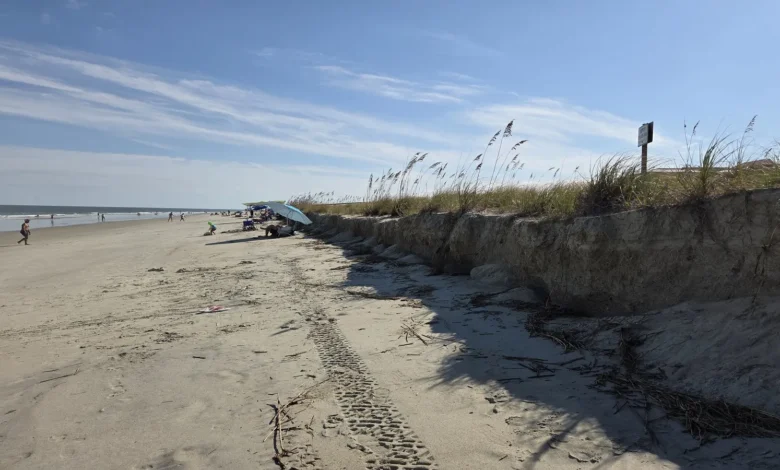
The physical reality of this loss is stark. Near the DeSoto Beach Hotel, the dune system has been severed, leaving behind a 5-foot-high vertical cliff. This is not merely an aesthetic issue; it is a structural failure of the island’s primary defense system. The vegetation that anchors the dunes—crucial for holding the sand in place—is now dangling, with roots exposed to the air and saltwater.
The implications of this erosion have become increasingly severe over the last 36 months:
- Biological Impact: Loggerhead sea turtles, which rely on the dunes to nest, are seeing their habitats destroyed. Storm surges and high tides have cut directly into nesting sites, threatening the reproductive success of these protected species.
- Economic Impact: The local tourism industry, which accounts for a significant portion of the city’s tax base, is struggling. Chair and umbrella rental operators have been forced to relocate or cease operations as the beach frontage disappears. Local hotels report a decline in bookings, as the loss of usable beach space diminishes the island’s appeal.
- Infrastructure Risk: The dunes serve as the first line of defense against storm surges. As they disappear, the risk of property inundation during even moderate tropical events increases significantly.
The Financial Struggle for Renourishment
The path to securing the next round of renourishment was fraught with political and budgetary hurdles. The process, which is estimated to cost approximately $20 million, requires a 40 percent local cost-share from the city, county, and state. While local stakeholders successfully set aside their portion of the funding, the federal government faced its own complications.
In recent budget cycles, the federal beach renourishment program faced significant underfunding. Tybee Island, despite its critical need, was initially left off the project list. This created a scramble for resources, with beach communities across the Southeast competing for a shrinking pool of federal dollars. The situation prompted an aggressive lobbying campaign from city officials and a grassroots letter-writing initiative from residents. The turning point came when members of the Georgia congressional delegation visited the island to witness the erosion firsthand.
In September, the Army Corps of Engineers announced a "miracle" redirection of funds from other projects, ensuring that the necessary financial support would be available for Tybee. The project is now scheduled to move forward this winter.
A New Approach: Nearshore Placement
The upcoming renourishment project will mark a departure from traditional methods. Rather than pumping all the dredged sand directly onto the dry beach, the Corps plans to experiment with "nearshore placement."
In this model, sand dredged from the Savannah River shipping channel will be deposited in the shallow waters just off the coastline. The logic behind this strategy is to use the energy of the waves to distribute the sand onto the beach naturally, rather than fighting against the wave action. By creating an underwater bar of sand, the project aims to dampen the power of incoming waves, thereby reducing the rate at which the beach is scoured.
City Manager Bret Bell remains cautiously optimistic about this approach. "That really is expected to extend the life of our nourishment," Bell noted. "Instead of the next nourishment happening in seven years, it might be 10 years."
Broader Implications: Climate Change and Future Coastal Management
The challenges faced by Tybee Island are a microcosm of the risks facing coastal communities across the globe. With sea levels rising by approximately half an inch per year due to the effects of climate change, the traditional strategy of "dumping sand" is increasingly viewed by scientists as a stopgap measure rather than a permanent solution.
While the nearshore placement strategy offers a glimmer of hope for extending the intervals between projects, the long-term outlook remains uncertain. The ocean is not merely rising; it is becoming more energetic. As global temperatures increase, the intensity of storm surges is expected to grow, placing even greater pressure on already fragile barrier island ecosystems.
Furthermore, the competition for federal funding highlights a growing policy debate. As more coastal communities require federal intervention to prevent erosion, the fiscal sustainability of these programs is being questioned. Critics of current policies argue that the focus should shift toward "managed retreat" or more aggressive restoration of natural maritime forests and wetlands, rather than the perpetual replenishment of sand.
However, for a community like Tybee Island, where the local economy and physical safety are tied to the beach, the immediate priority is maintaining the status quo. The upcoming renourishment is a vital survival tactic. Yet, as the island waits for the dredgers to arrive this winter, the cliffside dunes near the DeSoto Beach Hotel serve as a constant, looming reminder: nature is a persistent force, and the cost of holding back the sea is only expected to rise in the decades to come.
The success of the new nearshore placement technique will likely serve as a case study for the Army Corps of Engineers. If it proves effective in slowing the erosion rate, it may provide a roadmap for other barrier islands struggling with the consequences of human-altered sediment flows. For now, the residents and officials of Tybee Island remain in a state of vigilant anticipation, aware that while the upcoming project will provide a temporary reprieve, the battle to preserve the island is a permanent fixture of their future.