President Donald Trump Delivers Fiery, Unvarnished Remarks at Rescheduled White House Correspondents’ Association Dinner

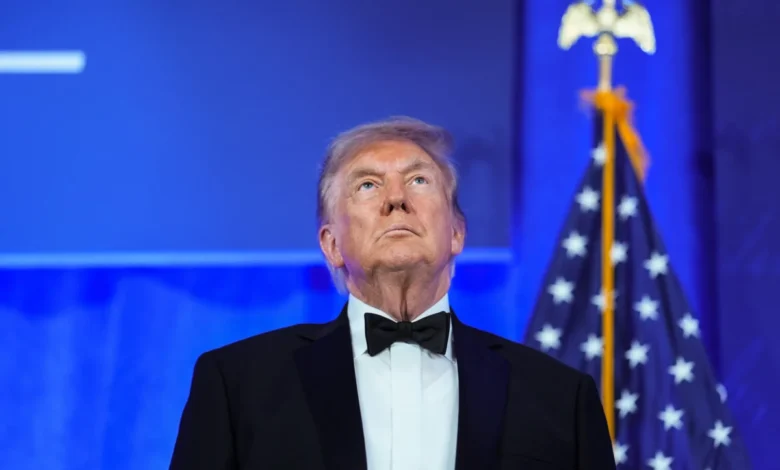
President Donald Trump made his debut at the White House Correspondents’ Association (WHCA) Dinner on Friday evening, a highly anticipated event that was rescheduled following a security incident earlier in the year. In a speech that stretched for just over an hour, Trump addressed the assembled journalists, politicians, and celebrities with a characteristic blend of sharp criticism and self-aggrandizement, targeting individuals and organizations with whom he has frequently clashed. The gala, held at the Waldorf Astoria hotel in Washington, D.C., marked a significant departure from the usual tone of the event, which traditionally features a comedian to offer satirical commentary on the administration.
Trump, who has historically maintained a contentious relationship with much of the mainstream media, began his remarks with a seemingly conciliatory tone, stating, "I am delighted to be here at the White House Correspondents’ Dinner. Amazing people, a lot of people that I like. Some I don’t like at all, but I respect most of them." However, this initial measured approach quickly gave way to his signature combative style. He appeared to grapple with the intended tone of the evening, remarking, "What do we do here? Is this supposed to be fun? Am I supposed to be serious? Am I supposed to be a comedian? So I guess you said, maybe a little bit of everything."
The President’s address soon pivoted to a direct confrontation with the press, labeling much of the media as "fake news." He drew a parallel between the perceived inaccuracies in journalistic reporting and the Academy Awards, stating, "This evening it’s really all about the fake news media and your handling of prizes – writing and producing and performing made-up stories like the Academy Awards." Trump elaborated on this point by referencing the declining viewership of the Oscars, attributing it to the awards ceremony’s perceived antagonism towards him. "The Academy Awards used to be the epitome of ratings outside of the Super Bowl… Now it’s down in the dumps. Nobody wants to watch it anymore because they took on Trump. They hit me all night long," he asserted.
A significant portion of Trump’s speech was dedicated to predicting the future financial landscape for news organizations in his absence. He confidently declared, "When I’m gone. You’re all going to be broke. Your business model is going to be finished. No, it’s true. When I’m not around, you’re going to be broke. There’s not going to be anybody to report on. Nobody gives a damn about anybody else." This statement underscored his belief that his own persona and the controversies surrounding him are the primary drivers of media engagement and profitability.
Trump further elaborated on his decision to forgo previous WHCA dinners, citing what he described as unfair treatment by the press. "I thought the press treated me very, very unfairly, and I don’t know. I think I made the right decision because they need to go where maybe you’re not wanted, but they did want me. They wanted me for ratings, and they wanted me for other reasons, but not for love. And I said, ‘You know, I’m not going to go.’ First time that ever happened… And I didn’t go for four years because I got treated terribly by the press."
This year’s decision by the WHCA to forgo a traditional comedian was also a point of contention for Trump. He offered his opinions on several prominent late-night hosts, stating, "They considered using Jimmy Kimmel, Jimmy Fallon… These guys – they’re terrible. They’re terrible. Stephen Colbert. These are people without talent… They have no talent, but they are not comedians. They’re not funny people. They’re angry people. They’re sick people."
The President took the podium at approximately 9:33 p.m. and spoke for roughly 64 minutes, a length that significantly exceeded the typical duration for such remarks.
A Shift in Tradition and a Nod to Legacy
The WHCA Dinner, a long-standing tradition in Washington D.C., has historically served as an opportunity for the President to engage with the press corps in a more informal setting, often with a humorous exchange. The event’s origins trace back to 1921, with the primary goal of fostering a stronger relationship between the White House and the Washington press corps. Over the decades, it evolved to include a formal dinner, the presentation of journalism awards, and a speech by the President, often accompanied by a comedic performance. This year’s deviation from the comedic tradition, particularly in light of the earlier security incident, highlighted the unique circumstances surrounding the rescheduled gala.
During his address, Trump alluded to a conversation with Paramount CEO David Ellison, whose company owns CBS News. Trump recounted that Ellison suggested renaming the WHCA dinner to the "Trump White House Correspondents’ Dinner" in the future, a notion the President embraced. "He told me that, and I like that very much. We’re going to change the name of it, OK?" Trump declared, drawing a parallel to his unsuccessful efforts to have his name associated with the Kennedy Center.
Targeted Criticisms and Controversial Remarks
Trump’s speech was punctuated by a series of direct criticisms and barbs aimed at various figures. He expressed well wishes for Bari Weiss at CBS News, a comment that elicited a noticeable reaction from the audience. He also acknowledged the challenging role of White House Press Secretary Karoline Leavitt, noting her task of "deal[ing] with all of you all the time, and you can be very difficult. You can be very, very difficult people."
In a statement that seemed to encapsulate his perception of the room, Trump quipped, "This place is the really the largest group of Trump derangement syndrome people ever put together at one time, I suspect," a remark that drew scattered laughter. The President’s repeated invocation of "Trump derangement syndrome" has become a familiar theme in his public discourse.
The President then turned his attention to individuals he has frequently identified as adversaries. He singled out Don Lemon, describing him as having "the lowest ratings and the lowest IQ on television" and labeling him "the dumbest man on television."
CNN anchor Kaitlan Collins was also a target. Trump acknowledged her award for broadcast coverage but dismissed it as "fake" and "all about me," stating, "She shouldn’t get the award. It was a fake, but I didn’t mind." CNN Worldwide Chairman and CEO Mark Thompson responded to Trump’s remarks with a statement asserting, "We stand by our journalists and the integrity and fair mindedness with which the CNN team reports the news. Honest, accurate journalism may sometimes irritate politicians, but our right to report and present that reporting to the public without government interference is fully protected by the U.S. Constitution. CNN will continue to exercise this right."
Trump’s commentary on Collins took a peculiar turn as he described her as "a young, active woman" but noted, "she never smiles." He urged her to "Just smile, Kaitlan. Just smile." He then attempted a joke involving a sponsorship, mistakenly linking her to a Bud Light advertisement featuring Dylan Mulvaney, a transgender influencer whose partnership with the brand in 2023 led to significant backlash. Trump commented on the financial repercussions of that campaign for Bud Light.
Anderson Cooper, another CNN anchor, also received a mention. Trump acknowledged a past positive relationship, stating, "I like Anderson actually because he’s covered me well for many years, and he went bad as soon as I went for politics. But for years, he loved interviews. I did so many interviews with him, and he was great."
The President’s broadsides extended to a number of prominent figures, including California Governor Gavin Newsom, U.S. Representative Ilhan Omar, Senators Elizabeth Warren and Chuck Schumer, Rosie O’Donnell, whom he called "a sick older woman," CNN’s Jake Tapper, and musician Bruce Springsteen. Regarding Springsteen, Trump expressed disappointment with the musician’s current appearance and his perceived political activism during concerts, quipping, "The tour has been renamed ‘Bored in the USA,’ and his new song was so bad."
A History of Media Confrontation and Legal Battles
Trump’s adversarial relationship with the press is well-documented. His consistent labeling of news outlets as "fake news" and his public insults directed at individual journalists have been hallmarks of his presidency. Beyond rhetoric, he has also pursued legal action against several news organizations, including The New York Times, The Wall Street Journal, CNN, ABC News, and CBS News’ "60 Minutes," over coverage he deemed unfavorable.
A particularly notable instance at the dinner involved the Wall Street Journal reporters who received the Katharine Graham Award for Courage and Accountability for their reporting on a birthday letter purportedly written by Trump to Jeffrey Epstein. Trump has denied authoring such a letter and had filed a $20 billion defamation lawsuit over the story. The Journal’s legal team had characterized his lawsuit as "an affront to the First Amendment." While a judge initially dismissed the suit, Trump refiled his complaint in May 2026, and the case remains pending. During the awards ceremony, Trump’s interaction with the winning reporters was described as an awkward handshake, followed by a gesture of mock resignation. "This has not been an easy evening. All these awards… Do I get a say in those awards?" Trump remarked humorously.
Looking Ahead: Political Aspirations and Lingering Grievances
Towards the conclusion of his lengthy address, Trump donned a "Trump 2028" hat, signaling his intentions for future political endeavors. He reiterated his unsubstantiated claim that he won the 2020 U.S. presidential election and expressed his intention to attend the correspondents’ dinner in 2027.
The President also made a jest at the expense of his Secretary of Health and Human Services, Robert F. Kennedy Jr., involving a narrative about a cow and a suggested appetizer of "male raccoon roadkill," which Trump claimed was rejected by event organizers.
The rescheduled WHCA dinner took place at the Waldorf Astoria, featuring a performance by mentalist Oz Pearlman. The earlier scheduled event on April 25 was disrupted by what was described as an "apparent assassination attempt on Trump," involving a gunman who breached security at the Washington Hilton. Trump addressed the incident during his remarks, expressing gratitude to law enforcement.
Outgoing WHCA President Weijia Jiang, a senior White House correspondent for CBS News, delivered opening remarks, sharing hosting duties with Fox News’ Jacqui Heinrich, who is set to assume the presidency of the organization for the 2026-27 term. The evening, while marked by tradition, was undeniably shaped by the President’s unconventional and confrontational style, reflecting the ongoing tensions between the White House and a significant portion of the American press corps. The extended duration and the nature of Trump’s remarks suggest a deliberate effort to leverage the platform for his political messaging and to directly address his perceived antagonists. The event’s scheduling and content have undoubtedly fueled further debate about the role of the media and the dynamics of political discourse in the digital age.