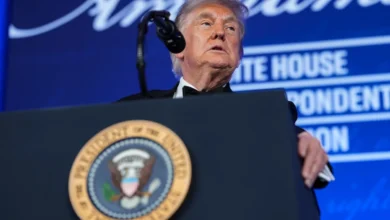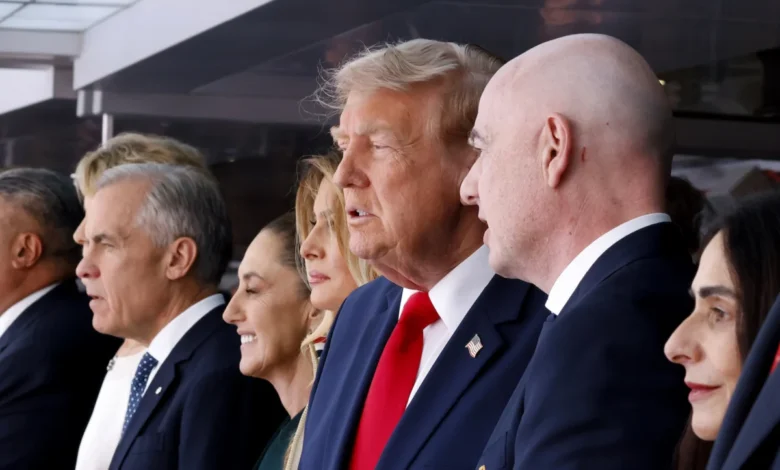
Spain may have emerged victorious in the 2026 World Cup, but the tournament’s conclusion was marred by a decidedly less celebratory moment for former U.S. President Donald Trump. During his appearance on the jumbotrons at MetLife Stadium in New Jersey, where the final was held, Trump was met with a chorus of boos from the assembled fans of both Argentina and Spain. This incident, which occurred shortly after Jennifer Hudson’s performance of the national anthem, marks yet another instance of Trump facing a hostile reception at a major sporting event, a pattern that has become increasingly noticeable throughout his public life.
Trump, who was slated to present the coveted World Cup trophy to the winning team, was shown on screen seated next to his wife, Melania Trump. This brief jumbotron appearance was not an isolated event; he was reportedly shown in a similar capacity on multiple occasions throughout the match. The jeers from the crowd underscored a persistent trend of public disapproval directed at Trump during his attendance at high-profile sporting spectacles. This latest World Cup controversy adds to a growing list of similar incidents, including past experiences at MLB’s World Series, the US Open, and various UFC fights and PGA Tour events, all of which have seen him subjected to audible discontent from attendees.
Beyond the public relations aspect of his attendance, Trump’s indirect involvement in the U.S. Men’s National Team’s (USMNT) World Cup campaign proved to be a source of significant controversy and, arguably, a detriment to the team’s performance. In a crucial Round of 16 match against Belgium, the USMNT’s star striker, Folarin Balogun, received a red card that suspended him from play. In a move that drew widespread attention, Trump reportedly made a personal call to FIFA President Gianni Infantino to discuss the decision. Following this intervention, Balogun’s red card was controversially overturned.
However, the subsequent impact of this decision on the U.S. team was far from positive. Instead of galvanizing the squad, the abrupt reversal of the red card and the perceived external pressure appeared to create a "stressed-out vibe shift" within the team. This disruption is believed by many observers to have contributed to what was arguably their poorest performance of the tournament. The U.S. team subsequently suffered a decisive 4-1 defeat against Belgium, ending their World Cup aspirations. This outcome led many fans and commentators to draw parallels between Trump’s intervention in the Balogun incident and his prior controversial appearance at Game 4 of the NBA Finals. In that instance, the New York Knicks lost a pivotal game against the San Antonio Spurs, a game Trump also attended and was booed at, further solidifying a perception of his presence correlating with negative outcomes.
The tradition of presidents presenting the World Cup trophy is a significant one, symbolizing the global reach and prestige of the tournament. However, Trump’s role in this year’s final was cast under a shadow by these preceding events. His previous experience presenting a major soccer trophy was at the FIFA Club World Cup the previous summer, where he handed the trophy to Chelsea FC. Reports at the time indicated that even Chelsea players, including star player Cole Palmer, appeared confused by his presence, suggesting a lack of understanding regarding the ceremonial nature of his involvement. While club tournaments are distinct from national team competitions, the underlying theme of an unexpected and seemingly out-of-place presidential appearance persisted.
The geopolitical context surrounding the 2026 World Cup final also adds an interesting layer to Trump’s role. Argentina’s President Javier Milei, a self-proclaimed ideological ally of Trump, has cultivated a close relationship with the former U.S. president. Milei has participated in several U.S. political events and has been a guest at Trump’s Mar-a-Lago resort. This ideological alignment between the two leaders contrasts sharply with the relationship between Spain’s current government and Trump, which is characterized by a less amicable dynamic. The differing political relationships between the trophy presenter and the two finalist nations raised questions about the optics and potential political undertones of the trophy presentation ceremony.
Background and Chronology of the 2026 World Cup
The 2026 FIFA World Cup, co-hosted by the United States, Canada, and Mexico, represented a monumental event in international football. This edition was particularly significant as it expanded to include 48 teams, a substantial increase from the previous 32-team format, requiring an extensive logistical and organizational effort across North America. The tournament culminated in a highly anticipated final held at MetLife Stadium, a venue chosen for its capacity and proximity to major population centers.
The journey to the final was a month-long spectacle, beginning on June 11, 2026, with the opening match. Teams from across the globe competed in a series of group stage matches, followed by knockout rounds that progressively narrowed the field. The USMNT, as one of the host nations, carried significant expectations, aiming to replicate or surpass their historic performances in previous World Cups. Their campaign saw them navigate through the group stages and reach the Round of 16, where they faced a formidable Belgian side.
The match against Belgium, held on July 3, 2026, became a focal point of controversy. The initial red card decision against Folarin Balogun, a pivotal player for the U.S., was a critical turning point in the game. The subsequent intervention, reportedly by Donald Trump, leading to the overturning of the card, was a highly unusual development in international football. The timeline of this intervention and its immediate aftermath are crucial to understanding the impact on the USMNT’s performance. While specific details of Trump’s communication with FIFA remain private, the timing of the overturned red card and the team’s subsequent decline in performance were striking.
The final match itself, played on July 19, 2026, between Spain and Argentina, drew a massive global audience. The presence of Donald Trump, not just as a spectator but as the designated trophy presenter, was a significant talking point leading up to the event. His prior interactions with sporting events and the consistent booing he has received in such settings set a precedent for the reception he might expect.
Supporting Data and Precedent
Donald Trump’s history of receiving boos at sporting events is well-documented. In October 2019, he was loudly booed by the crowd at Nationals Park during Game 5 of the World Series between the Washington Nationals and the Houston Astros. Chants of "Lock him up!" were also reportedly heard. This incident occurred during a period of heightened political polarization in the United States.
Another notable instance took place in June 2024 at Game 4 of the NBA Finals between the New York Knicks and the San Antonio Spurs. Reports from the event indicated that Trump was met with boos upon his arrival and introduction. The Knicks ultimately lost that game, a defeat that contributed to their eventual series loss. The juxtaposition of these events highlights a recurring pattern of public disapproval directed at Trump in arenas and stadiums.
The influence of political figures on sporting events, while not unheard of, typically remains within established protocols. Direct intervention in officiating decisions, as alleged in the Balogun case, is exceptionally rare and raises questions about the integrity of the game and the impartiality of governing bodies like FIFA. The U.S. Soccer Federation and FIFA have not issued official statements detailing the specifics of any communication regarding Balogun’s red card, leaving room for interpretation and speculation.
Official Responses and Reactions
Following the World Cup final, the primary focus of official statements from FIFA and the participating nations was on the sporting outcome and the celebration of Spain’s victory. However, the controversy surrounding Trump’s intervention and his reception at the stadium did not go unnoticed by media outlets and segments of the public.
While no direct official comments were issued by the White House or the Trump campaign regarding the boos at the World Cup final, Trump’s own social media platform, Truth Social, has historically been a conduit for his responses to public reactions. Given his past engagement with similar situations, it is plausible that he may have addressed the incident through his preferred channels.
FIFA, as the governing body of international football, typically maintains a neutral stance on political matters and rarely comments on the reception of dignitaries at matches, focusing instead on the administration of the sport. Their official statements would likely have centered on the successful conclusion of the tournament and the celebration of the champions.
The Spanish and Argentinian football federations, while focused on their national teams’ achievements, would have been aware of the political undertones surrounding the trophy presentation. However, official statements from these bodies would likely have prioritized diplomatic courtesies and sporting congratulations.
Broader Impact and Implications
The incidents involving Donald Trump at the 2026 World Cup have implications that extend beyond a single sporting event. They underscore the increasingly blurred lines between politics and sports in the public consciousness. The vocal disapproval from crowds at major sporting events suggests a segment of the population that remains highly resistant to his political persona, even in non-political settings.
The alleged intervention in the USMNT’s match raises serious questions about the potential for political influence in the integrity of international sports. If political figures can exert pressure on governing bodies to overturn officiating decisions, it could undermine the fairness and credibility of competitions. This could lead to greater scrutiny of such interactions and potentially calls for stricter protocols to safeguard the autonomy of sporting organizations.
Furthermore, the contrasting relationships between Trump and the leaders of Spain and Argentina highlight the complex geopolitical landscape in which international events are held. The optics of a politically charged trophy presentation can have subtle but significant diplomatic implications, especially when the presenter is a figure with a controversial international standing.
The trend of booing at sporting events, while not unique to Trump, has become a notable characteristic of his public appearances. This pattern of public reception suggests a deeply divided electorate and a public that is not hesitant to express its views, even in the context of entertainment and sport. For future major sporting events involving prominent political figures, the potential for similar public reactions will likely remain a consideration for organizers and attendees alike. The 2026 World Cup, in this regard, served as another chapter in a narrative of political figures navigating, and sometimes disrupting, the world of sports.