Gritt Emerges from Stealth with $26 Million to Revolutionize Solar Installation Through AI-Powered Robotics

The global push for renewable energy, particularly solar power, stands as one of the most critical endeavors of our time, driven by the urgent need to combat climate change and achieve energy independence. This massive solar energy build-out, however, faces a significant bottleneck: a persistent labor market challenge characterized by a limited supply of skilled workers to meet the escalating demand for installation. Historically, industrial robots have struggled in the unpredictable, unstructured environments typical of construction sites. Yet, a new generation of artificial intelligence models is rapidly changing this equation, paving the way for advanced automation in complex outdoor tasks.
This paradigm shift is the driving force behind Gritt, a burgeoning startup founded by two Carnegie Mellon-trained roboticists, CEO Puneet Puri and CTO Vishal Dugar. The company officially exited its stealth phase on Tuesday morning, announcing a substantial $26 million Series A funding round. This round was led by Obvious Ventures, with notable participation from Union Square Ventures and Active Impact Investment, bringing Gritt’s total funding to $34 million. This follows an earlier seed round that saw investments from First Round Capital, Climactic, Congruent Ventures, and VSC Ventures. Gritt’s overarching mission, as articulated by Puri, is to develop an intelligent system designed to "help civilization build infrastructure faster," a crucial objective in an era demanding rapid deployment of green technologies.
The Imperative of Solar Expansion and Its Labor Challenge
The global energy landscape is undergoing an unprecedented transformation, with solar photovoltaic (PV) leading the charge. According to the International Energy Agency (IEA), solar PV is projected to account for over half of the new renewable electricity capacity installed globally by 2028, with global solar PV additions surging by an astounding 80% to 400 GW in 2023 alone. In the United States, the Solar Energy Industries Association (SEIA) and Wood Mackenzie anticipate an average annual growth rate of 32% for solar over the next five years, projecting a quadrupling of total installed capacity by 2033. This ambitious expansion is vital for decarbonizing electricity grids, enhancing energy security, and mitigating the worst effects of climate change.
However, the sheer scale of this build-out presents formidable logistical and human resource challenges. Solar panel installation, particularly on utility-scale projects, is physically demanding, requiring repetitive lifting of heavy panels, often in harsh outdoor conditions and remote locations. The construction industry as a whole has been grappling with a severe labor shortage for years. A 2023 survey by the Associated General Contractors of America (AGC) revealed that 85% of contractors struggled to find qualified workers, a trend exacerbated by an aging workforce and a perceived lack of interest among younger generations in manual labor trades. The median age of construction workers often hovers in the mid-40s, highlighting a looming succession crisis. This deficit is not merely a matter of quantity but also of quality, with a pressing need for skilled tradespeople.
Furthermore, the work involves significant safety risks. Manually handling large, heavy solar panels—which can weigh over 100 pounds—at height or overhead contributes to a high incidence of musculoskeletal injuries, falls, and other accidents. This combination of high demand, labor scarcity, and inherent dangers makes the solar installation sector a prime candidate for technological intervention, particularly solutions that can augment human capabilities and improve safety.
Gritt’s AI-Driven Solution: A New Paradigm for Construction Robotics
Gritt’s innovative approach directly addresses these challenges by leveraging the latest advancements in AI to deploy intelligent systems capable of operating autonomously in complex outdoor construction environments. Unlike traditional industrial robots confined to structured factory settings, Gritt’s technology is designed to thrive in the "chaotic environments" of construction sites, as Puri emphasizes. The key differentiator lies in its generalizability—the ability for the same underlying intelligence to adapt and perform across varied and dynamic conditions.
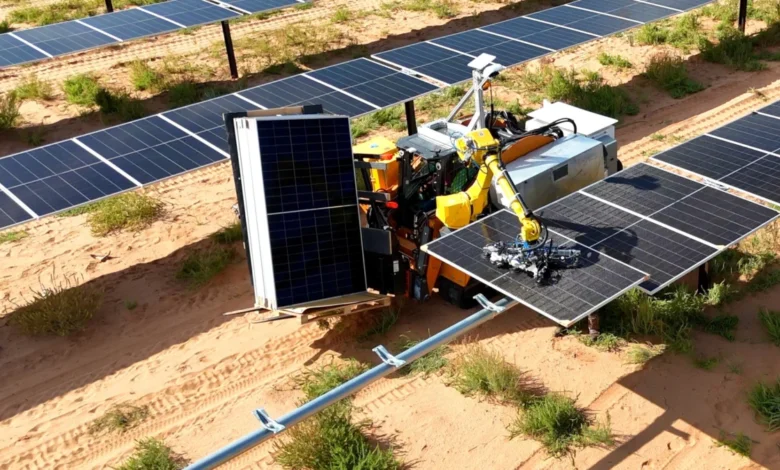
Rather than developing bespoke robotic hardware from scratch, a capital-intensive and time-consuming endeavor, Gritt adopts a strategic approach of utilizing off-the-shelf equipment. This includes readily available machinery such as rented skidders and commercial robotic arms manufactured by companies like Kawasaki. Gritt then integrates its proprietary AI models as the "brain" controlling these platforms. This strategy offers several advantages: it reduces development costs, accelerates deployment, and allows the company to focus its resources on developing cutting-edge AI software, which is its core competency.
The company’s initial application focuses on a critical and labor-intensive phase of solar installation: the precise handling and positioning of large, glass solar panels. Gritt’s systems autonomously unload these panels, transport them across the construction site to the designated metal frames, and then position them on the frames with sub-millimeter accuracy. This precision is crucial for ensuring proper alignment and subsequent fastening by human workers, effectively taking over the "dirty, dull, and dangerous" aspects of the job.
Andrew Beebe, a partner at Obvious Ventures who led Gritt’s Series A round, praised the founders’ pragmatic and impactful vision. "There are people who used to build rockets that went into space and had infinite budget for the smallest little part, and then there are people who know what it means to get into dirty, dull, and dangerous jobs and scale them like mad," Beebe remarked. "These guys are in the second camp, and that’s a special kind of entrepreneur that has the technical chops, the AI, and the machine vision skills to make it work." This sentiment underscores Gritt’s focus on practical, scalable solutions for real-world industrial problems.
Chronology of Growth and Early Impact
Gritt’s journey began with its foundational work at Carnegie Mellon, where Puri and Dugar honed their expertise in robotics and AI. Their initial seed funding round, backed by investors such as First Round Capital, Climactic, Congruent Ventures, and VSC Ventures, provided the capital necessary to develop their core AI platform and conduct early-stage pilots. This initial investment validated their concept and allowed them to build out their foundational technology.
The recent $26 million Series A round marks a significant milestone, enabling Gritt to scale its operations, expand its team, and accelerate the deployment of its systems. The lead investor, Obvious Ventures, is known for backing companies with a strong social and environmental impact, aligning perfectly with Gritt’s mission to accelerate renewable energy infrastructure. Union Square Ventures and Active Impact Investment’s participation further underscores confidence in Gritt’s technological prowess and market potential.
The early results from Gritt’s deployed systems are compelling. The company currently has two of its intelligent robotic systems operating in the field, actively collecting data to continuously refine and improve their performance. Puri highlights a dramatic increase in efficiency: a typical eight-person human crew can install approximately 800 solar panels per day. However, the same crew, when augmented by Gritt’s intelligent systems, can install between 3,000 to 4,000 panels daily, representing a 375% to 500% increase in productivity.
This efficiency gain is translating into significant commercial traction. Gritt has already secured contracts to assist in the installation of 2.8 gigawatts (GW) of solar panels over the next 18 months, a testament to the industry’s readiness to adopt such innovative solutions. Its customer base includes three of the top ten power construction companies in the United States, indicating strong validation from major industry players. The company aims to have 48 of its systems operational within the next six months, demonstrating an aggressive deployment strategy.
Customer feedback further reinforces the value proposition. One Gritt customer, who requested anonymity for competitive reasons, expressed enthusiastic support for the system’s ability to enhance their operations. This customer anticipates that Gritt’s technology will make it easier to undertake projects in remote locations, where attracting and retaining a sufficient workforce is particularly challenging. Crucially, they also expect a significant reduction in workplace injuries, as human workers will no longer be required to repeatedly lift heavy, 100-pound panels overhead, thus improving safety and reducing worker compensation claims.
The Competitive Landscape and Strategic Differentiation
Gritt operates within an emerging but increasingly competitive space, vying with other companies developing robotic solutions for solar panel installation. Notable competitors include Luminous Robotics, Cosmic, and China’s Trinabot. A key strategic differentiator, however, lies in Gritt’s core approach. While these competing firms are primarily focused on building their own proprietary robotic hardware from the ground up, Gritt’s strategy revolves around developing an advanced AI "intelligence layer" that can control and optimize off-the-shelf vehicles and robotic arms.
This difference in approach could have profound implications for market growth, cost structure, and scalability. By avoiding the complexities and capital expenditures associated with designing, manufacturing, and maintaining custom hardware, Gritt potentially gains a leaner cost structure and greater agility. This allows them to focus resources on software innovation, rapid iteration, and the generalizability of their AI, which could enable faster deployment and wider adoption as demand for automated construction solutions surges. The ability to integrate with existing machinery also lowers the barrier to entry for potential customers who may already own or lease compatible equipment.
The broader construction robotics market is poised for significant expansion. Grand View Research estimated the global construction robotics market size at USD 2.6 billion in 2022 and projects it to grow at a compound annual growth rate (CAGR) of 20.3% from 2023 to 2030. This growth is driven by the same factors Gritt addresses: labor shortages, safety concerns, and the demand for increased efficiency and precision in construction processes. Beyond solar installation, robotics are finding applications in various construction tasks, from bricklaying and concrete pouring to surveying and demolition, signaling a broader industry shift towards automation.
Future Vision: Beyond Installation to Intelligent Site Management
Gritt’s current success with solar panel positioning is merely the first step in a much broader vision. The company aims to incrementally expand the capabilities of its intelligent systems to encompass a wider range of manipulation tasks. This includes automating the fastening of solar panels, drilling posts for their supports, and even constructing the racks upon which the panels sit. Looking further ahead, Gritt intends to tackle other common, labor-intensive construction tasks, such as tying rebar before concrete is poured, a highly repetitive and physically demanding job.
The founders attribute the feasibility of this ambitious vision to the dramatic advancements in modern AI models. Puri explains that while building a system for a single, specialized solution was somewhat possible five years ago, contemporary AI has ushered in an era of generalizability. This means that the same underlying AI pipeline can be reused and continuously improved across a multitude of diverse tasks. As a compelling example, Puri notes that training Gritt’s system to stack cinder blocks took several weeks. However, leveraging the same underlying software, a similar demonstration involving rebar tying required only a single day of training, showcasing the exponential efficiency gains offered by generalizable AI.
Beyond automating physical labor, Gritt envisions its systems evolving into a comprehensive "physical AI" layer that not only performs dexterous tasks but also significantly enhances site management and decision-making. Equipped with a suite of advanced sensors and embedded intelligence, Gritt’s systems can continuously monitor the construction site environment. For instance, they could detect an open trench as a storm approaches and proactively alert workers to cover it, preventing potential damage to components or safety hazards. Similarly, the system could flag missing inventory in real-time, streamlining logistics and preventing costly delays.
"Gritt becomes now this layer of physical AI, which is doing this dextrous, labor-intensive task, plus it can help you take decisions on the site," Puri states. This capability transforms the robotic system from a mere tool into an intelligent assistant, offering unprecedented levels of oversight, safety, and efficiency. Such an integrated approach could revolutionize project management, enabling more agile responses to dynamic site conditions and fostering a safer, more productive work environment.
Broader Implications and Societal Impact
Gritt’s emergence holds profound implications across several critical sectors. For the renewable energy industry, it represents a potent accelerator. By dramatically increasing installation speed and efficiency, Gritt’s technology can help overcome the labor bottleneck, reduce project timelines, and lower the overall cost of solar energy. This directly contributes to meeting ambitious climate goals and accelerating the transition away from fossil fuels.
For the construction industry, Gritt’s innovation signals a future where robotics and AI augment human capabilities rather than simply replacing them. By taking over the most physically strenuous, repetitive, and dangerous tasks, these systems free up human workers to focus on higher-value, more complex problem-solving, supervision, and specialized finishing work. This shift can elevate the quality of construction jobs, make the industry more attractive to a new generation of workers, and significantly improve workplace safety records, potentially reducing injuries and associated costs.
Economically, the ability to complete projects faster and more efficiently will lead to increased returns on investment for solar developers and power construction companies. Reduced labor costs, fewer delays, and enhanced safety all contribute to a healthier bottom line, encouraging further investment in renewable infrastructure.
Finally, Gritt’s success demonstrates the immense potential of AI at the frontier of real-world, dynamic environments. The ability of sophisticated AI models to control complex machinery for precise tasks in unstructured outdoor settings pushes the boundaries of robotics and machine learning. As Gritt’s systems gather more data and expand their capabilities, they will contribute valuable insights to the broader AI research community, paving the way for further advancements in autonomous systems across various industries.
In conclusion, Gritt stands at the nexus of several transformative trends: the urgent need for renewable energy, the critical labor shortage in construction, and the rapid evolution of artificial intelligence. By offering a scalable, AI-driven solution to a fundamental challenge in solar installation, Gritt is poised to become a pivotal player in accelerating the global energy transition, reshaping the future of construction work, and demonstrating the transformative power of intelligent automation.