A Decade in the Making: The George Lucas Museum of Narrative Art Opens Its Doors in Los Angeles

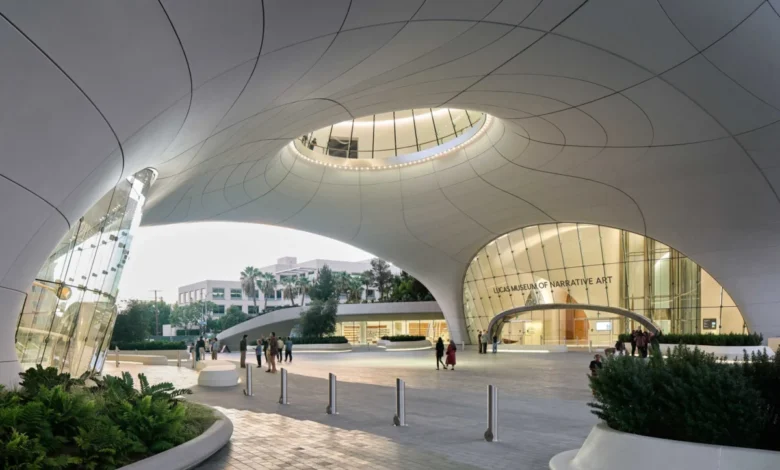
After more than ten years of meticulous planning, complex architectural engineering, and intense global anticipation, the George Lucas Museum of Narrative Art officially opens to the public on September 22 in Los Angeles. Situated on a sprawling 13-acre campus in the historic heart of Exposition Park, the institution occupies what was formerly a utilitarian asphalt parking lot. Spearheaded by legendary filmmaker George Lucas and his wife, businesswoman and philanthropist Mellody Hobson, the museum represents a monumental shift in how cultural institutions define, curate, and display fine art.
Featuring over 30 dedicated art galleries, an expansive sculpture garden, and a free, three-star public research library, the massive 300,000-square-foot institution aims to bridge the gap between high art and popular culture. While Lucas is universally recognized as the visionary behind cinematic epics such as the Star Wars and Indiana Jones franchises, the museum deliberately transcends the boundaries of a traditional fan shrine. Instead, it serves as a comprehensive exploration of storytelling through the ages, housing a remarkably diverse collection of more than 40,000 works that span multiple generations, cultures, and mediums.

A Long and Winding Road: The Chronology of a Cultural Milestone
The journey to the opening of the Lucas Museum of Narrative Art has been characterized by perseverance, strategic relocation, and architectural ambition. George Lucas’s personal journey as an art collector began over half a century ago during his college years, starting modestly with pieces of comic art and expanding exponentially over the decades. As his collection burgeoned, Lucas envisioned a permanent public home for works that told compelling visual stories—art forms that frequently found themselves marginalized by traditional fine art establishments.
Initially, Lucas sought to establish the museum in Chicago, proposing a lakefront site near Soldier Field in 2014. However, the proposal faced intense legal and administrative hurdles from local civic groups, prompting Lucas to abandon the Midwestern location in 2016 and shift his focus back to California. Los Angeles readily embraced the project, offering a prime location within Exposition Park, adjacent to institutions like the California Science Center and the Natural History Museum of Los Angeles County.
Groundbreaking followed, and the ensuing years were dedicated to the monumental task of realizing a futuristic architectural vision. Lead architect Ma Yansong of MAD Architects was tasked with designing a structure that felt entirely unprecedented. Eschewing traditional boxy museum architecture, Yansong conceived a building designed to look and feel “light and free as a cloud.” Drawing inspiration from the grand, overarching canopies of the trees in Exposition Park, the resulting white, curved structure features a distinct lack of straight lines, challenging structural engineers and construction teams alike for nearly a decade.

Architecture and Landscape: Merging Form with Function
The physical layout of the Lucas Museum campus is designed to initiate the visitor experience long before they cross the threshold of the main building. Parking infrastructure is deliberately submerged underground, allowing visitors to transition smoothly from the frenetic energy of Downtown Los Angeles into an expansive, meticulously landscaped urban oasis.
Landscape architect Mia Lehrer designed the surrounding 13 acres to reflect the diverse topography of Southern California, incorporating rolling green hills, winding walkways, and elevated bridges. Rather than dictating a linear path, the gardens encourage exploration. “There is no single route through the gardens,” Lehrer noted during press previews. “Paths climb, descend, cross bridges, and embrace sculptures.”
Among these integrated outdoor elements are 10 major sculptures strategically placed throughout the grounds. Visitors entering the park are immediately greeted by Maternity, a monumental bronze statue by renowned Colombian artist Fernando Botero that evokes the timeless forms of a Renaissance Madonna.

Upon entering the main building, visitors are guided through an intentional sequence of spaces. The ground floor kicks off with the introductory exhibition, “The History of Native Art: Heroes, Myth, The Sacred.” This gallery combines physical pieces from the museum’s permanent holdings with monumental visual recreations of iconic world heritage sites, including details from the Sistine Chapel ceiling and the interior of the Hagia Sophia. This foundational exhibit sets a high-minded historical precedent for the narrative techniques explored in greater detail upstairs.
Dismantling Hierarchies: The Curatorial Philosophy
At the core of the museum’s mission is the systematic dismantling of traditional art-world hierarchies. For generations, elite art institutions have prioritized specific mediums—such as oil painting and classical sculpture—while relegating illustration, comic books, manga, and commercial art to secondary status. Lucas and Hobson have deliberately upended this paradigm, placing works by acknowledged masters alongside pioneering comic strip creators and commercial illustrators.
The galleries feature iconic American fine artists such as Norman Rockwell and Frida Kahlo, alongside seminal figures from the underground comix movement of the 1960s, including Robert Crumb (R. Crumb). Cartooning legends are likewise well-represented, with original works by Jim Davis (Garfield) and Charles Schulz (Peanuts). Instead of organizing collections strictly by chronological period or geographic origin, curators have grouped works around universal thematic motifs, such as “Motherhood” and “Sports.”

A significant focal point of the museum’s inaugural installation is the work of the late Ernie Barnes. A former NFL offensive guard who transitioned into a celebrated career as a painter, Barnes was affectionately dubbed the “Rembrandt of the Broncos” by his teammates. Despite creating dynamic, fluid depictions of everyday Black life and athletics that earned him high-profile commissions—such as the cover art for Marvin Gaye’s landmark 1976 album I Want You and an appointment as the official artist of the 1984 Los Angeles Olympic Games—Barnes largely remained outside the inner circle of the mainstream fine art establishment during his lifetime. The museum’s prominent display of his work serves as a long-overdue institutional acknowledgment of his profound artistic legacy.
Further up in the multi-story facility, the fifth-floor gallery is dedicated to large-scale mural arts and public expression. This space features works by Mexican modernist master Diego Rivera and contemporary French artist JR. Notably, the gallery also showcases iconic pieces by the elusive street artist Banksy, including Girl with Balloon, alongside newly commissioned works created specifically for the museum’s debut.
Cinematic Roots and Public Access
While the museum deliberately avoids becoming a monument to George Lucas’s personal cinematic output, it makes meaningful concessions for the millions of fans worldwide who have been shaped by his storytelling. The “Cinema” section houses dedicated programming, including the “Star Wars in Motion” gallery, which displays authentic vehicles and starfighters utilized in the production of the first six films in the franchise, alongside detailed props and recreations from the Indiana Jones series.

To support deeper academic and public engagement, the campus features two specialized film theaters. The Robert Flaherty Theater is devoted to the screening and study of documentary filmmaking, while the Slavko Vorkapich Theater focuses on experimental short films that push the boundaries of visual editing and cinematic structure. Additionally, a three-story free research library provides scholars, students, and casual visitors with unprecedented access to an extensive archive dedicated to the history of narrative art.
The commitment to public access extends to the institution’s leadership and operational philosophy. Museum CEO Tracey Bates emphasized this community-first approach during preparations for opening day, stating, “Every gallery, every program, every corner of this museum was built with our visitors in mind.”
Broader Impact and Industry Implications
The opening of the Lucas Museum of Narrative Art arrives at a pivotal moment for urban cultural centers, particularly in Los Angeles. As metropolitan museums worldwide grapple with declining attendance, shifting demographics, and the need to justify their civic relevance in the digital age, the Lucas model offers a compelling alternative. By validating popular culture forms—animation, comic books, science fiction, and illustration—as vital threads in the fabric of human storytelling, the institution broadens the traditional definition of who museum spaces are for.

Furthermore, the integration of extensive green spaces, free research facilities, and community-centric architectural design sets a new benchmark for urban renewal projects. Transforming an asphalt parking lot into a 13-acre cultural park revitalizes Exposition Park while establishing a new architectural landmark for the city of Los Angeles.
Ultimately, the museum stands as a physical manifestation of George Lucas’s lifelong thesis regarding the unifying power of shared stories. As Lucas remarked during the international media preview: “A picture is very powerful, and stories are very powerful. Those two elements create a society. Narrative art creates a group of people with common belief systems, and that common belief system allows them to work together, and there’s very few things in this world you can do all by yourself.”