France book South Africa rematch in Nations Championship final with bonus-point victory over Argentina


France secured their place in the inaugural Nations Championship final on Saturday, delivering a clinical 45-17 bonus-point victory over Argentina. The result, achieved through a seven-try masterclass, sets the stage for a highly anticipated rematch against South Africa at Twickenham on November 29. The fixture promises to be a definitive conclusion to a tournament that has reshaped the international rugby calendar, pitting the two most formidable sides of the current cycle against one another in a neutral-venue decider.
The path to the final became clear earlier in the day when England dismantled New Zealand 37-12. That outcome placed the onus squarely on the French side: to reach the final, they required a victory against the Pumas that included a four-try bonus point. Trailing South Africa in the standings following the Springboks’ complex group stage—which saw them finish atop the southern hemisphere pool despite a narrow loss to Ireland—France approached the contest with singular focus.
A Chronology of Dominance
The match at the Stade de France began with a poignant moment of reflection. Before the opening whistle, both teams and the crowd observed tributes for Federico Martín Aramburú, the former Argentina international and cultural icon who tragically lost his life in Paris four years ago. Once play commenced, however, the intensity was immediate.
Argentina briefly threatened an upset, holding a 10-7 lead for ten minutes following a well-worked converted try by centre Justo Piccardo and a penalty from fly-half Tomas Albornoz. It was the only period of the match where the French defense looked vulnerable. The home side quickly recalibrated, with lock Mickaël Guillard and hooker Peato Mauvaka crossing the whitewash before halftime to restore order. By the interval, France held a 21-10 advantage, but the necessary bonus point remained elusive.
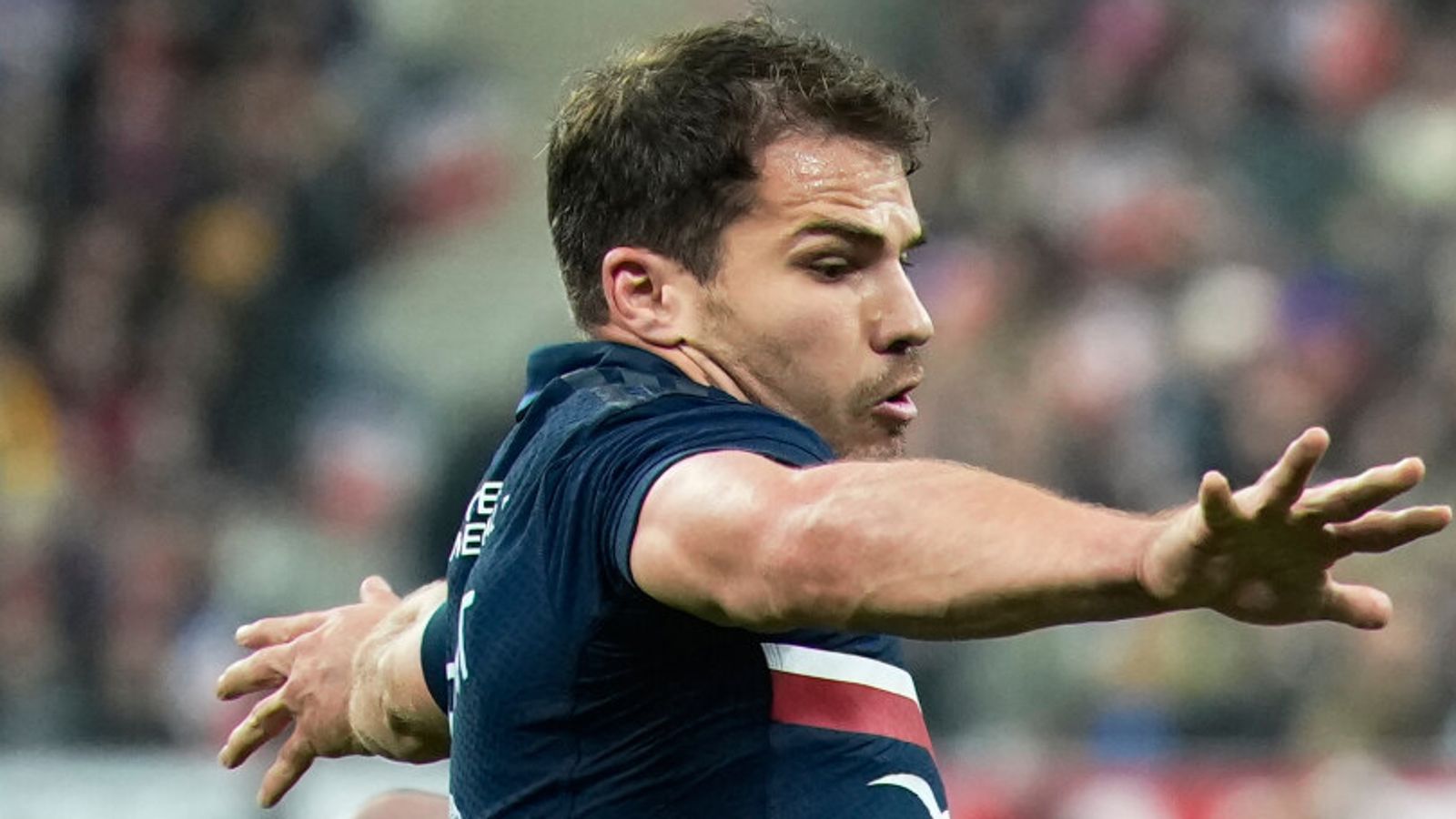
The second half saw the return of Antoine Dupont to his natural scrum-half position, a strategic shift from his appearance at fly-half during the previous week’s victory over South Africa. The restoration of the talismanic captain to his primary role acted as a catalyst for the backline. Shortly after the break, fly-half Matthieu Jalibert, having made a faster-than-expected recovery from a thigh tear, orchestrated a brilliant move that set up centre Kalvin Gourgues for his first try of the night.
The turning point for the bonus point came in the 64th minute. With the match stretching, Emilien Gailleton touched down for the fourth try. The situation for Argentina deteriorated further when prop Mayco Vivas was sent to the sin-bin; a subsequent TMO review upgraded the yellow card to a red, reducing the Pumas to 14 men for the remainder of the contest.
With numerical superiority, France exploited the gaps. Tyler Duguid powered through following an attacking lineout, Gourgues showcased exceptional acceleration to dot down for his second of the evening, and Louis Bielle-Biarrey finalized the rout with his 31st international try in just his 30th cap.
Technical Analysis and Key Performers
The statistics tell the story of a team hitting peak form at the optimal moment. France’s ability to generate seven tries against a side as defensively resilient as Argentina underscores the evolution of their attacking structure under pressure.
Antoine Dupont’s influence cannot be overstated. His tactical kicking, highlighted by the perfectly weighted ball down the left flank that led to Bielle-Biarrey’s score, dictated the tempo of the final quarter. Equally impressive was the contribution of Kalvin Gourgues, who stepped into the role of place-kicker in the absence of a specialized option, converting five of the seven tries with composure.
For Argentina, the result is a bitter end to a campaign that showed glimpses of high-level potential but ultimately suffered from disciplinary lapses. The loss of Vivas in the second half effectively killed any remaining momentum, leaving the Pumas unable to contain a French backline playing with complete freedom.
Contextualizing the Nations Championship
The Nations Championship represents the most significant structural change to global rugby in the professional era. By creating a tiered, meritocratic pathway for the world’s leading nations, the tournament has sought to eliminate "dead rubber" matches. The final at Twickenham on November 29 is the culmination of a cycle that has seen the traditional power dynamics between the Six Nations and The Rugby Championship challenged.
France enters the final with a psychological edge, having defeated South Africa 21-19 in Paris just last week. That encounter was defined by a brutal defensive effort and a high-stakes tactical battle. However, the move to Twickenham—a neutral ground—removes the home-field advantage that favored the French in the pool stage.
The Springboks, despite their recent loss to Ireland, remain the benchmark for physical intensity. Their ability to recover from the loss to France and secure their spot in the final by topping the southern hemisphere pool speaks to their depth. The November 29 clash will test whether France can replicate their tactical efficiency on neutral turf or if South Africa’s forward-oriented game plan can stifle the fluidity that Dupont and his men exhibited on Saturday night.

Strategic Implications for 2026 and Beyond
For France, reaching the final is the validation of a long-term strategic project. The successful integration of players like Bielle-Biarrey and Gourgues into the starting XV demonstrates a depth of talent that was previously considered a weakness. The decision to shift Dupont back to scrum-half and trust Jalibert at fly-half proved to be the correct tactical adjustment, providing the necessary stability to bridge the gap between their defensive foundation and their attacking flair.
The broader implications for international rugby are significant. The Nations Championship has effectively forced nations to prioritize consistency over experimentation. Every match has carried tournament-defining weight, leading to higher intensity levels and improved spectator engagement. The fact that the final will be played between the two highest-performing teams in the tournament—France and South Africa—validates the format’s success in identifying the sport’s current elite.
Looking ahead, both teams will spend the coming week refining their strategies. For France, the focus will be on maintaining their defensive discipline against the Springboks’ heavy-duty pack. For South Africa, the mandate will be to address the breakdown issues that plagued them in Paris last week, where France’s ability to recycle quick ball proved decisive.
As the rugby world turns its eyes to London, the atmosphere surrounding the final is expected to be unprecedented. It is a meeting of two different philosophies: the tactical pragmatism and physical dominance of South Africa versus the expansive, creative, and fast-paced game of France. Regardless of the outcome, the 2026 Nations Championship has successfully provided a framework for the sport’s most compelling rivalries to play out on the biggest stage, cementing its place as the premier event in the international calendar.
With seven tries to their name and a collective performance that silenced any remaining doubts about their championship credentials, France heads into the Twickenham final with momentum. The challenge of beating the world’s elite twice in as many weeks is monumental, but based on the evidence of their clinical demolition of Argentina, Les Bleus are firmly prepared to meet the test.
Related posts: