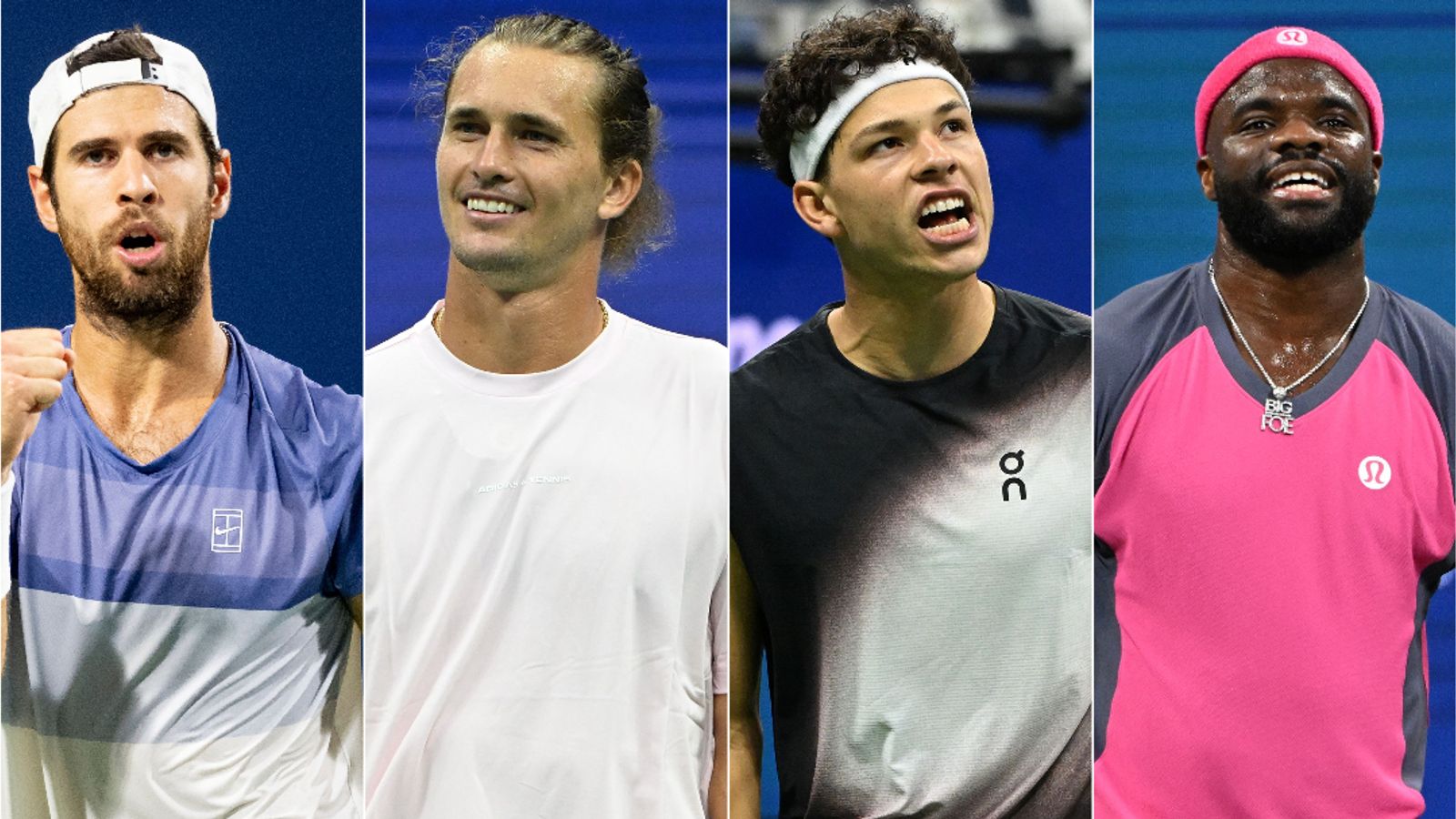
US Open: Is men’s singles victory a formality for Alexander Zverev or will Ben Shelton, Frances Tiafoe or Karen Khachanov trouble him?


The path to the semi-finals has been defined by extreme drama and athletic endurance. Ben Shelton, the 2023 US Open semi-finalist and 2025 Australian Open standout, secured his place in the final four following a historic victory over defending champion Carlos Alcaraz. The match, which concluded in the early hours of Wednesday morning, set a new record for the latest-finishing encounter in the tournament’s history. Describing the five-set marathon as a "war," Shelton acknowledged that the intensity of the contest marked a high point in his professional career, showcasing the mental and physical fortitude required to survive at the elite level.
Frances Tiafoe’s progression has been equally resilient. After falling two sets and a break behind against Alex Michelsen in the quarter-finals, Tiafoe executed a remarkable comeback to keep his championship aspirations alive. For the 28-year-old, this marks his third appearance in the US Open semi-finals, a testament to his consistency on the New York hard courts. Having previously famously defeated Rafael Nadal to reach the 2022 semi-finals, Tiafoe is now positioning himself to surpass his previous benchmarks.
A New Chapter for American Tennis
The stakes for the upcoming clash between Shelton and Tiafoe are amplified by the weight of historical significance. Should either player advance to the final and subsequently claim the title, they would become the first Black American man to reach a US Open final since Arthur Ashe in 1972, and the first Black American man to reach any major final since MaliVai Washington’s 1996 appearance at Wimbledon.
Tiafoe, who has undergone a significant professional and personal transformation over the past year, emphasizes that he is a different player than the one who made these stages in 2022 and 2024. His recent rise has been attributed to a rigorous overhaul of his lifestyle and fitness regimen. Former world No. 1 Lindsay Davenport noted that the shift in Tiafoe’s demeanor is palpable. According to Davenport, observing Tiafoe fight back from a two-set deficit—a scenario where he might have faltered in the past—proves that he has fully committed himself to the demands of championship-level tennis.
"I’m not that person who I was when I made a semi-final in 2022," Tiafoe remarked during a post-match briefing. "I have higher hopes for myself. There is still a lot of tennis to be played, a lot of physical obstacles to overcome, but I am excited to see what this version of me can achieve."
The Calm Efficiency of Alexander Zverev
While the American duo commands the home-crowd spotlight, world No. 2 Alexander Zverev continues to navigate the draw with clinical precision. In a tournament landscape marked by the absence of top-tier rivals such as Jannik Sinner and the early exits of Novak Djokovic and Carlos Alcaraz, Zverev has emerged as the clear favorite.
Zverev’s path to the semi-finals has been characterized by efficiency rather than flash. Having dispatched Botic van de Zandschulp in straight sets in the quarter-finals, the German has avoided the high-drama volatility that plagued his compatriots. His statistics remain impressive; he has faced a relatively modest field in terms of ranking, with the 21st-seeded Luciano Darderi being his toughest test to date.
The 29-year-old’s confidence is bolstered by a stellar season that saw him capture his first Grand Slam title at the French Open and a subsequent appearance in the Wimbledon final. Despite his dominance, Zverev remains cautious. "The more often you reach these stages, the more normal it becomes, but you should never take it for granted," Zverev stated. "Confidence is incredibly important, but it can disappear as quickly as it arrives. I learned that the hard way after Wimbledon, where my form dipped during the hard-court swing. I am happy with my current trajectory, but there are still two matches to win."
Tactical Analysis: The Semi-Final Pairings
The semi-final schedule, set for Friday, September 11, presents two distinct tactical challenges.
In the first match, Zverev will face the unseeded Russian Karen Khachanov. Historically, Zverev holds a significant edge in their head-to-head record, leading 6-3. Their most notable confrontation remains the 2021 Tokyo Olympics final, where Zverev secured the gold medal in straight sets. Khachanov, however, is no stranger to the pressure of a major semi-final, having reached the final four at both the 2022 US Open and the 2023 Australian Open. Despite a turbulent season that saw him struggle in early-round matches at other hard-court tournaments, Khachanov’s presence in the final four indicates a timely return to form.
The second match, the all-American showdown between Shelton and Tiafoe, promises to be a physical test of wills. Shelton’s high-velocity serve and aggressive net play contrast sharply with Tiafoe’s defensive versatility and flair for crowd-engaging shot-making. Having faced each other previously in 2024, both players possess intimate knowledge of the other’s game, making this a contest likely to be decided by unforced errors and mental fatigue rather than raw talent.
Broader Implications and Historical Context
The implications of the 2026 US Open extend beyond the trophy. The tournament serves as a barometer for the health of the men’s game during a transition period. With the decline of the "Big Three" era, the sport is searching for a new hierarchy. The fact that the semi-finals feature a mix of established elite performers like Zverev and hungry, peaking players like Shelton and Tiafoe suggests that the men’s tour is entering an era of parity.
Furthermore, the physical toll of the 2026 calendar cannot be understated. With players competing in high-intensity matches finishing well past 3:00 AM, the recovery protocols implemented by the Association of Tennis Professionals (ATP) and the United States Tennis Association (USTA) are under scrutiny. The tournament’s organizers have faced criticism regarding scheduling, yet the players themselves seem to thrive on the energy of the New York crowd, viewing the extreme conditions as part of the unique challenge that defines the US Open.
As the tournament moves toward its conclusion, the focus remains on the Arthur Ashe Stadium court. Whether the result is a continuation of Zverev’s dominance or a historic homecoming victory for the American contingent, the 2026 US Open has already solidified its place in the annals of the sport as a tournament defined by resilience, tactical evolution, and the relentless pursuit of greatness. Fans globally will be watching on September 11 to see which of these contenders can survive the final hurdle and etch their name into tennis history.