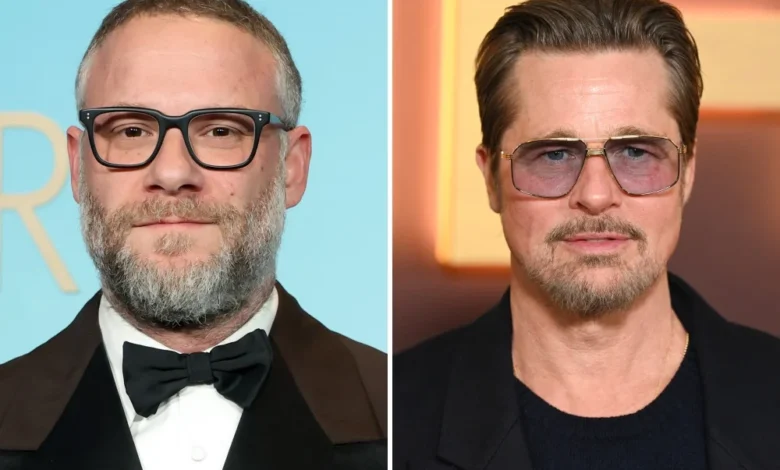
Seth Rogen and Brad Pitt formed an unlikely social connection while filming contrasting projects in New Orleans in 2013

The intersection of Hollywood’s creative ecosystems often results in unexpected professional and personal synergies, particularly when multiple major motion pictures occupy the same geographical production hub. Such was the case in 2013, when the city of New Orleans served as the simultaneous backdrop for two diametrically opposed cinematic projects: Steve McQueen’s harrowing historical drama 12 Years a Slave and the raucous, surrealist apocalyptic comedy This Is the End, directed by Seth Rogen and Evan Goldberg. The convergence of these two casts provided a unique window into the disparate emotional tolls exacted by different genres of filmmaking, as revealed in recent reflections by Rogen.
The New Orleans Convergence: 2013
During the summer of 2013, New Orleans was a nexus for high-profile film production, benefiting from Louisiana’s aggressive tax incentive programs for the film industry. The city’s infrastructure allowed for large-scale productions to operate concurrently, bringing together A-list talent from across the industry spectrum.
While the production teams occupied the same city, their professional environments could not have been more distinct. For the cast and crew of 12 Years a Slave—a film detailing the true story of Solomon Northup, a free Black man kidnapped and sold into slavery in 1841—the atmosphere on set was reportedly heavy, reflective, and emotionally taxing. Conversely, the production of This Is the End—a meta-commentary on celebrity culture featuring Rogen, James Franco, Jonah Hill, and others playing fictionalized versions of themselves—was defined by improvisation, physical comedy, and an inherently lighthearted, irreverent tone.
The Emotional Contrast of Cinematic Storytelling
In a recent appearance on the podcast Happy Sad Confused, Seth Rogen provided insight into the social dynamics that emerged during this period. Rogen noted that the cast of 12 Years a Slave, including Brad Pitt, Michael Fassbender, and Chiwetel Ejiofor, frequently sought out the company of the This Is the End ensemble.
Rogen articulated a clear psychological divide between the two groups: "Understandably, the cast and crew of 12 Years a Slave were in a bummed-out headspace a lot of the time." The gravity of the subject matter, directed by Steve McQueen, necessitated a deep immersion into the historical trauma of American slavery. Fassbender, who portrayed the brutal plantation owner Edwin Epps, and Ejiofor, who portrayed Northup, were tasked with maintaining a profound level of emotional intensity.
By contrast, Rogen’s set was designed to be an environment of collaborative humor. The project, which featured a cavalcade of guest stars, was built upon the premise of a chaotic party during the biblical apocalypse. Rogen described the social interactions between the two groups as a form of relief for the 12 Years a Slave cast, noting, "They would come and hang out on our set, and we would go to bars and stuff… we were having the time of our lives, and then you’d see Steve McQueen and Brad Pitt and Chiwetel would sulk in, and then we’d give them a few drinks and they’d kinda perk up."
Chronology of Production and Release
The 2013 production period was a pivotal moment for both films, which would eventually go on to achieve significant, though vastly different, forms of industry recognition.
- Early 2013: Principal photography commences for both 12 Years a Slave and This Is the End in the New Orleans area.
- Mid-2013: The films occupy the same production facilities and local hospitality venues, facilitating the informal social exchanges described by Rogen.
- June 2013: This Is the End is released theatrically in the United States, earning critical praise for its inventive script and commercial success, grossing over $126 million worldwide against a modest $32 million budget.
- October 2013: 12 Years a Slave receives a limited theatrical release, followed by a wide release, garnering near-universal acclaim for its historical significance and artistic merit.
- March 2014: 12 Years a Slave dominates the 86th Academy Awards, securing the Oscar for Best Picture, as well as Best Adapted Screenplay and Best Supporting Actress for Lupita Nyong’o.
The Professional Legacy of the Encounter
The interaction between these actors transcended simple social visits. It fostered long-term professional relationships. Seth Rogen’s association with Michael Fassbender, for instance, evolved beyond these incidental New Orleans meetings. The two would go on to share the screen in the 2015 biographical drama Steve Jobs, directed by Danny Boyle. In that film, Fassbender portrayed the titular tech icon, while Rogen took on the dramatic role of Apple co-founder Steve Wozniak. This transition from the casual, alcohol-lubricated social settings of 2013 to the rigorous, disciplined environment of a prestige biopic highlights the versatility required of modern film actors.
Analytical Implications: Genre and Actor Welfare
The anecdotes provided by Rogen offer a brief but insightful look into the concept of "emotional labor" in acting. While the industry often focuses on the physical demands of stunts or the intellectual demands of script memorization, the psychological toll of inhabiting characters within traumatic historical contexts is significant.
Industry experts often discuss the necessity of "de-roling"—the psychological process by which an actor sheds the persona of a character once the cameras stop rolling. The tendency of the 12 Years a Slave cast to seek out the comedic, low-stakes environment of the This Is the End set can be interpreted as a natural, informal method of de-roling. By immersing themselves in a lighthearted, non-judgmental atmosphere, the actors were able to mitigate the "bummed-out" reality of their daily professional lives.
Furthermore, the juxtaposition of these two films serves as a case study for how the American film industry manages tonal diversity. While the blockbuster comedy and the historical drama represent different business models, the human element—the cast and crew—remains a cohesive community. The ability of these actors to bridge the gap between such disparate projects speaks to the adaptability of talent in the contemporary Hollywood studio system.
Statistical Context of the Awards Season
The critical reception of 12 Years a Slave serves to emphasize why the cast might have felt the weight of their work. The film was nominated for nine Academy Awards, winning three. The performance of Chiwetel Ejiofor earned him a nomination for Best Actor, while Michael Fassbender’s portrayal of Edwin Epps earned him a nomination for Best Supporting Actor. The film’s success was not merely a matter of critical acclaim but also a reflection of its cultural impact, as it remains one of the most significant cinematic depictions of the slave era in American history.
In comparison, This Is the End, while not an awards-season darling, holds a distinct place in the comedy genre. It was praised for its bold risk-taking and its ability to utilize a large ensemble cast effectively. The film’s financial performance confirmed that there was a robust market for the type of high-concept, self-referential comedy that Rogen and his collaborators were perfecting at the time.
Conclusion
The intersection of these two productions in New Orleans remains a noteworthy footnote in the history of 2010s cinema. It serves as a reminder that behind the finished product—whether an award-winning historical masterpiece or an irreverent apocalyptic comedy—lies a human experience. For the cast of 12 Years a Slave, the ability to step away from the gravity of their work and engage with the levity provided by the This Is the End team was perhaps as essential to their process as the rehearsals themselves. For observers, this anecdote clarifies the reality of the actor’s life: a constant balancing act between the heavy demands of their craft and the human need for connection and respite.