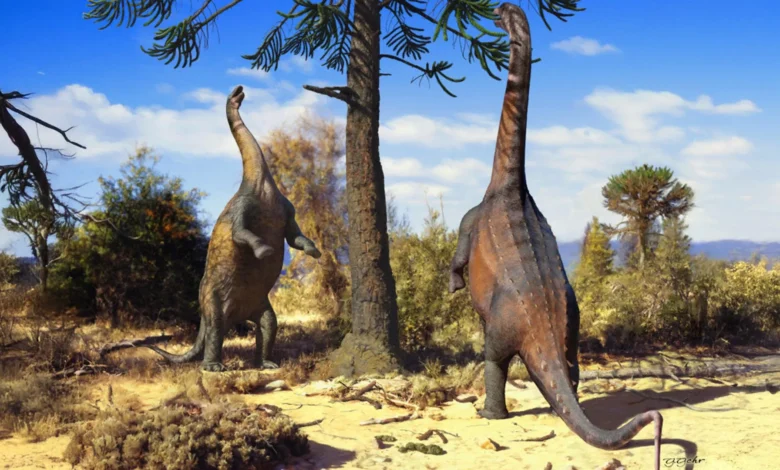
Some long-necked dinosaurs may have been far more capable of standing upright than their enormous bodies suggest. This groundbreaking insight comes from a new study that employed sophisticated engineering simulations to analyze the biomechanics of extinct sauropods, revealing that certain species, particularly younger South American giants, possessed a remarkable ability to balance on their hind legs for extended periods. This capability, previously underestimated, could have played a crucial role in their survival, influencing their feeding strategies, social interactions, and even their defensive tactics.
A New Perspective on Sauropod Biomechanics
For decades, the sheer immensity of sauropods, the group of long-necked, herbivorous dinosaurs that dominated ecosystems for over 150 million years, has led paleontologists to assume they were largely confined to a quadrupedal existence. Their colossal size and immense weight seemed to preclude any significant bipedal locomotion. However, recent research, published in the esteemed journal Palaeontology, challenges this long-held assumption. By applying computational engineering tools to the fossilized remains of two South American sauropods, Uberabatitan from Brazil and Neuquensaurus from Argentina, scientists have uncovered evidence suggesting a surprising degree of upright mobility, especially in their younger stages of life.
The study, supported by the prestigious São Paulo Research Foundation (FAPESP), involved an international collaboration of scientists from Brazil, Germany, and Argentina. Their findings indicate that these particular sauropods, while substantial by modern standards—comparable in size to modern elephants—possessed a skeletal and muscular structure that allowed for a more dynamic range of motion than previously understood. The research focused on the femur, or thigh bone, a critical component for weight-bearing and locomotion, using advanced simulation techniques to model the stresses and strains these bones would have endured during bipedal stances.
The Engineering of Ancient Stances: Finite Element Analysis in Paleontology
The core of this innovative research lies in the application of Finite Element Analysis (FEA), a computational method widely used in engineering to predict how structures will behave under various loads and conditions. In this paleontological context, FEA was employed to digitally reconstruct the femurs of seven different sauropod species, representing a diverse array of evolutionary branches, body sizes, and anatomical features. These digital models were meticulously built from fossil data housed in natural history museums across the globe.
The simulations were designed to replicate two primary scenarios: the "extrinsic" scenario, which accounted for external forces like gravity and the dinosaur’s own body weight acting on the femur when standing on its hind legs, and the "intrinsic" scenario, which modeled the internal forces exerted by muscles on the bone. By combining the data from these two simulations, the researchers could estimate the total stress experienced by the femur in each species.
"Smaller sauropods like these had a bone and muscle structure that allowed them to stand more easily and for longer on their two hind legs," explained Julian Silva Júnior, a postdoctoral researcher at the School of Engineering of São Paulo State University (FEIS-UNESP) and the study’s lead author. "Larger ones were probably also able to stand, but for a shorter time and with less comfort, since the position caused a lot of stress on the femur." Silva Júnior conducted this groundbreaking research during an internship at the University of Tübingen in Germany, supported by a FAPESP scholarship.
Unveiling the Agility of Uberabatitan and Neuquensaurus
The FEA simulations revealed particularly low stress levels in the femurs of the two South American sauropods: a juvenile Uberabatitan ribeiroi and Neuquensaurus australis. Both species lived approximately 66 million years ago during the Late Cretaceous period. The robust nature of their femurs, characterized by greater thickness and sturdiness, was key to their ability to effectively dissipate the forces generated when standing upright. This structural advantage allowed them to maintain a bipedal stance with less strain on their skeletal system.
"They had more robust femurs and could dissipate stress better," elaborated Silva Júnior. "The bigger ones had very large muscles and even giant femurs, but not enough to support their weight. That doesn’t mean they couldn’t stand up, but they probably chose the best time to do so, because it must have been an uncomfortable position." This suggests that while larger sauropods might have been physically capable of standing on their hind legs, it was likely a less frequent and more taxing maneuver for them compared to their smaller relatives.
The research also highlighted a developmental aspect of this bipedal capability. While the juvenile Uberabatitan examined in the study demonstrated a strong aptitude for upright posture, adult Uberabatitan individuals would have likely faced the same challenges as other giant sauropods. Their significantly increased body mass would have subjected their femurs to much higher stress levels, diminishing their capacity for prolonged bipedal stances. This indicates a potential trade-off between growth and locomotive flexibility within these species.
The Evolutionary Advantages of Standing Tall
The newfound understanding of sauropod bipedalism opens up a fascinating realm of possibilities regarding the adaptive advantages of this posture. For herbivorous creatures like sauropods, standing upright could have provided critical access to food sources. By elevating themselves on their hind legs, they could have reached tender leaves and vegetation located in the higher canopy of trees, an area inaccessible to shorter herbivores. This could have been a significant advantage in environments with intense competition for food resources.
Beyond foraging, upright stances may have played a vital role in social and reproductive behaviors. For males, the ability to stand tall could have facilitated visual displays, making them appear more imposing to rivals or more attractive to potential mates. In some instances, it might have been necessary for mounting females during reproduction, although the mechanics of sauropod mating are still a subject of ongoing scientific inquiry.
Furthermore, bipedalism could have served as an effective defensive strategy. By rearing up on their hind legs, sauropods could have dramatically increased their perceived size, presenting a more intimidating front to predators. This elevated posture, potentially combined with the use of their tails for balance—forming a stable tripod stance with the two hind legs and the tail—could have been a powerful deterrent against carnivores. The ability to momentarily adopt such a formidable stance might have been a crucial factor in their survival against the predatory threats of the Cretaceous period.
A Timeline of Discovery and Evolution
The evolutionary journey of sauropods spans a vast period, from the Late Triassic (around 230 million years ago) to the end of the Cretaceous (66 million years ago). During this immense timeframe, sauropods diversified into a multitude of forms, ranging from relatively small, slender species to the truly gargantuan titans like Argentinosaurus and Patagotitan. The discovery of Uberabatitan in Brazil and Neuquensaurus in Argentina adds significant pieces to this complex paleontological puzzle, particularly concerning the South American sauropod fauna during the Late Cretaceous.
Uberabatitan ribeiroi, named in honor of the Brazilian municipality of Uberaba where its fossils were unearthed, is considered one of the largest dinosaurs known from Brazil. Its adult length is estimated to have reached up to 26 meters. Neuquensaurus australis, found in the Neuquén Basin of Argentina, is another significant sauropod from the region. Both species coexisted in ecosystems shaped by the changing geological and climatic conditions of the Late Cretaceous, a period that ultimately culminated in the Cretaceous-Paleogene extinction event.
The scientific endeavor to understand these ancient creatures has been a progressive one. Early paleontological studies often relied on descriptive morphology. However, the advent of advanced computational techniques, coupled with a deeper understanding of biomechanics and comparative anatomy, has allowed for more sophisticated analyses. This current study, by integrating paleontology with engineering principles, represents a significant leap forward in our ability to reconstruct the functional capabilities of extinct animals.
Limitations and Future Directions
While this study offers compelling insights, the researchers acknowledge certain limitations in their models. The simulations did not incorporate the role of cartilage, the flexible tissue that cushions joints and absorbs shock. Cartilage, which was not preserved in the fossilized specimens, would have played a significant role in stress distribution. Similarly, the precise stabilizing effect of the tail in a tripodal stance was not explicitly modeled.
The researchers made a simplifying assumption that cartilage would have played a similar cushioning role across all the studied species. This means that while the comparative analysis of stress distribution between different sauropods is likely accurate, the absolute stress values for any individual species might not be precise.
"The tool we use is very efficient for comparisons, even if the answer isn’t exact for each one," stated Silva Júnior. "By comparing representatives from different lineages, we can get a fairly accurate picture of how these animals behaved millions of years ago." This comparative approach remains highly valuable for understanding evolutionary trends and functional adaptations within the sauropod lineage.
Future research could aim to incorporate more detailed reconstructions of soft tissues, including cartilage and musculature, if sufficient fossil evidence becomes available. Further studies focusing on different sauropod groups and ontogenetic stages could also refine our understanding of bipedal capabilities across the broader sauropod family tree. The ongoing exploration of dinosaur biomechanics promises to continue reshaping our perception of these magnificent prehistoric creatures, revealing a world of surprising complexity and dynamism.
Broader Impact and Implications
The implications of this research extend beyond the specific species studied. It suggests that the ability to stand upright, and the functional advantages it conferred, might have been a more widespread trait among sauropods than previously thought. This could lead to a re-evaluation of fossil evidence and a reconsideration of the ecological roles played by these giants in ancient ecosystems.
The study underscores the power of interdisciplinary research, demonstrating how applying tools and methodologies from seemingly unrelated fields, such as engineering, can unlock new understandings in paleontology. It also highlights the ongoing importance of international scientific collaboration, with researchers from different countries pooling their expertise and resources to tackle complex scientific questions.
Ultimately, this research contributes to a richer, more nuanced picture of dinosaur life. It moves beyond static portrayals of these animals as mere lumbering giants, revealing them as dynamic beings with sophisticated adaptations that allowed them to thrive in a diverse and challenging world for millions of years. The capacity for upright locomotion, even if limited to specific life stages or species, adds another layer to the remarkable evolutionary success story of the sauropods.