North Carolina Bolsters Disaster Resilience with Solar Microgrid Expansion in Hurricane Helene Recovery Zones

The Burnsville Fire Department in western North Carolina has long served as more than just a station for emergency vehicles; it is the heartbeat of a community that has faced the brunt of increasingly volatile weather. Nearly two years ago, when Hurricane Helene tore through the Appalachian Mountains, knocking out power and severing communication lines, Fire Chief Niles Howell found himself in a race against time. To maintain the station’s role as a landing pad for medical helicopters, a base for search-and-rescue teams, and a makeshift field hospital for the wounded, Howell had to rely on a traditional diesel generator. However, the logistical nightmare of securing fuel during a regional catastrophe loomed over every operation. That anxiety is now set to become a thing of the past as Burnsville prepares to integrate into a pioneering statewide microgrid project designed to ensure that critical infrastructure remains powered, even when the central grid fails.
The transition in Burnsville involves the installation of 40 kilowatt-hours of solar panels paired with 80 kilowatt-hours of battery storage. This system is part of a broader initiative led by the North Carolina Department of Environmental Quality (DEQ) and a coalition of sustainable energy nonprofits. The project represents a shift in how rural communities approach disaster preparedness, moving away from a total reliance on fragile, centralized power lines toward a decentralized, "islanded" energy model. For Chief Howell, the move is about more than just green energy; it is about the fundamental necessity of redundancy. In his view, every system eventually faces a point of failure, and having multiple avenues to generate and store electricity is the only way to guarantee public safety during the next "once-in-a-century" storm.
The Evolution of Energy Resilience in the Appalachian Region
The Appalachian landscape presents unique challenges for energy providers and emergency responders. The steep terrain and dense forests make traditional power line maintenance difficult and repair efforts slow following a major storm. In recent years, western North Carolina has been repeatedly battered by extreme rainfall and flash flooding, events that climate scientists suggest are becoming more frequent due to shifting atmospheric patterns. When Hurricane Helene struck, the resulting floods didn’t just knock down poles; they washed away the very roads needed to bring in repair crews and fuel trucks.
This vulnerability has catalyzed a movement toward small-scale energy resilience. The $5 million investment announced by the North Carolina DEQ last August aims to mitigate these risks by funding 26 microgrid projects across the state. These systems are specifically designed to "black start"—the ability to restore power independently without relying on the external transmission network. By June, five of these sites had been finalized, focusing on areas along the path of Helene’s destruction. The goal is to create a network of "safe havens" where essential services, such as water treatment, emergency communications, and medical triage, can continue uninterrupted.
Understanding Microgrid Technology and the Beehive Model
A microgrid is a localized group of electricity sources and loads that normally operates connected to and in synchronization with the traditional wide-area synchronous grid, but is also able to disconnect and function autonomously as physical or economic conditions dictate. In the context of the North Carolina project, these systems rely heavily on solar photovoltaics (PV) and advanced lithium-ion battery storage.
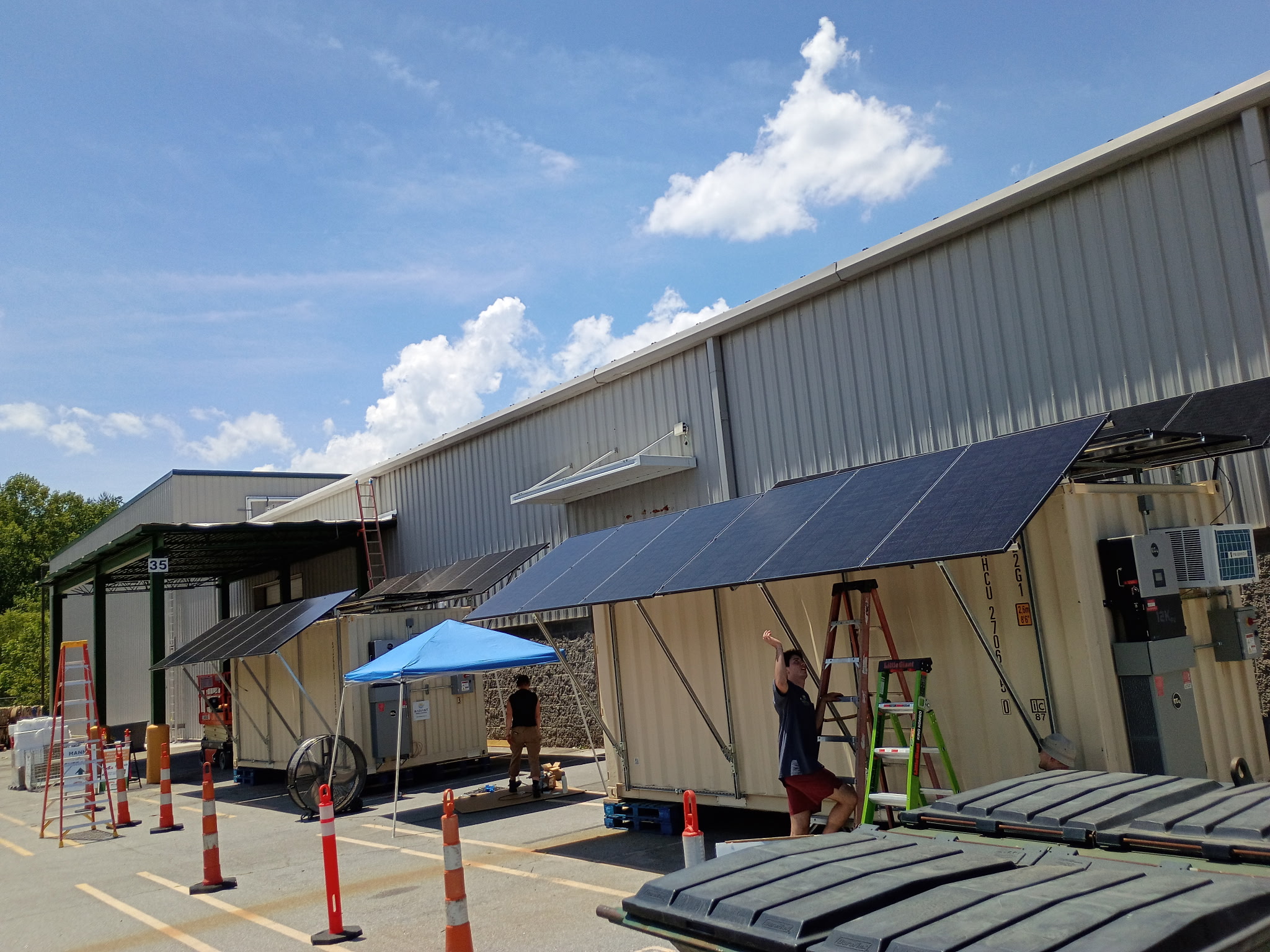
While stationary microgrids are being installed at fixed locations like the Burnsville Fire Department, the project also introduces a mobile element. The Footprint Project, a nonprofit partner in the initiative, has developed what they call "beehives"—portable, trailer-mounted solar and battery systems. These units are categorized by their specific functions:
- Cooler Bees: Equipped with high-efficiency refrigeration units to preserve temperature-sensitive medications and food supplies.
- Power Bees: Dedicated to providing high-capacity charging stations for laptops, radios, and cellular devices, which are vital for maintaining communication during a blackout.
- Water Bees: Outfitted with advanced filtration systems to provide potable water when local treatment plants are offline.
These mobile units can provide up to 100 kilowatt-hours of energy, enough to power a large community building for roughly 10 hours or maintain critical medical equipment for days. The portability of these systems allows emergency managers to tow them directly into the heart of a disaster zone, providing immediate relief before traditional utilities can be restored.
Comparative Success: Lessons from Puerto Rico and New Orleans
North Carolina’s initiative does not exist in a vacuum; it draws inspiration from successful microgrid deployments in other storm-ravaged regions. Following the devastation of Hurricane Maria in 2017, Puerto Rico became a global testing ground for solar microgrids. With a centralized grid that was both aging and prone to failure, local communities and nonprofits began installing "solar hubs" in mountain villages. These systems allowed residents to keep lights on and refrigerators running during subsequent hurricanes, proving that decentralized energy is more resilient than a single-point-of-failure system.
Similarly, in New Orleans, the "Community Lighthouse" project was born out of the lessons learned from Hurricane Ida. A network of churches and community centers installed solar and storage systems to serve as cooling centers and charging stations during the sweltering heatwaves that often follow Gulf Coast storms. North Carolina officials are looking to these models as proof of concept, demonstrating that while the initial capital investment is high—most stationary microgrids in this project cost upwards of $100,000—the long-term savings in disaster recovery and the mitigation of human suffering are invaluable.
Chronology of the North Carolina Microgrid Rollout
The timeline for this resilience project reflects both the urgency of the climate crisis and the logistical complexities of state-funded infrastructure:
- August 2023: The North Carolina Department of Environmental Quality allocates $5 million for the expansion of sustainable energy microgrids, focusing on disaster-prone counties.
- June 2024: Official announcement of the first five stationary sites, including the Burnsville Fire Department. Engineering and site assessments begin.
- Summer 2024: Installation begins at the five primary stationary sites. These installations include the mounting of solar arrays and the integration of battery "power walls."
- 2025-2026: Monitoring and data collection phase. The DEQ will analyze the performance of these grids during seasonal storms to refine the technology for broader use.
- 2027: Deployment of two large-scale mobile solar power trailers ("beehives") to be managed by regional emergency response coordinators.
Economic Hurdles and the Political Landscape
Despite the clear benefits, the path to statewide energy resilience is fraught with financial and political challenges. The technology is expensive, and for small municipalities or local nonprofits, the six-figure price tag for a microgrid is often prohibitive without significant government or philanthropic support.
Sara Nichols, a representative of the Land of Sky Regional Council, emphasized that the current project is intended to serve as a "proof of clinical efficacy" for the funding model. By combining state DEQ funds with nonprofit expertise, the project seeks to bypass the barriers created by recent changes in federal and state solar incentives, which have made small-scale solar less accessible for some property owners.
The political dimension is equally complex. Governor Josh Stein recently requested $1 million specifically for microgrid expansion as part of a larger $792 million Helene relief package. However, the North Carolina General Assembly did not include the microgrid funding in the final budget cut, prioritizing more immediate recovery needs such as debris removal and road repair. This highlights a recurring tension in disaster management: the struggle to balance immediate "cleanup" costs with "build back better" investments that prevent future damage.
Strategic Implications for Rural Climate Resilience
The implications of North Carolina’s microgrid project extend far beyond the borders of Burnsville. As the first state-led effort of this scale in the region, it is setting a national precedent. If successful, the model could be replicated across the entire Appalachian range and other rural areas where geography makes traditional grid fortification nearly impossible.
Reid Wilson, Secretary of the North Carolina DEQ, has indicated that his department is actively seeking additional partners to expand the program. The focus is on creating a "resilience corridor" where solar-powered community hubs are spaced closely enough to support one another during a regional blackout. This strategy acknowledges that while we cannot prevent the storms, we can change how we survive them.
By investing in microgrids, North Carolina is essentially buying insurance against the future. The ability to maintain a field hospital, keep medications cold, and ensure that emergency radios stay charged is the difference between a managed crisis and a humanitarian catastrophe. For Fire Chief Niles Howell and the residents of Burnsville, the arrival of solar panels and batteries represents a new era of self-reliance—one where the community’s safety is no longer dependent on a single wire or a tank of diesel, but on the power of the sun and the resilience of their local infrastructure.