New England Clean Energy Connect Faces Early Performance Hurdles as Canadian Hydropower Exports Stagnate

The New England Clean Energy Connect, a high-voltage transmission line designed to serve as a critical artery for renewable energy flowing from the Canadian wilderness to the power-hungry hubs of the American Northeast, began its operational life in January with the promise of a greener future. Marketed as a cornerstone of Massachusetts’ ambitious decarbonization strategy, the project—commonly referred to as NECEC—was expected to stabilize energy prices and significantly reduce the region’s reliance on fossil fuels. However, nearly six months into its operation, a granular analysis of energy flow data reveals a reality that has yet to meet the lofty expectations of its proponents. Far from a steady surge of clean power, the line has been characterized by intermittent flows, technical outages, and a broader trend of diminishing energy exports from Quebec that suggests the region’s energy transition may be more complex than initially advertised.
Initial data indicates that the total volume of electricity entering the New England grid from Canada has increased only marginally since the line went live. Most strikingly, the NECEC line has experienced approximately 27 days of total inactivity since January, including a significant two-week outage between late May and early June. While state-owned utility Hydro-Québec has attributed these disruptions to "technical difficulties" and the expected "fine-tuning" associated with new infrastructure, the lack of consistent throughput has raised concerns among energy analysts. If current trends persist, there is a distinct possibility that New England will receive less total hydropower this year via two transmission lines than it did over a single line in previous years, highlighting a potential bottleneck in the cross-border energy trade.
A Decadelong Struggle: The Chronology of NECEC
The path to energizing the NECEC was fraught with nearly a decade of political, legal, and environmental challenges. To understand the current performance issues, one must look back to the origins of the project and the shifting regulatory landscape of the Northeast.
In 2016, Massachusetts passed a landmark energy law requiring the state to procure 1.6 gigawatts of offshore wind and 1.2 gigawatts of "clean energy generation," which was widely understood to mean Canadian hydropower. The state’s utilities initially selected the "Northern Pass" project, a 192-mile line through New Hampshire. However, that proposal was unceremoniously scrapped in 2019 after New Hampshire regulators, citing concerns over forest preservation and local tourism, denied the necessary permits.
With Northern Pass dead, attention shifted to the NECEC, a 145-mile route through the Maine North Woods. The project immediately became a lightning rod for controversy. Opponents, ranging from local environmental groups to rival fossil fuel generators, argued that the line would permanently scar Maine’s pristine wilderness for the benefit of Massachusetts consumers. In 2021, Maine voters passed a statewide referendum to retroactively ban the project, leading to a multi-year legal battle. Construction only resumed in 2023 after a Maine jury and the state’s Supreme Judicial Court ruled that the developers had "vested rights" to complete the project because they had begun significant work before the law changed.
The line finally began carrying its first electrons in early 2024, a moment hailed by Massachusetts Governor Maura Healey as a "major win" for the state’s climate goals. Under the 20-year contract, Hydro-Québec is tasked with delivering 9.55 terawatt-hours of electricity annually, which accounts for roughly 20 percent of Massachusetts’ total electricity demand.
The Data Gap: New Infrastructure vs. Net Energy Flows
The central concern for energy experts is not merely the technical reliability of the new line, but the "net flow" of energy across the border. Historically, New England has relied on a different transmission corridor known as Phase 2, which runs from Quebec into central Massachusetts. In 2019, Phase 2 carried more than 12 terawatt-hours of electricity into the region.
However, data from the first four months of 2024 shows a troubling shift. While the NECEC carried approximately 2.4 terawatt-hours of power through April, flows on the older Phase 2 line have plummeted to just over half a terawatt-hour. To some observers, it appears that Hydro-Québec is not necessarily providing more energy to New England, but is instead rerouting existing supplies through the new, contractually obligated NECEC line while reducing shipments on the older corridor.
"We’re not seeing much net new flows coming from our neighbors," noted Dan Dolan, president of the New England Power Generators Association. Dolan pointed out that the current net energy flows are hovering near the lows seen in 2023, which was already a historically weak year for Canadian imports. This "shuffling" of power raises questions about whether the $1 billion investment in NECEC is actually displacing fossil fuel generation or simply changing the geography of the grid.
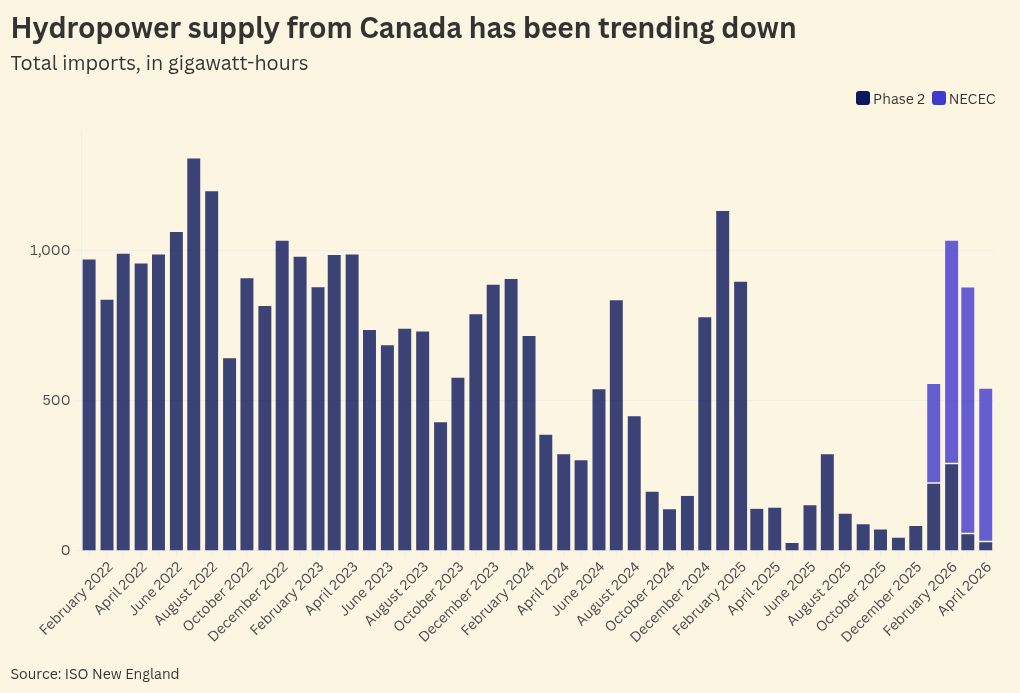
Compounding the issue is the rare occurrence of "reverse flows." In early 2024, New England actually exported over 500 gigawatt-hours of electricity north to Canada. Because New England’s grid still relies heavily on natural gas-fired power plants, this means the region was effectively burning fossil fuels to support the Canadian grid, even as it sought to import hydropower for its own decarbonization goals.
Environmental and Technical Constraints
The primary driver behind the sluggish exports appears to be environmental rather than political. Quebec has been gripped by persistent drought conditions over the last several years. Hydropower is often viewed as a "baseload" renewable, but it is ultimately dependent on the hydrologic cycle. When precipitation is low, reservoir levels drop, forcing Hydro-Québec to prioritize its domestic customers over international export contracts.
Gilbert Bennett, a senior adviser for WaterPower Canada, explained that during dry spells, the hydropower industry must manage its reservoirs as long-term batteries. "As generators wait for rainier days, their first obligation is to supply domestic customers," Bennett said. This domestic-first policy means that during peak winter demand or extended dry periods, Hydro-Québec may have to scale back exports or even import power from New England to maintain its own grid stability.
Furthermore, the regional competition for Quebec’s "blue gold" is intensifying. Just this month, the Champlain Hudson Power Express (CHPE) began operations, a transmission line designed to send electricity from Quebec directly into New York City. With New York also competing for a slice of Hydro-Québec’s surplus, the total available supply for New England may be under greater strain than planners anticipated in 2016.
Economic Safeguards and the Role of Natural Gas
Despite the underwhelming early numbers, Massachusetts ratepayers are shielded from some of the financial risks by the structure of the contracts. According to Joseph LaRusso, manager of the Clean Grid Program at the Acadia Center, the agreements between Massachusetts utilities and Hydro-Québec include "liquidated damages" provisions. If Hydro-Québec fails to deliver the contracted amount of power, they are legally required to compensate the utilities for the cost of purchasing replacement power from other sources.
"To the extent that imports are curtailed, Hydro-Québec is liable to make the electric utilities whole," LaRusso said. While this protects consumers’ wallets, it does not solve the carbon problem. When Canadian hydro fails to show up, the "replacement power" in New England is almost invariably generated by natural gas plants. This has led to a heavier "gas burn" across the region’s generation fleet than many state officials had projected for 2024.
The Long-Term Outlook: A Greener Horizon?
Despite a rocky start, proponents of the NECEC maintain that the project’s long-term value remains intact. They point to specific days, such as May 16, as a blueprint for the future. On that day, a combination of high solar output and a fully operational NECEC line allowed ISO New England, the region’s grid operator, to run its natural gas plants at minimal levels. For a brief window, the region’s electricity needs were met almost entirely by non-fossil fuel resources.
"It really gets you thinking of the resources available and how they could be managed and shared in the future," LaRusso remarked.
Furthermore, climate projections for Quebec suggest that while the current drought is a setback, the long-term trend for the region is toward wetter conditions. Hydro-Québec is also in the midst of a massive $50 billion investment plan aimed at increasing its generating capacity through both new hydropower projects and a significant expansion into onshore wind. By 2035, the utility expects to have a much larger surplus of renewable energy to share with its southern neighbors.
As New England navigates the complexities of its energy transition, the NECEC serves as both a cautionary tale and a beacon of potential. The project illustrates the immense difficulty of building cross-border infrastructure and the unpredictability of climate-dependent energy sources. However, as offshore wind projects face their own headwinds from federal policy shifts and rising costs, the land-based connection to Canada remains one of the region’s most viable paths toward a net-zero grid. For now, New England remains in a state of watchful waiting, hoping that the "fine-tuning" of its newest power line will eventually lead to the flood of clean energy it was promised.