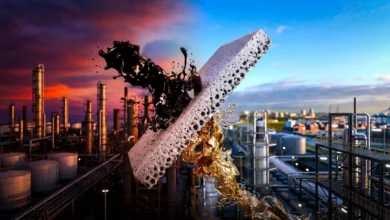
Molecular Engineering Breakthrough Allows Scientists to Program the Internal Structure of Glass During Manufacturing


A landmark collaborative study has unveiled a transformative method for manipulating the internal architecture of glass at the molecular level, a development that promises to redefine the boundaries of material science. By introducing a specific organic molecule, 1,10-phenanthroline, into the melting process of metal-organic framework (MOF) compounds, researchers have successfully demonstrated the ability to dictate the final properties of glass—including magnetic responsiveness and optical behavior—before it even solidifies. This research, recently published in the prestigious journal Nature Materials, represents a significant departure from traditional glass manufacturing, where the material’s characteristics have historically been constrained by the inherent properties of the starting ingredients.
The research was spearheaded by Professor Dr. Sebastian Henke of TU Dortmund University, in close coordination with experts from Paderborn University, the University of Duisburg-Essen, and the University of Oxford. This interdisciplinary effort has effectively turned the molten phase of glass production from a passive cooling step into an active, programmable reaction space.
The Evolution of Glass Manufacturing: A Brief Chronology
For millennia, the production of glass has relied on the rapid cooling of a molten liquid. As the substance loses heat, its atoms become trapped in a disordered, amorphous state, lacking the repeating, orderly lattice structure characteristic of crystals. Because this process is largely dictated by the thermodynamic properties of the raw melt, manufacturers have typically been limited to the chemical profiles dictated by their precursors.
The timeline of this specific research project began several years ago, as the scientific community sought ways to harness the unique properties of MOFs—crystalline, porous materials comprised of metal nodes connected by organic linkers—for glass production. While MOFs are highly desirable for their potential in gas storage and catalysis, their structural integrity often falters under the extreme heat required for traditional vitrification.
The breakthrough emerged when the research team hypothesized that they could act upon the "molten" phase of these compounds. By introducing 1,10-phenanthroline, the team found they could lower the melting point of the metal-organic frameworks significantly. This prevented the thermal decomposition that usually renders these materials unusable, allowing for the creation of stable, high-performance glasses that were previously considered impossible to manufacture.
The Molecular Mechanism: How Phenanthroline Transforms Glass
At the heart of this discovery is a process that goes beyond simple additive chemistry. Typically, additives in manufacturing are used to stabilize or color a substance. However, in this process, the 1,10-phenanthroline molecule functions as both a chemical flux and a structural architect.
During the melting process, the molecule actively binds to the metal centers within the framework. By doing so, it partially displaces existing bonds and alters the "coordination environment"—the number of neighboring atoms surrounding each metal center. Because the phenanthroline molecule exhibits a stronger affinity for these metal nodes than the original linkers, it forces a reorganization of the network before the material cools and locks into place.
"The crucial point is that the molecule does not simply remain as a filler," explains Professor Henke. "It enters into a reaction. We are altering the chemistry at precisely the moment when the material is still liquid."
This level of control allows engineers to "tune" the glass. By adjusting the concentration of 1,10-phenanthroline added to the mixture, researchers can exert a proportional influence on the final material’s density, magnetic susceptibility, and light-emitting capabilities.
Supporting Data and Analytical Verification
Verifying these microscopic changes required the use of advanced diagnostic tools, as the amorphous nature of glass renders traditional, diffraction-based X-ray crystallography ineffective. To confirm that the internal structure had indeed been reorganized, the team employed X-ray absorption spectroscopy.
These measurements provided high-resolution data on the local environment of cobalt atoms used in the glass samples. The results were conclusive: while the oxidation state of the cobalt remained unchanged, the geometry of its immediate surroundings shifted significantly to accommodate the phenanthroline. The data showed an increase in the number of neighboring atoms, confirming that the molecule had successfully reconfigured the chemical network of the glass.
Furthermore, the data indicated a marked reduction in impurities. In standard high-temperature manufacturing, cobalt-based MOFs often produce decomposition products that degrade the glass’s performance. By lowering the melting temperature through the use of phenanthroline, the researchers successfully avoided these degradation pathways. This resulted in a cleaner, more homogeneous material, which is critical for applications where precise magnetic or electronic performance is required.
Official Perspectives and Collaborative Impact
The project highlights the necessity of cross-institutional cooperation in high-stakes material science. Professor Dr. Matthias Bauer of Paderborn University, who oversaw the spectroscopic analysis, emphasized the practical utility of this gentler process. "Thanks to this molecular trick, the material melts at significantly lower temperatures and remains stable. Studies on cobalt-containing glasses have shown that this gentler process prevents the formation of harmful decomposition products," Bauer noted.
The ability to avoid impurities is not merely a manufacturing preference; it is a functional requirement. In materials designed for magnetic sensing, for example, even trace impurities can obscure the signal, making it impossible to characterize the material’s true behavior. By maintaining chemical stability throughout the melting and cooling cycle, this new technique provides a "cleaner" canvas for researchers to develop next-generation sensors and electronic components.
Broader Implications for Industry and Technology
The implications of this discovery are extensive, touching on fields ranging from sustainable energy to advanced computing.
- Energy Storage and Catalysis: The porous nature of these metal-organic-derived glasses makes them prime candidates for advanced gas storage systems, particularly for hydrogen or carbon capture. The ability to customize the pore size and chemical environment within the glass structure could lead to more efficient and selective catalysts for chemical production.
- Optoelectronics: Because the new method allows for the incorporation of specific metal ions that emit light or interact with electromagnetic fields, these glasses could be utilized in the development of sophisticated optical sensors or light-modulating components in high-speed telecommunications.
- Magnetic Technologies: The ability to precisely control the magnetic environment of metal centers opens doors to new forms of data storage or quantum-level sensing, where the stability of the host material is paramount.
The versatility of the method was further bolstered by successful experiments with carboxylate-based framework structures. This suggests that the 1,10-phenanthroline approach is not limited to a single class of materials, but could potentially be adapted as a general tool for the design of "designer glasses."
Looking Toward the Future
As the scientific community continues to explore the potential of "programmable" materials, this discovery stands as a testament to the power of molecular-level engineering. By moving away from the "trial and error" approach of mixing raw ingredients and hoping for a favorable outcome, researchers have moved toward a design-based methodology.
The vision for the future, as articulated by Professor Henke, is one where the melt is no longer treated as a volatile, uncontrolled phase, but rather as a deliberate "reaction space." By treating the manufacturing process as a controlled synthesis, industry players may eventually be able to order glass with highly specific, pre-programmed physical and chemical properties.
While the research is currently in the laboratory phase, the compatibility of this method with existing industrial heating processes suggests that scaling up may be feasible. As these advanced glasses move closer to real-world applications, they are expected to solve some of the most persistent bottlenecks in fields requiring both the durability of glass and the functional complexity of metal-organic frameworks.
Ultimately, this collaborative achievement marks a pivot point in materials science. It confirms that the future of glass is not just about melting and molding, but about the precise, molecular orchestration of the material’s internal identity, ensuring that tomorrow’s technology is built on a foundation that is as chemically sophisticated as it is structurally sound.