The study, led by Susmita Garai, a graduate student at The University of New Mexico, alongside professor Zachary Sharp and colleague Peter Olson, reconstructs the hostile, high-energy environment of the Hadean Eon—the period roughly 4.5 billion years ago when the Earth was still in its infancy. Their work suggests that as the planet accumulated mass through the accretion of rocky "pebbles," it simultaneously generated an atmosphere dense with hydrogen. Under these conditions, a volatile chemical reaction occurred: the hydrogen gas reduced the iron oxide within the falling rocks, stripping away oxygen and bonding it with hydrogen to create water vapor.
The Evolution of the "Water Delivery" Theory
For decades, the consensus regarding Earth’s moisture has centered on the "Late Veneer" hypothesis. Astronomers and geochemists have long argued that the early inner solar system was too hot for water to condense, leading to the belief that the Earth was initially a dry, rocky desert. According to this model, the vast majority of our oceans were delivered by carbonaceous chondrite meteorites or comets originating from the cooler, outer reaches of the solar system, such as the asteroid belt or the Kuiper Belt.
However, this theory has faced persistent scrutiny. Chemical analyses of the hydrogen isotopes found in Earth’s water—specifically the ratio of deuterium to protium—often do not match the profiles of many known comets. Furthermore, the logistical challenge of transporting sufficient quantities of icy material to a nascent, growing Earth has left a gap in the timeline of planetary development. The new findings from the University of New Mexico do not necessarily invalidate the role of meteorites, but they offer a secondary, perhaps more robust, internal source that requires no external delivery system to explain the planet’s vast reservoirs.
Experimental Methodology: Recreating the Hadean Crucible
To test their hypothesis, the research team sought to replicate the extreme thermal environment of the early Earth. Using high-pressure furnaces, they subjected silicate rocks—mimicking the primordial material that formed the planet—to temperatures ranging from 1,200 to 1,400 degrees Celsius.
The experimental design required precise control. The samples were exposed to a flow of hydrogen gas, simulating the hydrogen-rich atmosphere theorized to have existed during the planet’s accretion phase. To ensure the chemical changes were specifically due to the hydrogen interaction, the researchers conducted control experiments using helium, an inert gas. The results were stark: in the hydrogen-rich environment, approximately 80% of the iron oxide within the silicate rocks was converted into metallic iron within minutes, with water vapor emerging as a direct chemical byproduct.
The speed of this reaction was perhaps the most surprising element of the study. While scientists had hypothesized that iron reduction might occur, the sheer volume of water produced suggests that the process was not merely a side effect, but a primary engine of planetary hydration. When these experimental findings were extrapolated to account for the mass of the entire planet during its formation, the calculations indicated that the mechanism could have yielded hundreds of oceans’ worth of water—far more than is currently present on the Earth’s surface today.
The Role of Pebble Accretion
The concept of "pebble accretion" has gained significant traction in the last decade as a model for how planets grow. Unlike older theories that suggested planets formed through the violent, sporadic collisions of massive planetesimals, pebble accretion describes a more continuous process where a growing planet sweeps up a constant stream of centimeter-to-meter-sized rocky pebbles from the surrounding protoplanetary disk.
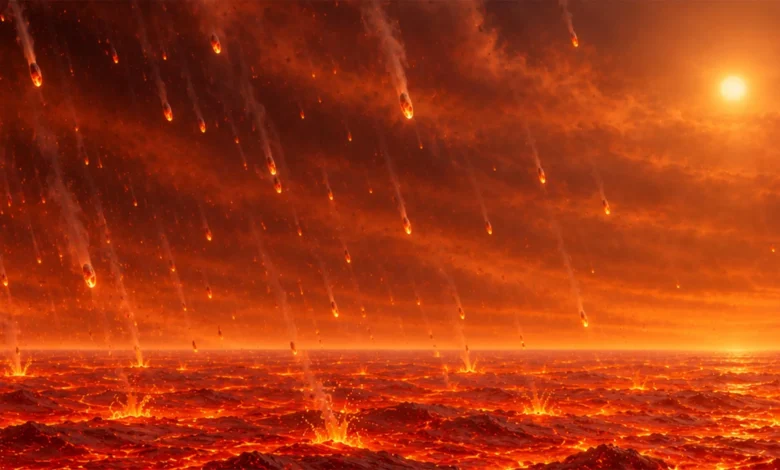
This model is critical to the new findings. As Earth grew, it would have been bombarded by this steady rain of pebbles. If the atmosphere were indeed hydrogen-rich—a condition common to many young, large planetary bodies—each falling pebble would have acted as a small, independent chemical reactor. As the pebble descended, the hydrogen-rich atmosphere would have "stripped" the oxygen from the iron oxides in the rock, effectively "raining" water onto the surface of the growing core. This shifts the focus of planetary evolution from a passive recipient of space-borne ice to an active, self-hydrating chemical system.
Implications for Astrobiology and Exoplanet Research
The implications of this discovery extend far beyond Earth’s geological history. If the production of water is a standard feature of planetary formation, the criteria for "habitable zones" around distant stars may need to be revised.
Currently, the search for life in the universe is heavily biased toward finding planets that occupy the "Goldilocks zone"—the distance from a star where liquid water can exist. If water is an inevitable byproduct of the formation of any rocky, Earth-sized planet with a hydrogen-rich atmosphere, then the number of potentially habitable worlds in the galaxy could be significantly higher than current models predict.
"In order to evaluate the possibility of ‘pebble rain’ being a source of water, we needed to construct and execute some very challenging high-temperature experiments," said Professor Zachary Sharp. "Dr. Garai’s efforts paid off mightily, as she found that water is produced in just minutes in the high-temperature environment of the early Earth’s atmosphere."
Sharp noted that while this discovery solves the "delivery problem," it also suggests that the early Earth was a far more dynamic and volatile environment than previously assumed. "Looking out over a large body of water, it is hard to imagine that that water may have been produced 4.5 billion years ago in a hell-like atmosphere, but it very well may have," he added.
Future Research and Scientific Consensus
While the study provides a compelling mechanism, the scientific community maintains a cautious stance regarding the total contribution of this process. The researchers acknowledge that further inquiry is needed to quantify exactly how much of Earth’s modern water inventory is "autochthonous" (locally produced) versus "allochthonous" (brought in from elsewhere).
Future studies will likely focus on:
- Isotopic Fingerprinting: Comparing the isotopic signatures of water produced in hydrogen-reduction experiments with the water currently found in Earth’s mantle and oceans.
- Atmospheric Modeling: Determining how long a hydrogen-rich atmosphere could have been maintained on the young Earth before being stripped away by solar winds.
- Exoplanet Observations: Utilizing next-generation space telescopes, such as the James Webb Space Telescope (JWST), to search for signs of hydrogen-rich atmospheres and water vapor in the formative stages of rocky planets around other stars.
The consensus among planetary scientists is that this research provides a vital missing piece of the puzzle. It challenges the "late delivery" narrative by suggesting that the ingredients for life were being synthesized even as the planet was taking shape. By bridging the gap between planetary formation models and geochemical reality, the team at The University of New Mexico has opened a new window into the fiery, chaotic beginnings of our world.
Ultimately, this study serves as a reminder that the history of the Earth is written in its chemistry. The oceans that define our blue planet may not have arrived as a cosmic afterthought via asteroid bombardment; they may have been a fundamental, inherent part of the planet’s birth—a chemical inevitability forged in the intense, high-pressure crucible of the early solar system. If this process is indeed universal, it suggests that the ingredients for life are not rare treasures to be delivered by chance, but standard equipment for any planet forged in the fire of its own creation.