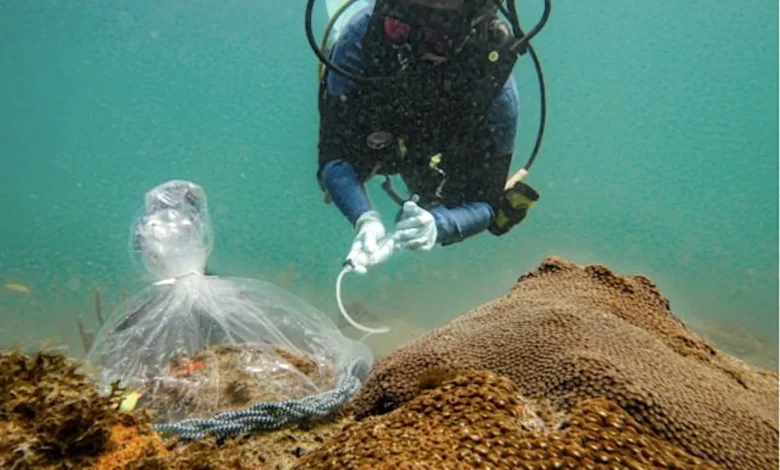
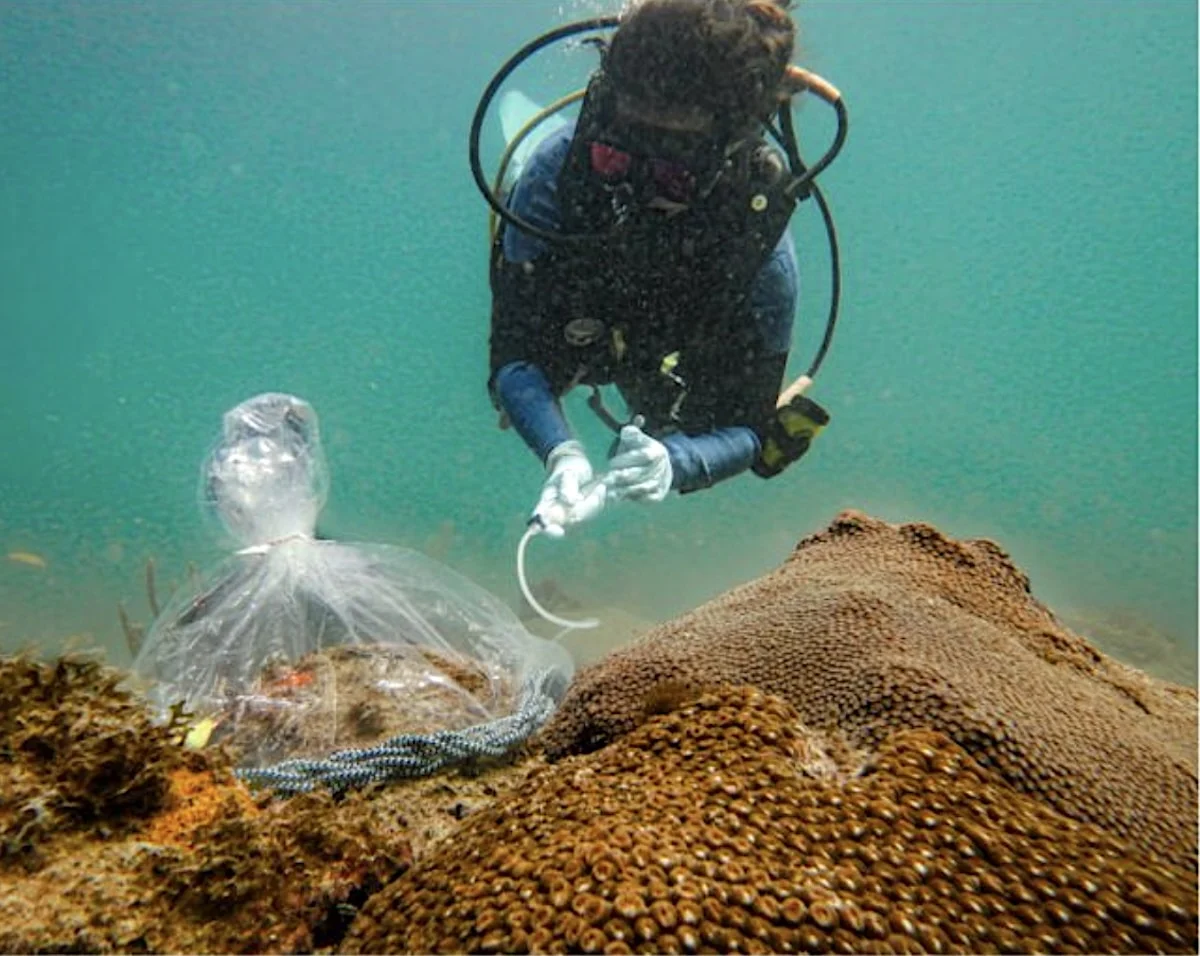
Probiotic treatment of Montastraea cavernosa colonies using a whole-colony bagging technique. Frontiers in Marine Science

The health of the Florida Reef Tract, the only living coral barrier reef in the continental United States, has been under unprecedented assault for nearly a decade. At the center of this ecological crisis is Stony Coral Tissue Loss Disease (SCTLD), a highly virulent, water-borne pathogen that has decimated dozens of coral species across the Caribbean. However, recent breakthroughs in marine microbiology, specifically the application of beneficial bacterial probiotics, are providing a glimmer of hope. Researchers from the Smithsonian Marine Station have demonstrated that a specific probiotic strain, MCH1-7, can significantly mitigate the spread of SCTLD in Montastraea cavernosa, or great star coral, offering a potential lifeline for these vital marine ecosystems.
The Emergence of a Deadly Pathogen
SCTLD was first identified off the coast of Miami-Dade County in 2014. Unlike typical coral bleaching events, which are often driven by thermal stress, SCTLD is a water-borne disease that causes rapid tissue loss, stripping corals of their living outer layers and leaving behind only a stark, white skeleton. The disease is characterized by its high transmission rate and its capacity to kill entire colonies within weeks or months. Since its initial outbreak, it has spread throughout the Florida Keys and across the Caribbean, affecting more than 20 species of hard corals.
For years, the scientific community struggled to develop effective mitigation strategies. While antibiotic pastes have shown some success in treating individual lesions on large coral heads, they are labor-intensive and often fail to prevent the disease from re-emerging elsewhere on the colony. The search for a more systemic, long-term solution led researchers to the study of natural disease resistance.
Discovery of the MCH1-7 Probiotic
The breakthrough occurred in 2018 when Smithsonian Marine Station scientists observed a coral colony that appeared to be naturally immune to the rampant SCTLD outbreak. By isolating the bacteria living on that resilient colony, researchers identified the MCH1-7 strain. This strain produces a compound known as tetrabromopyrrole (TBP).
TBP is a secondary metabolite that serves as a powerful antimicrobial agent. Jennifer Sneed, a biologist at the Smithsonian Marine Station, has theorized that TBP may play a dual role in coral health. Not only does it provide a chemical defense against pathogens, but it also appears to function as a settlement cue for coral larvae. In nature, coral larvae are highly selective about where they settle; if they can detect the presence of TBP—an indicator of a healthy, protected environment—they are more likely to thrive. This evolutionary link suggests that the MCH1-7 bacteria may be a critical component of a coral’s natural immunological defense system.
Methodology: The Bagging Technique vs. Localized Treatment
To test the efficacy of the MCH1-7 probiotic, researchers focused on Montastraea cavernosa, a hardy, boulder-like coral species that is ecologically significant to the reef structure. The study, recently published in the journal Frontiers in Marine Science, compared two primary delivery methods: a topical paste applied directly to infected lesions and a "whole-colony bagging" technique.
The bagging method involved placing a weighted, flexible bag around the entire coral colony. Scientists then injected a concentrated dose of the probiotic into the enclosed seawater. This allowed the beneficial bacteria to coat the entire surface of the coral, rather than just the visible areas of infection. The researchers monitored these corals for 2.5 years, a significant duration in the context of marine disease studies.
The findings were stark. Corals treated via the bagging method lost only approximately 7% of their tissue to SCTLD, a remarkable contrast to the 35% tissue loss observed in the untreated control group. Conversely, the localized paste application failed to provide the same level of long-term protection, suggesting that SCTLD is not merely a surface-level infection but a systemic one that requires whole-colony treatment to effectively suppress.

Scientific Implications and Field Challenges
The success of the bagging method raises critical questions regarding the feasibility of scaling such interventions. The process requires significant manpower, as divers must carry specialized equipment, install the bags, and later retrieve them. While the logistics are more demanding than the rapid application of a paste, the performance metrics provide a compelling argument for its adoption.
Lead author Kelly Pitts, a researcher at the Smithsonian Marine Station, emphasized the nuance required in interpreting these results. "It’s important to understand that this is the very beginning," Pitts stated. "This is definitely not a cure-all, but we’re definitely moving in the right direction." The team’s focus has now shifted to ensuring that the application of MCH1-7 does not disrupt the delicate balance of other healthy Caribbean coral species, confirming through field trials that the treatment is both safe and targeted.
Broader Environmental Context and Future Outlook
The implications of this study extend far beyond the Florida Reef Tract. As climate change continues to elevate ocean temperatures and acidify marine environments, corals are becoming increasingly susceptible to pathogens. The development of a probiotic-based defense strategy represents a paradigm shift in reef restoration. Instead of simply attempting to outplant new, healthy corals—which may still fall victim to local diseases—scientists are now exploring ways to bolster the "immune systems" of existing colonies.
Furthermore, the discovery that TBP acts as a natural settlement cue could have transformative effects on coral restoration efforts. If researchers can "prime" degraded reef sites with MCH1-7 before attempting to reintroduce coral larvae, they may significantly improve the survival rates of nursery-raised corals.
Chronology of the Research
- 2014: Initial detection of Stony Coral Tissue Loss Disease (SCTLD) near Miami.
- 2018: Discovery of the MCH1-7 probiotic strain by Smithsonian Marine Station researchers on a resistant colony.
- 2021–2023: Two-and-a-half-year longitudinal study conducted on Montastraea cavernosa using the whole-colony bagging technique.
- 2025: Publication of the findings in Frontiers in Marine Science, confirming the long-term effectiveness of the probiotic in reducing tissue loss.
Challenges to Implementation
Despite the success of the recent trials, several hurdles remain. Scaling the production of the MCH1-7 strain to treat thousands of hectares of reef is a monumental challenge. Furthermore, the regulatory framework for introducing laboratory-cultured bacteria into the wild must be navigated carefully to avoid unforeseen ecological consequences.
Environmental policy experts have noted that while technical solutions are essential, they must be accompanied by broader efforts to reduce water pollution and thermal stress. The probiotic is essentially a "supportive care" measure; it helps the coral survive, but it does not eliminate the stressors that made the coral vulnerable to SCTLD in the first place.
Conclusion: A Collaborative Path Forward
The Smithsonian Marine Station study serves as a critical milestone in the effort to preserve marine biodiversity. By integrating microbiology into the management of marine protected areas, scientists are gaining new tools to manage the resilience of coral reefs.
While the scientific community awaits the results of larger-scale field applications, the current data provides a clear path forward. The focus for the next phase of research will likely involve refining the application methods to reduce the physical burden on dive teams, and investigating whether other probiotic strains can be combined with MCH1-7 to address a wider array of diseases. As the climate crisis intensifies, the ability to protect and fortify existing coral populations will remain one of the most vital frontiers in environmental science, marking a transition from reactive conservation to proactive biological management.