Larry David Returns to HBO Max with Star-Studded Historical Sketch Comedy "Life, Larry and the Pursuit of Unhappiness"

Larry David has once again graced the screens of HBO Max with his unique brand of observational humor, this time through the lens of American history in the sketch comedy series Life, Larry and the Pursuit of Unhappiness. The show marks David’s return to the platform following the acclaimed conclusion of his long-running improvisational sitcom, Curb Your Enthusiasm. Beyond the involvement of executive producers Barack and Michelle Obama, the series boasts an impressive ensemble cast, featuring dozens of celebrity guests portraying historical figures.
This ambitious undertaking transcends the typical cameo-laden production. Each episode of Life, Larry and the Pursuit of Unhappiness showcases over a dozen prominent guest stars. The roster is a remarkable convergence of talent, including several of David’s former Curb co-stars, the late Rob Reiner in what is understood to be his final on-screen performance, and major Hollywood figures like Samuel L. Jackson and Lin-Manuel Miranda. Television mainstays such as Jerry Seinfeld and Jon Hamm also don historical attire, immersing themselves in different eras. The Hollywood Reporter is closely monitoring the series to ensure all contributing artists receive due recognition for their involvement.
The series airs new episodes on Friday nights at 9 p.m. on HBO and is available for streaming on HBO Max.
A Deep Dive into the Historical Canvas
Life, Larry and the Pursuit of Unhappiness meticulously recreates pivotal moments and figures from American history, imbuing them with David’s signature awkwardness and often hilariously flawed characters. The show’s structure allows David to inhabit a variety of historical personas, often finding himself in absurd situations that highlight the timeless nature of human foibles.
Episode 1: "Livingston"
The inaugural episode sets the tone with a familiar and significant presence: former President Barack Obama, appearing as himself. As one of the executive producers through his Higher Ground Productions, Obama provides a welcoming introduction to the series. He offers a blend of patriotic sentiment as the nation approaches its semiquincentennial and lighthearted jabs at David, playfully positioning himself as a counterpoint to the comedian’s established persona as America’s favorite curmudgeon. The narration that follows is delivered by Samuel L. Jackson, whose distinctive voice has become a prominent feature in contemporary voiceover work.
The episode’s first sketch features Henry Winkler as John Hancock, Chris Parnell as Benjamin Franklin, and Alan Tudyk as Thomas Jefferson. They are depicted as the quintessential Founding Fathers, humorously shutting down the elaborate additions proposed by David’s character, Robert Livingston, for the Declaration of Independence. The narrative then shifts to David portraying Alexander Graham Bell, struggling to engage in polite conversation with Richard Kind as Thomas Watson during the telephone’s debut. The public’s reaction is portrayed as comically demanding, with attendees already requesting features like text messaging and color options for the revolutionary device. This segment features sitcom veterans Alison Becker, Mary Sohn, and Rodney J. Hobbs as members of the expectant crowd.
A subsequent sketch transports viewers to the trenches of World War I. David plays a reluctant soldier under the command of Michael Chiklis, embodying a tough sergeant. His fellow soldiers are portrayed by Mike Castle and Jake Reiner, son of the late Rob Reiner, who also had a recurring role in Curb Your Enthusiasm. The premiere concludes with David as an inconveniently seated bus passenger, sharing a space with Jurnee Smollett’s nuanced portrayal of civil rights icon Rosa Parks.
Episode 2: "Farewell"
Episode two opens with a reunion of titans: Larry David and Jerry Seinfeld, the creative minds behind the iconic sitcom Seinfeld. In this historical reimagining, they portray explorers Lewis and Clark, embarking on their renowned mission to map the Louisiana Territory and discover a westward water route. The comedic premise hinges on their convenient camaraderie, with Rita Wilson appearing as Mavis Lewis, Meriwether Lewis’s long-suffering wife, who observes their close bond with a degree of skepticism.
David then satirizes the intricacies of the Electoral College by embodying Samuel Tilden, the presidential candidate who won the popular vote in 1876 but narrowly lost the election. Matthew Jones and Rich Fulcher join him as Tilden’s advisors, conveying the frustration and political maneuvering of the era.
The series then ventures into the Great Depression, where David is joined by Larry Wilmore and Colton Dunn. A standout moment features Kaley Cuoco as a grieving widow, whom David’s character attempts to maneuver past in line for bread, highlighting the scarcity and desperation of the period.
The episode culminates in the much-anticipated final screen performance of Rob Reiner, who portrays George Washington. In this segment, Washington discusses presidential term limits, subtly critiquing current political figures. Jimmy Kimmel also makes an appearance, offering meta-commentary on his well-documented public feud with a prominent political figure, implicitly referencing Donald Trump.
Episode 3: "McCarthy"
Episode three begins with David in another historical scenario, this time as an accidental participant in the Boston Tea Party. Lin-Manuel Miranda, leveraging his Hamilton background, delivers a memorable performance as one of the key instigators of the protest. Comedian Lou DiMaggio also features, playing off David’s character’s outsider status.
J.B. Smoove’s character, Jonesey, is then introduced along the Underground Railroad, where his demanding nature and the arrival of his companions create comedic friction. David then portrays a less-than-heroic Wright sibling, engaging in domestic squabbles with his wife over his butter-churning abilities, while Jon Hamm and Sean Hayes portray the actual aviation pioneers Orville and Wilbur Wright as they prepare for their historic flight.
The episode’s most talked-about segment features David as Senator Joseph McCarthy. Michael McKean, known for his roles in Saturday Night Live and Better Call Saul, delivers the iconic "Have you no decency, sir?" rebuttal as attorney Joseph Welch. Rob Huebel also appears as a senator moderating one of McCarthy’s infamous hearings. This segment taps into a significant period of American political history, marked by fear and accusations of communism.
Episode 4: "Deepthroat"
The fourth episode tackles the Watergate scandal. David plays "Deep Throat," the anonymous informant who leaked crucial details to Washington Post reporters. However, David’s version of Deep Throat proves to be unhelpfully vague, offering trivialities rather than actionable intelligence to Beck Bennett’s Bob Woodward.
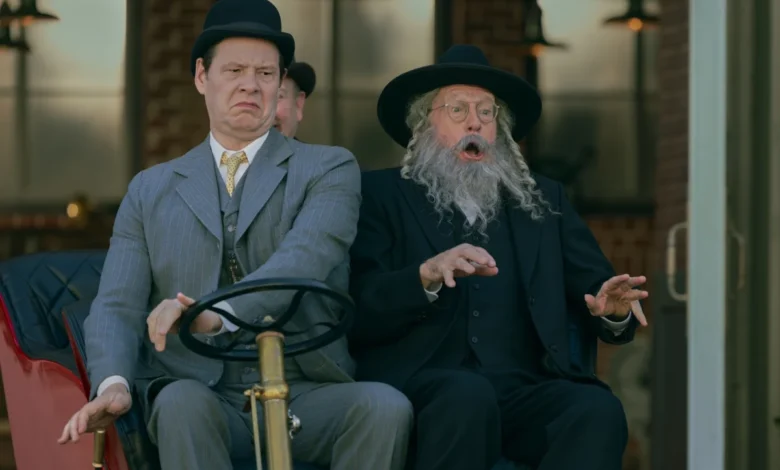
The next sketch features Ike Barinholtz as Henry Ford, expressing displeasure at having his new automobile demonstrated to David’s rabbi character, touching upon Ford’s well-documented antisemitic views. David then takes on the role of President James Buchanan, engaging in awkward flirtations at a party where he is introduced to the concept of passed appetizers. Jordana Brewster and Katie Aselton portray women who encounter Buchanan, while Diallo Riddle plays his assistant.
The episode’s most significant segment revisits a personal anecdote from David’s stand-up routine, portraying the proud mother of Jonas Salk, Dora. She brags about her son’s polio vaccine discovery to her neighbor, Evelyn, played by Judy Gold. This sketch also includes a pointed parody of contemporary vaccine hesitancy, with a young man named Bobby expressing unfounded fears about the vaccine’s safety, drawing a parallel to current public health debates. This element adds a layer of contemporary relevance to the historical context.
Episode 5: "Lincoln"
The fifth installment focuses on two major historical moments. The first is set at the O.K. Corral, where Timothy Olyphant as Wyatt Earp and Don Johnson as Doc Holliday are depicted in a classic Curb-style argument about the logistics of the famous shootout. Marc Menchaca, who previously played a Klansman in Curb, appears as a cowboy who criticizes David’s character’s actions. Johnno Wilson and Maximo Salas round out the cast of this Western-themed sketch.
The second, and perhaps most impactful, segment delves into the strained relationship between Abraham Lincoln and his wife, Mary Todd Lincoln. Bill Hader portrays a beleaguered Lincoln, who, along with his chief of staff, Lawrence Butterfield, conspires to remove Mary from Ford’s Theatre during a performance of Our American Cousin. The sketch culminates in an argument between Butterfield and Mary over a stolen sweater, a scenario that feels remarkably akin to the domestic squabbles often depicted in Curb Your Enthusiasm. Kathryn Hahn portrays Mary Todd Lincoln, and Lennon Parham plays Laura Keene, the actress in the play. Jay Renshaw appears as John Wilkes Booth and Seth Morris as Andrew Johnson.
This series represents a significant cultural moment, bringing together a vast array of comedic and dramatic talent to reimagine American history through the singular comedic vision of Larry David. The show’s ability to blend historical accuracy with David’s signature style of observational humor and awkward social interactions has resonated with audiences, offering a fresh and often surprising perspective on the nation’s past. The involvement of high-profile figures like the Obamas also signals a broader trend of prominent individuals engaging with entertainment platforms to deliver messages and foster dialogue. The detailed casting and thematic exploration across each episode underscore the ambitious scope of Life, Larry and the Pursuit of Unhappiness, solidifying its place as a notable addition to the landscape of streaming comedy.