The Quiet Crisis Behind the AI Boom: Inside the Growing National Backlash Against Data Centers

The rapid and unprecedented expansion of artificial intelligence infrastructure is colliding with a powerful wave of grassroots community resistance across the United States. While technology giants and enterprise customers pitch the construction of new data centers as engines of high-tech job creation and local economic vitality, public opinion polls reveal a different reality. According to recent data from Gallup, a majority of Americans actively oppose the establishment of large-scale data centers in their immediate neighborhoods. These anxieties are rarely abstract; they are rooted in documented concerns over hyper-localized environmental degradation, surging electricity costs, and the heavy resource strains associated with cooling and powering modern computing facilities.
Nowhere is this tension more palpable than in legacy industrial urban centers, where residents who have spent generations living in the shadow of heavy manufacturing and petrochemical refining are drawing a hard line against the next wave of technological development.
From the Streets of Grays Ferry to National Mobilization
For activist Shawmar Pitts, the threat of unbridled industrial expansion is deeply personal. A lifelong resident of the Grays Ferry neighborhood in Southwest Philadelphia, Pitts grew up adjacent to the sprawling Philadelphia Energy Solutions (PES) oil refinery, which at its peak operated as the largest petroleum processing facility on the East Coast. For decades, the massive industrial complex defined the physical and social landscape of the surrounding community.
Throughout his youth and early adulthood, chronic health issues were treated as an unfortunate, yet normal, part of daily life. Friends, family members, and neighbors suffered from persistent respiratory ailments, cancers, and autoimmune disorders. It was not until 2018, when members of the local environmental justice collective Philly Thrive set up informational tables to protest a proposed refinery expansion, that Pitts connected the dots between his community’s systemic health crises and the industrial emissions right outside their windows.

“I read the information they had on the table about how living near the refinery affects you, and I’m looking at all the sicknesses on this paper, and I’m like, ‘My mother has this, my sister has that, my next-door neighbor suffers from this’ — every house, someone has something on that list,” Pitts recalled. “From that point, I was all the way in.”
The stakes of this environmental burden were violently underscored in June 2019, when a catastrophic series of explosions ripped through the PES refinery, sending massive fireballs into the Philadelphia skyline and releasing toxic hydrofluoric acid into the air. While the disaster ultimately forced the permanent closure of the facility, the toxic legacy remained etched into the bodies of the people who lived nearby.
Philly Thrive board president Sonya Sanders lost her husband in 2020 to a rare bone cancer. Sanders, who also grew up along the refinery’s fence line, noted that he neither smoked nor drank, attributing his terminal illness to decades of toxic inhalation. At a prominent rally outside Philadelphia’s City Hall, Sanders delivered a blunt indictment of corporate priorities. “In my eyes, they killed him,” Sanders told the crowd. “The pollution killed him. I believe he would be here today if he wasn’t silently murdered, because it was the pursuit of profit that killed him.”
The AI Gold Rush and the Scramble for Power
Although a modern data center does not process crude oil, the sheer scale of energy required to train and run contemporary artificial intelligence models has created a new kind of industrial footprint. While Philadelphia city officials have not yet received formal construction proposals, municipal planners have already identified two potential sites for data center development: one in Northeast Philadelphia and another directly within Pitts’ Grays Ferry neighborhood.
This scenario is playing out nationwide. As tech conglomerates race to capture market share in the global AI landscape, the demand for electrical grid capacity has skyrocketed. According to forecasts released by BloombergNEF, U.S. data centers are projected to consume more natural gas than Germany and Japan combined by the year 2035—a projection that nearly doubles the firm’s estimates from just nine months prior.

While natural gas burns cleaner than heavy crude oil or coal, its climate and localized environmental impacts are far from negligible. Combustion of a single cubic foot of natural gas yields roughly 60 grams of carbon dioxide. Furthermore, data center expansion is projected to pump an additional one million metric tons of greenhouse gases into the atmosphere daily—representing approximately 12% of contemporary total U.S. emissions.
Public health experts warn that the health toll of fossil fuel dependency will only intensify. Landmark research published by Harvard University in 2021 linked fossil fuel air pollution to roughly one in five deaths worldwide, a staggering baseline statistic that environmental advocates fear will worsen as energy demands escalate.
Grid Vulnerabilities and Emergency Generators
At the Philadelphia City Hall rally, Clean Air Council attorney Annie Fox highlighted a less-discussed operational hazard associated with modern computing infrastructure: backup power generation.
“A typical data center planned in Pennsylvania has hundreds of diesel engines that spew air pollution, and even if they’re supposedly reserved for emergencies, the government has already said that the data center should use those rather than drawing from an overstressed electrical grid during some heat waves,” Fox explained. “We can expect that to get more frequent… Fossil fuel-hungry data centers will worsen climate change, making those heatwaves more frequent and severe.”
The intersection of grid instability and heavy corporate consumption has put public utilities under immense pressure. In regions managed by grid operators like PJM Interconnection, summer heatwaves routinely push power systems to their absolute limits. For local residents, the prospect of sacrificing local grid reliability to power server farms that primarily benefit distant tech headquarters is proving to be a powerful catalyst for political mobilization.

The National Wave of Moratoriums
The growing pushback from communities is increasingly translating into legislative action. State and municipal governments across the country are listening to constituent concerns and hitting the pause button on digital infrastructure expansion.
In New York, Governor Kathy Hochul signed a landmark executive order implementing a temporary state-wide halt on the approval of new permits for large-scale data center projects. “Progress shouldn’t arrive with a higher utility bill, deleted water supply, or noise pollution,” Hochul stated during a press conference announcing the freeze. “These data centers can only be built, should only be built in places that want them.”
Similar regulatory caution has swept across multiple U.S. municipalities. Cities including Denver, Indianapolis, Asheville, Charlotte, and Reno have all enacted formal data center moratoriums or temporary zoning freezes. The primary objective behind these legislative pauses is to grant local governments adequate time to conduct comprehensive impact studies regarding water usage, noise pollution, infrastructure strain, and carbon emissions before locking their communities into multi-decade commitments.
Community Resistance Gains Momentum
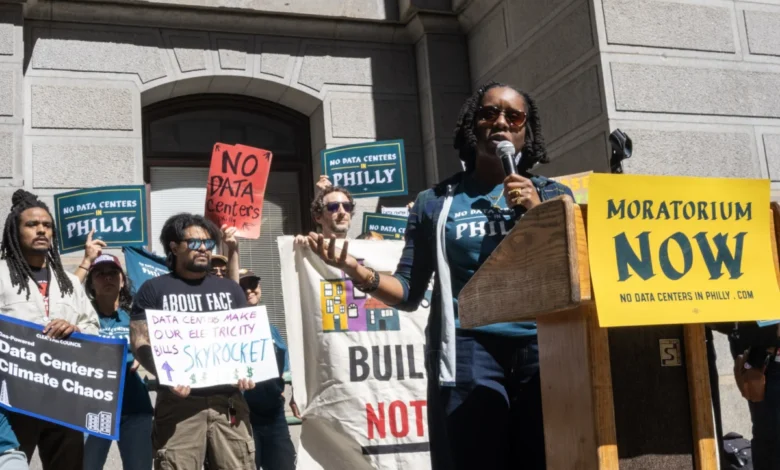
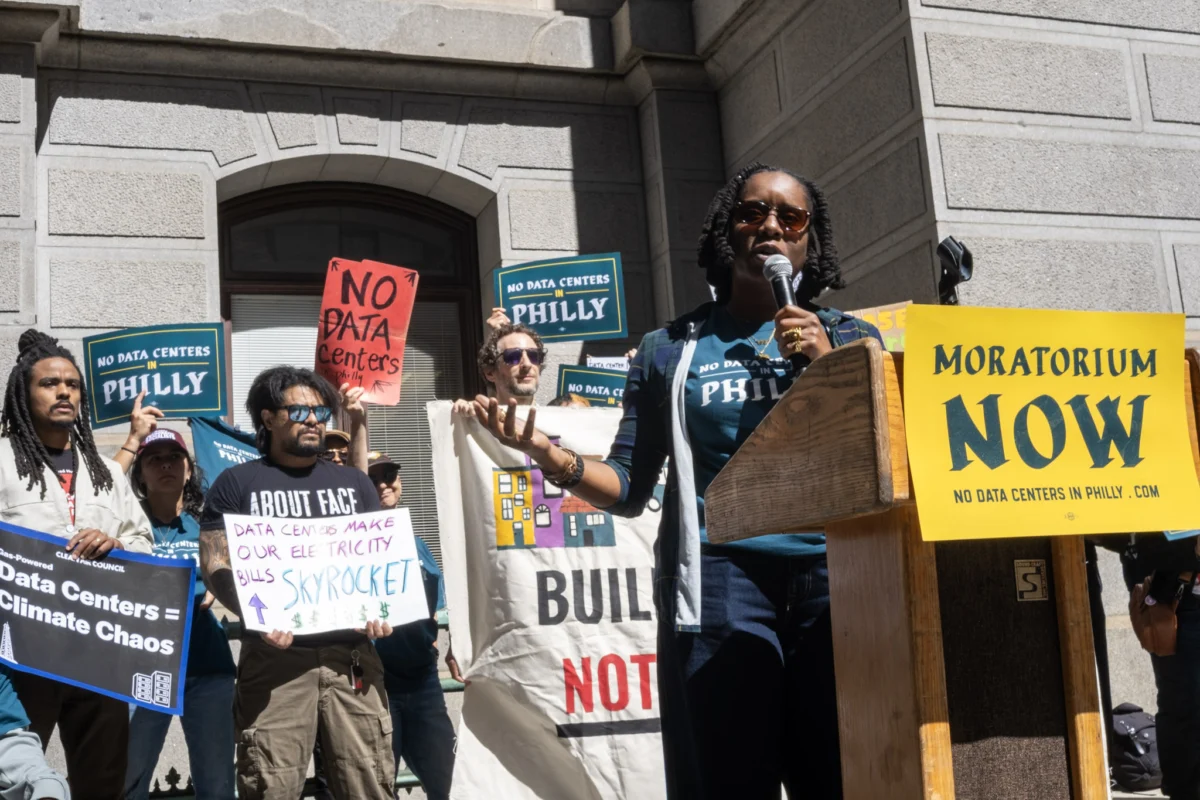
Back in Philadelphia, more than 100 residents and activists gathered outside City Hall to officially launch the "No Data Centers in Philly" campaign. Chanting slogans and holding informational banners, participants aimed to ensure that elected officials inside municipal offices could hear their demands for a permanent moratorium on data center construction within city limits.

Donna Greenberg, a Philadelphia resident who participated in the demonstration, pointed to a matrix of fears shared by many urban communities facing sudden technological interest. “I’m worried about pollution,” Greenberg said. “I’m worried about surveillance and the fact that they’re going to have access to information they have no business knowing, and I’m concerned that they’re going to be using water and electricity that takes away from the people and the neighborhoods who need it.”
For leaders like Shawmar Pitts, who now serves as managing co-director of Philly Thrive, the ability of his neighbors to organize and push back against corporate developments represents a vital shift in how historically marginalized communities engage with urban planning.
“I just think that our community standing up and fighting back is tremendous,” Pitts reflected. “It takes a lot of effort and a lot of people.”
Broader Implications and Industry Outlook
The friction between artificial intelligence expansion and local environmental justice movements highlights a foundational challenge for the tech industry: the physical reality of the cloud. As long as digital infrastructure relies on massive physical facilities that demand millions of gallons of water for cooling and gigawatts of electrical power generated predominantly by fossil fuels, tension with local populations will persist.
For technology companies, the path forward will require unprecedented investments in dedicated renewable energy sources, advanced closed-loop cooling technologies, and rigorous community engagement strategies. Without genuine transparency and enforceable environmental safeguards, the grassroots resistance currently playing out in neighborhoods from Grays Ferry to Reno threatens to create systemic regulatory roadblocks that could slow the pace of American artificial intelligence development for years to come.