Shania Twain Unplugged: Inside the Global Tour Itinerary, Packing Essentials, and Travel Philosophy of Country Music Royalty

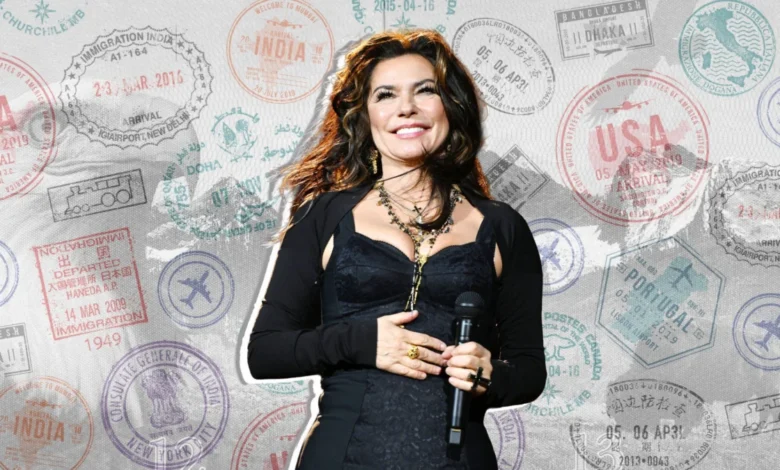
While the average commercial airline passenger packs a carry-on bag with standard travel comforts such as a light sweater, a paperback novel, a digital tablet, electronic chargers, snacks, hand sanitizer, and a sleep mask, global pop and country music icon Shania Twain approaches air travel with an entirely different operational standard. Tucked securely inside her carry-on baggage is not a simple paperback or a change of clothes, but a fully functional, professional-grade mobile recording studio.
For many years, the best-selling female artist in country music history has carried her personal Pro Tools recording setup across international borders. Twain’s mobile rig includes an Apollo audio-processing hardware interface, a professional studio microphone, a high-performance laptop, and the requisite cabling to track vocals and instruments while on the road. Rather than waiting for dedicated studio time between tour stops, the Grammy Award-winning singer-songwriter frequently writes and records fresh material directly from her hotel rooms. This unwavering commitment to her craft underscores a relentless creative drive that has defined her decades-long career, allowing her to capture spontaneous musical inspiration regardless of her geographic coordinates.
This dedication to continuous creation heavily informed her latest musical project, Little Miss Twain, a release that features compositions and productions dating back years, drawing deep thematic inspiration from her adolescent romances and formative years. As a foundational figure who bridged the gap between traditional country and mainstream pop music—selling over 100 million records worldwide—Twain’s perspective on global mobility offers a fascinating glimpse into the life of a touring superstar. Reflecting on her expansive career with travel chroniclers, the iconic performer recently opened up about her earliest milestones in commercial aviation, her extensive touring residencies, her upcoming international itineraries, and the meticulous organizational habits that keep her grounded amidst a whirlwind international schedule.
Evolution of Travel: From Early Commercial Flights to Luxury Tour Buses
Twain’s relationship with transportation has evolved dramatically since her rise to international stardom. When asked about her preferred mode of transit during heavy touring schedules, the singer points directly to the highway rather than the sky. For Twain, the tour bus represents an essential sanctuary of stability in an otherwise nomadic professional life.
"If we’re speaking about touring, bus is my favorite way to travel," Twain notes. "I just love moving into it and then not having to unpack every day. I don’t love living out of a suitcase. I like to settle in; that’s my thing. I like sleeping in small spaces."
This preference for a cozy, stationary environment on wheels contrasts sharply with her early memories of commercial flight. Following the signing of her landmark record deal, which ultimately propelled her to superstardom with multi-platinum albums like The Woman in Me and Come On Over, Twain experienced her first-ever business-class flight on a route from Toronto to Nashville.
That inaugural journey offered a cultural snapshot of a bygone era in commercial aviation. Passengers were still permitted to smoke cigarettes inside the cabin, a practice that presented a distinct challenge for the artist.
"People were still smoking on planes then, and I’m so sensitive to cigarette smoke," Twain recalls. "I thought, ‘Gee, if you’re moving up in the world, do you have the right to say, Do you mind?’ I was so perplexed that people could smoke in business class, but that was the way it was. And I remember the food was better."
Meticulous Packing and Hotel Room Hospitality
To manage the logistical challenges of shifting between international hotels, tour buses, and massive stadium stages, Twain has developed an exceptionally disciplined approach to luggage management. Eschewing the frantic, last-minute packing habits of many frequent travelers, she classifies herself as a deliberately organized packer with a firmly established routine.
"I’m a good packer, a really good packer," she states. "I would say I’m a thoughtful packer, in the sense that I’ve got a good routine down. I pack in categories: I’ll do the shoes, then jewelry, then pajamas, then underwear and socks. Quite organized."
This high level of organization extends directly into her temporary accommodations. Because extended stays in luxury hotels can sometimes isolate artists from the comforts of domestic routines, Twain has engineered a specific protocol to recreate the comforts of home, specifically regarding nutrition and culinary independence.
As an established vegetarian, Twain frequently encounters dietary limitations while navigating foreign cities and standard hotel dining menus. To circumvent these culinary roadblocks, she travels with specific provisions designed to transform a standard hotel room into a functional kitchenette.
"One thing I miss the most when I’m traveling in hotels is not being able to cook," Twain explains. "I love to cook, so I always make sure that there is a really good blender, and that I have things like raw spinach, avocados, tomatoes, and bread—things that I can put olive oil and salt and pepper on and make my own snack without calling room service."
Cultural Immersion: Walking Cities and Historic Architecture
When Twain is not recording music or preparing for high-profile live performances—such as her major 12-night summer residency alongside pop sensation Harry Styles at London’s iconic Wembley Stadium—she prioritizes active cultural immersion. Rather than isolating herself behind security details, the artist prefers to explore her surroundings on foot, seeking out historic architecture, local theater, and green spaces.
During her extended stay in London this past summer, Twain utilized her downtime to deeply engage with the city’s walkable neighborhoods, historic pubs, independent cafes, and theater districts. Her itinerary included visits to Hyde Park—where she enjoys partaking in horseback riding and attending live outdoor concerts—alongside taking in West End productions. She highlights a particularly memorable theatrical experience from the trip: seeing the stage adaptation of Paddington.
"It was extraordinary. It was just adorable," Twain says of the production. "The cast is really exceptional. I mean, the story is great—we all know the story—but I just thought the theater was ideal for the intimacy of it."
When evaluating ideal tour stops and leisure destinations, Twain consistently gravitates toward locations that offer a blend of historical preservation, pedestrian-friendly layouts, and architectural charm. Among her favored North American locations is Quebec City, which she likens to a preserved European enclave on Canadian soil.
"Quebec City is a great place for a day off on tour," she observes. "It’s very Paris-like, this little time capsule—like a little bit of Paris was brought over to Canada. It’s so quaint and beautiful, and on the water. Very walkable as well."
Furthermore, Twain remains a passionate advocate for the rugged, untouched landscapes of her native country. She frequently encourages international travelers to venture beyond major metropolitan hubs and explore northeastern Ontario, the region where she spent her formative years. According to the artist, the true majesty of Canada lies in its vibrant, undisturbed wildlife ecosystems.
"I would recommend people visiting Canada see more of where I’m from, because nature is the most extraordinary," Twain notes. "We’ve got areas where you can go moose watching, for example. You’re not in a zoo. You see all these wild animals and it’s really beautiful."
International Horizons: History, Gastronomy, and Future Itineraries
Twain’s global perspective is deeply shaped by her residential roots and her strategic vacation planning. In addition to her professional bases in North America, the singer maintains a residence in Switzerland, a location carefully chosen to balance personal history with geographical splendor. Growing up in a bilingual town in Ontario provided Twain with a foundation in the French language, a skill she actively maintains by residing on the French-speaking side of Switzerland. Furthermore, the Swiss geography offers a unique blend of seasonal stability and outdoor accessibility that appeals to her Canadian sensibilities.
"The benefit of being in Switzerland is you have the valley and the lakes below, but then you can just drive up for 20 minutes and be on a glacier," Twain explains. "I’ll never give up my four seasons—and being Canadian, I love winter."
When planning dedicated vacations away from the pressures of the recording studio and concert stages, Twain’s decision-making process is anchored by two primary pillars: ancient history and plant-based gastronomy. This dual mandate frequently guides her toward destinations where every city block serves as an open-air museum.
Egypt holds a special place in the artist’s personal travel portfolio, perfectly satisfying her appetite for both historical exploration and specialized cuisine. "One of my favorite places to visit and eat as a vacation trip is Egypt, because it gives me everything I need," she shares. "I like to walk everywhere and see the architecture. That’s a big thing for me—to see history on every block. I love ancient history particularly, and the cities and villages that are museums in themselves. And then, like I said, the food. The Lebanese food [in Egypt] is extraordinary for vegetarians. So that’s a part of the world that I really love."
Despite a decades-long career that has taken her to the world’s most prominent cultural capitals and entertainment hubs, Twain’s travel map still contains notable blank spaces that she is eager to explore. As she looks toward the immediate future, the country-pop pioneer is actively plotting her first expedition to the Indian subcontinent.
Drawing on recommendations from friends and colleagues, Twain has formalized travel plans for the upcoming winter season, with a targeted itinerary leading her to Hyderabad. For an artist whose life on the road is defined by rigorous organization, mobile creative output, and a deep appreciation for regional culinary traditions, the upcoming journey promises a fresh wave of cultural inspiration.
"Even though I’ve been very lucky to travel in my career, there’s a lot of places I haven’t been. I’ve never been to India," Twain reflects. "I’ve got a trip planned this January to Hyderabad, because I have friends from there. I’ve heard so much about [the country], and I know so many people that have gone, but this will be my first experience. And don’t forget, India has the best vegetarian food!"