High Stakes, Vowels, and Vocabulary: Inside the Intense Climax of the New South Wales Premier’s Spelling Bee Finals

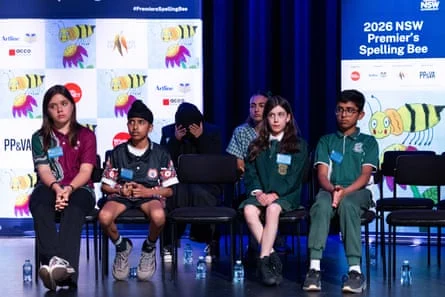
The margin between triumph and heartbreak in competitive spelling can be as thin as a single misplaced vowel, reducing months of rigorous preparation to naught in an instant. This unforgiving reality was on full display inside a packed theatre hall in Penrith, situated in Sydney’s western suburbs, as 34 of New South Wales’ most gifted primary school students squared off in the state finals of the prestigious Premier’s Spelling Bee.
Under the glare of stage lights and the watchful eyes of anxious parents, teachers, and judges, these finalists sat stony-faced, carrying the weight of an entire academic season on their young shoulders. They were not merely participants; they represented the absolute pinnacle of linguistic aptitude in Australia’s most populous state. Having navigated a grueling gauntlet that began months earlier with approximately 200,000 students across 1,070 public schools, this elite cohort comprised the top 0.03% of hopefuls.
As the competition unfolded, it morphed into a marathon of psychological endurance, vocabulary mastery, and sudden-death elimination rounds. When the dust finally settled, Afeef Ahmed emerged as the champion, claiming the ultimate title after an exhausting battle that tested the limits of human concentration and lexicographical knowledge.
The Path to the State Finals: A Nationwide Phenomenon
The New South Wales Premier’s Spelling Bee has evolved significantly since its inception, transforming from a minor interschool activity into a major fixture on the state’s educational calendar. Designed to encourage literacy, improve spelling skills, expand vocabulary, and build public-speaking confidence among primary students, the tournament engages hundreds of thousands of children annually.
The journey to the Penrith stage is an exercise in attrition. Competitors must first conquer their classroom rounds before advancing to school-wide competitions. Successful spellers then progress through fiercely contested online regional finals held in August. Only the top performers from those regional showdowns earn an invitation to the state championships.
The demographics of this year’s finalists underscored the rich multicultural tapestry and geographical diversity of the public school system. Among the 34 finalists, 23 spoke a language other than English at home, highlighting the cognitive benefits of multilingualism in language acquisition. Furthermore, 18 students had traveled substantial distances from regional and rural areas outside the Sydney metropolitan footprint, proving that linguistic excellence is not restricted to city classrooms.
Familiarity with the pressure cooker environment was an asset for a select few. Five students—Wafiq Ayyash of the Hunter region, Bobby Ivaneza of Sydney’s inner west, Ewan Mattick of the state’s central west, Caleb Borg from the Riverina, and Alesha Kahfandi from the Hunter—had qualified for the state finals for three consecutive years. Ayyash entered the arena as the reigning 2024 junior state champion, while Ivaneza sought redemption after finishing as runner-up the previous year.
The Rules of Engagement and the Opening Rounds
The format of the Premier’s Spelling Bee is designed to progressively elevate the difficulty, systematically weeding out competitors who lack deep lexical foundations. Contestants begin the competition by tackling "seen" words—a predetermined list that students are given in advance to practise rigorously at home. However, as the rounds advance, the safety net is pulled away, introducing "unseen" words that test broader linguistic intuition, etymological understanding, and unyielding composure under pressure. Each round is sudden death: misspell a word, and you are immediately eliminated.

ABC presenter and event host Rae Johnston guided the audience and contestants through the tense proceedings, introducing each competitor with lighthearted personal details to break the crushing tension. The humanizing profiles ranged from Archie Griffith’s love of the Parramatta Eels rugby league team and his dachshund puppy to Bobby Ivaneza’s admiration for the historic engineer Nikola Tesla and his sophisticated palate for camembert cheese.
Yet, once the microphone was switched on, the atmosphere shifted instantly from charming to cutthroat. The first round alone claimed seven casualties, as hopefuls stumbled over moderately complex vocabulary such as "tourmaline" and "malapropism." Round two matched that attrition rate, removing another seven competitors when confronted with tongue-twisters like "lepidopterist."
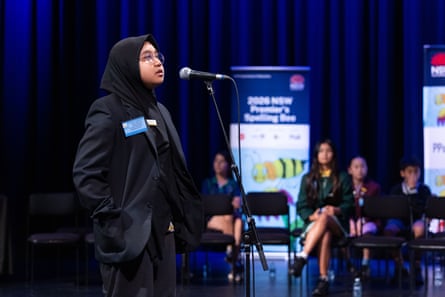
As the rounds ticked past, the linguistic vocabulary scaled vertical cliffs of obscurity. Students were forced to process etymological roots in seconds, relying on auditory cues from the pronunciator without the benefit of seeing the words written down. Ewan Mattick drew cheers from the crowd after successfully navigating "centurion," offering a reassuring thumbs-up to his family in the audience. By round seven, as the psychological toll mounted, Alesha Kahfandi could be seen quietly praying before stepping up to the microphone.
Words such as "pernicious" and "sagacious" swiftly whielded the field down to a final quintet of Year 6 students: Afeef Ahmed, Bobby Ivaneza, Alesha Kahfandi, Caroline Wang, and Maximilian Lumley. Two of these final five—Ivaneza and Kahfandi—were returning veterans, adding a layer of seasoned desperation to the contest.
The Turning Point: Heartbreak and Resilience
Round eight saw all five remaining contestants successfully spell their assigned terms, though cracks in the armor began to show. Ivaneza, who had previously breezed through the earlier tiers with apparent ease, stumbled and was forced to restart his pronunciation before correctly spelling "whimsical."
The definitive turning point arrived in round nine. Ivaneza was assigned the word "unserviceable." In the breathless silence of the hall, he missed the critical second "e."
The realization struck him instantly. Visibly devastated, Ivaneza slumped into his stage seat, burying his face in his hands as the reality of elimination set in. Despite his previous success and status as a seasoned competitor, the sudden-death nature of the bee offered no appeals or second chances. Fighting back tears, he walked off the stage into the crowd to seek comfort in the embrace of his father—a poignant reminder of the immense emotional stakes involved for children operating at this competitive level.
With Ivaneza out, the remaining four competitors faced an intensified barrage of challenging lexicon. Afeef Ahmed cleanly dispatched "immemorial," but his peers quickly faltered. Kahfandi stumbled on "antepenultimate," Wang tripped over the culinary term "parmigiana," and Lumley missed "genealogy" by a single letter. In a sudden flurry of activity, Ahmed found himself standing alone as the champion.
The Battle for Second Place: A War of Attrition
With the championship decided, the tournament directors faced an administrative and logistical anomaly: determining the runner-up between the remaining high-performing students who had fallen in the same overarching tier.
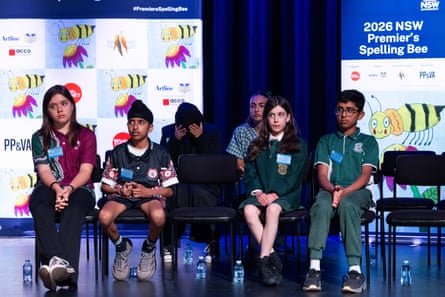
"We are in an interesting situation," Johnston announced to the amused yet exhausted crowd. "We need to play for a runner-up."
What followed was an extraordinary exhibition of endurance. Caroline Wang was eliminated immediately after drawing the formidable word "grandiloquent." This left Alesha Kahfandi and Maximilian Lumley locked in a tense stalemate that lasted for five grueling rounds. Round after round, the pair matched each other step-for-step—either both spelling their complex words correctly or both missing them in tandem.
The audience watched in spellbound silence, with many joking that the event risked exhausting the entirety of the Macquarie Dictionary before a resolution could be reached.
The deadlock finally broke when Kahfandi faltered on the word "vociferous." Stepping forward to claim the runner-up spot, Maximilian Lumley faced his final test: "apocalypse." After taking a deliberate, deep breath to steady his nerves, he delivered the correct spelling cleanly and accurately.
The hall erupted into cheers. Lumley returned to his seat, staring reflectively at the floor, looking visibly drained, akin to a soldier returning from an arduous campaign.
His grandmother, Sue, expressed the collective anxiety of the families in attendance. "It was so stressful, and he looked so calm," she reflected backstage. "He’s worked so hard. Some of those words, I didn’t even know what they were. We’re very proud."
Kahfandi, despite missing out on second place after a phenomenal run, maintained a mature and reflective perspective on her third-place finish. "It was very tense in the room, there was a lot of pressure on everyone," she noted. "I feel a bit disappointed I didn’t get second and I was a bit tired after all those rounds, but getting third place is also really good."
The Anatomy of a Champion: Preparation and Pedagogy
For the newly crowned state champion, Afeef Ahmed, the victory came as a modest surprise, though those closest to him viewed it as the logical culmination of disciplined preparation.
Ahmed revealed that when the final announcement was made, he initially did not comprehend the magnitude of his achievement. "I didn’t realise," he admitted. "But then when they said we had a winner, I felt happy. The runners-up words were harder than the ones I got."
Behind Ahmed’s victory lay a disciplined, long-term training regimen orchestrated in partnership with his family. His mother disclosed that she had dedicated 30 minutes every single night before bedtime to quizzing him over the course of several months.
"He reads a lot," his mother noted, highlighting the correlation between extensive leisure reading and superior linguistic retention. "I knew he would win; he was three-time champion at school."
Broader Implications for Literacy and Education
Education experts and literacy advocates emphasize that events like the Premier’s Spelling Bee serve a purpose far beyond the awarding of trophies and certificates. In an era dominated by digital communication, predictive text, and automated spell-checkers, competitions of this caliber place a vital emphasis on foundational phonics, etymology, and structural grammar.
By delving into the historical roots of English—drawing from Latin, Greek, French, and numerous other language groups—students develop a deeper comprehension of how language functions. This cognitive exercise expands far beyond spelling; it enhances reading comprehension, boosts vocabulary acquisition across academic disciplines, and builds critical resilience.
Furthermore, the public-speaking and performance aspects of the state finals cultivate emotional regulation in young people. Standing alone on a stage, facing public scrutiny, and learning how to process both victory and sudden defeat in front of an audience provide invaluable life lessons in sportsmanship and emotional maturity.
As the 2026 New South Wales Premier’s Spelling Bee concluded in Penrith, the children packed their bags, returning to their respective regional and metropolitan schools. They carried with them memories of immense pressure, triumphant breakthroughs, and the shared camaraderie of a community bound by a deep appreciation for the power of words. For Afeef Ahmed, Maximilian Lumley, Alesha Kahfandi, and their peers, the competition was much more than a spelling test—it was a formative milestone in their educational journeys, proving that mastery over language is one of the most powerful tools a young mind can acquire.