Israel election too close to call as exit polls project no clear winner and anti-Netanyahu bloc leads while Likud remains largest party

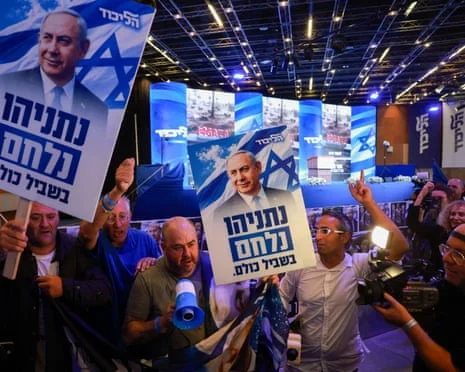
Israel’s high-stakes general election concluded on Tuesday night with an outcome that remains decidedly too close to call following a day of historic voter turnout. Major television network exit polls released after voting stations closed at 10 p.m. local time projected that a majority of Israeli voters have rejected Prime Minister Benjamin Netanyahu’s far-right governing coalition. However, Netanyahu’s right-wing Likud party managed to narrowly emerge as the single largest party in the 120-seat Knesset.
The initial projections set the stage for weeks of intense, high-stakes coalition negotiations and political maneuvering. With neither the pro-Netanyahu camp nor the fractured opposition bloc securing an outright parliamentary majority, the path to forming a stable government remains fraught with uncertainty, raising the possibility of protracted political deadlock or even a future round of snap elections.
Exit Poll Projections and the Parliamentary Landscape

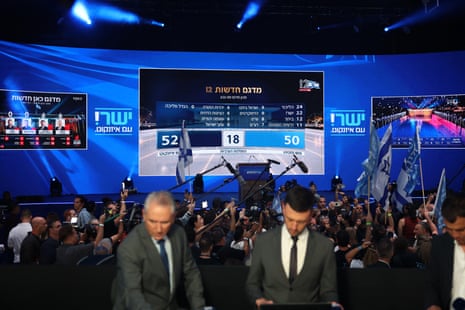
According to exit polling data compiled by Israel’s Channel 12, Channel 13, and Kan News, the bloc of Jewish-led opposition parties opposing Netanyahu holds a slim numerical advantage. The anti-Netanyahu bloc is projected to secure between 52 and 53 seats in the Knesset. Conversely, the parties backing Netanyahu and his existing coalition partners are projected to win approximately 50 seats.
Within these blocs, individual party performances highlight shifting political dynamics. Netanyahu’s Likud party is projected to capture 24 seats, while the centrist Yashar party, led by former Israel Defense Forces (IDF) Chief of Staff Gadi Eisenkot, is projected to win 22 seats.
Crucially, neither political grouping comes close to the 61-seat threshold required to form a majority government in the 120-member Knesset. This parliamentary arithmetic elevates the electoral fortunes of the parties representing Palestinian citizens of Israel. Projections indicate these parties are on track to win a historic 17 to 18 seats, positioning them as potential kingmakers in the post-election landscape. While Eisenkot previously ruled out formal partnerships with Arab-led parties, political analysts note that precedents exist for minority governments relying on external support to unseat long-standing administrations.
Historic Voter Turnout and Election Day Controversies

Tuesday’s election was characterized by unprecedented public engagement, driven by a deeply polarized electorate viewing the vote through an existential lens. By 8 p.m. local time, nationwide voter turnout had surged to 74.3%, according to the Central Elections Committee—surpassing not only the 66.3% recorded at the same hour during the 2022 election but also exceeding the total turnout of 70.6% registered across the entirety of the previous election day.
The surge was notably pronounced among Palestinian citizens of Israel, who make up roughly 21% of the population. Community organizers and election monitors reported long queues and high motivation at polling stations in major towns such as Nazareth and Kfar Qasim, fueled by widespread grievances over systemic discrimination, economic inequality, and the socio-political fallout of the multi-year regional conflict.
The high-stakes voting environment was marked by intense friction and political rhetoric. Early in the day, Prime Minister Netanyahu and far-right National Security Minister Itamar Ben-Gvir deployed aggressive mobilization tactics. Netanyahu issued social media warnings and robocalls alleging irregular voter mobilization in opposition strongholds, while Ben-Gvir appeared near predominantly Palestinian towns to urge right-wing voters to the polls to safeguard a Jewish and Zionist majority.
Opposition figures strongly condemned these tactics. Yair Golan, leader of the left-leaning Democrats party, characterized the messaging as a "poison machine" designed to undermine democratic norms. The tension also manifested physically; the Democrats reported a foiled attempted stabbing attack against Golan by an unidentified assailant at a Tel Aviv campaign event, though security personnel swiftly subdued the suspect and police made an arrest. Furthermore, right-wing parties petitioned the Central Elections Committee for a one-hour extension to voting hours, citing long lines, but the request was rejected on the grounds that existing laws already permit any voter in line by 10 p.m. to cast their ballot.

Background Context and Key Figures
The 2026 election represents the first time Israelis have gone to the polls since the devastating Hamas-led attacks of October 7, 2023, which claimed approximately 1,200 lives—primarily civilians—and triggered a catastrophic multi-front regional war. Over the subsequent three years, Netanyahu’s government presided over the military campaign in Gaza, subsequent escalations involving Iran and regional proxies, and an aggressive expansion of settlement activity in the occupied West Bank accompanied by a surge in extremist settler violence.
Domestically, Netanyahu’s leadership has faced relentless scrutiny. He remains on trial in three separate corruption cases, while his coalition’s legislative efforts to curtail the powers of the judiciary have sparked years of massive street protests and deep societal division.
Facing Netanyahu is Gadi Eisenkot, a relative political newcomer who founded the Yashar party under a banner of administrative competence and personal integrity. Unlike Netanyahu’s polished political persona, Eisenkot presents a modest, unvarnished profile rooted in his military background. While Eisenkot has pledged to address intelligence failures surrounding October 7, introduce universal conscription by ending exemptions for ultra-Orthodox communities, and rein in settler violence in the West Bank, he has remained characteristically evasive on broader diplomatic horizons, offering non-committal stances regarding a definitive two-state solution.
Reactions from Political Leaders
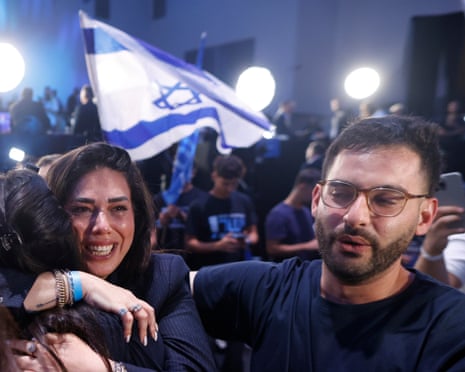
Reactions to the preliminary exit polls varied wildly across the political spectrum, reflecting the deep uncertainty of the parliamentary outcome.
Gadi Eisenkot hailed the exit polls as an indication of a "complete lack of confidence in Netanyahu and the October 7th government" among the mainstream Zionist majority. He stated his immediate intention to work toward establishing a government of national mobilization.
Yair Golan declared that the public had decisively "dismissed" the incumbent administration, framing the results as a historic opportunity to implement genuine political change.
Former Prime Minister Yair Lapid echoed these sentiments on social media, asserting that Netanyahu’s bloc had suffered a "crushing defeat."
Conversely, members of the incumbent administration urged caution. Israeli Foreign Minister Gideon Saar dismissed opposition celebrations as "premature," emphasizing on social media that Likud remained the largest single party in the country.
Implications and the Road Ahead
As the nation awaits the final certified election results—expected by October 30, with official publication scheduled for November 4—the political calculus shifts to President Isaac Herzog. Once final tallies are confirmed, Herzog will consult with leaders of all elected parties before tasking the candidate deemed to have the best chance of forming a governing coalition with a 42-day mandate.
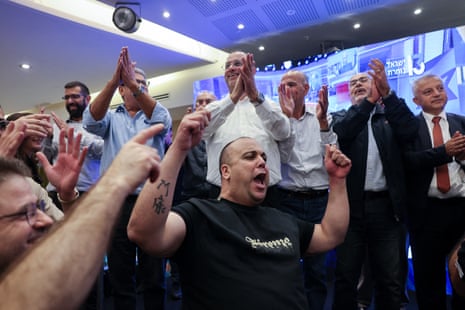
Given the fractured nature of the 120-seat Knesset, the process of coalition-building is widely anticipated to take weeks of intense negotiations, policy trade-offs, and backroom bargaining. Should the anti-Netanyahu bloc fail to forge a viable governing coalition, or should negotiations break down entirely, Israel risks entering a prolonged constitutional impasse, leaving Netanyahu and his cabinet in place as a caretaker government while the prospect of another snap election looms large over the country.