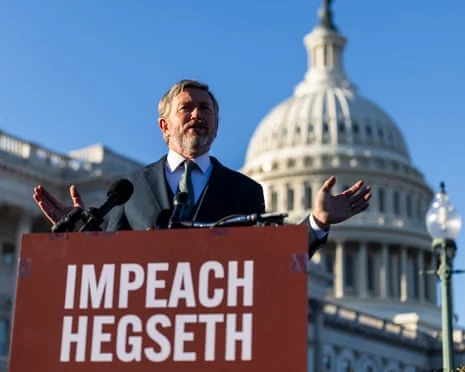
The political landscape in Washington has entered a period of extraordinary turbulence following the 2026 midterm elections, culminating in a high-stakes legislative showdown over the future of Defense Secretary Pete Hegseth. Outgoing Republican Representative Thomas Massie of Kentucky has formally refiled eight articles of impeachment against Hegseth, setting up a mandatory two-day window for the House of Representatives to act. This aggressive maneuver brings long-simmering tensions within the Republican caucus to a boil, driven by deep-seated disagreements over executive overreach, unauthorized military engagements, and the administration’s handling of recent conflicts.
Massie, a conservative libertarian who lost his primary earlier this year and is serving out the remainder of his term, has made it clear that his push is neither symbolic nor personal. As Congress grapples with the fallout of a historic midterm election that saw Democrats flip control of both chambers, the impeachment resolution has injected a volatile variable into an already fractured lame-duck session.
Background Context and the Path to Impeachment
The roots of this impeachment push stretch back months, anchored primarily in congressional pushback against the administration’s military campaign in Iran. Massie and a bipartisan coalition of lawmakers have repeatedly argued that the ongoing conflict—launched without formal congressional authorization—blatantly violates the War Powers Resolution and the United States Constitution.
However, the scope of Massie’s resolution extends far beyond the Middle East. The eight articles of impeachment formally accuse Hegseth of abusing the powers of the Department of Defense through a series of controversial actions both domestically and abroad. Chief among these is a contentious military campaign in the Caribbean involving strikes on unverified watercraft, which human rights groups and defense critics estimate has resulted in over 200 civilian and unverified casualties. Massie has sharply criticized the rules of engagement utilized in these operations, warning that failing to properly identify targets and reportedly targeting survivors sets a dangerous precedent that jeopardizes American service members in future engagements.

Furthermore, the resolution highlights the Pentagon’s aggressive posture toward internal dissent, specifically pointing to Hegseth’s targeting of Democratic Senator Mark Kelly. Kelly, a former Navy captain and astronaut, had publicly urged military personnel to refuse unlawful orders. In response, Hegseth formally censured Kelly, accused him of seditious statements, and moved to strip him of his retired military rank and pension—an unprecedented punitive measure against a sitting lawmaker that was subsequently blocked by a federal judge.
Chronology of Events and Legislative Deadlines
The timeline leading to the current showdown highlights a collision between executive policy and congressional oversight:
- February: A deadly missile strike hits an elementary school in Minab, Iran, resulting in more than 175 civilian deaths. Independent analyses and preliminary defense department inquiries indicate United States military involvement, fueling fierce congressional inquiries.
- September: Massie initially introduces the articles of impeachment against Hegseth. The push is abruptly halted when Republican House Speaker Mike Johnson cancels the final day of legislative votes ahead of the midterm recess.
- Early November: The 2026 midterm elections take place, resulting in a seismic shift in power as Democrats secure majorities in both the House and Senate. President Donald Trump later questions the election results, even as administration officials adjust to the impending shift in Capitol Hill dynamics.
- November 9: Massie officially refiles the resolution on the House floor, forcing leadership’s hand. Concurrently, high-profile officials—including Secretary of State Marco Rubio—defend Hegseth, while Defense officials announce an upcoming Pentagon press conference.
- Current Lame-Duck Window: The House has a strict two-day constitutional window to address the refiled resolution, which could result in a floor vote, referral to a formal committee investigation, or being tabled entirely.
Reactions and Political Implications
The introduction of the impeachment resolution has triggered a sharp division within the federal government. Defense Secretary Pete Hegseth has dismissed the threat, telling reporters that the administration is "not worried about that" and pointing journalists toward a scheduled morning press conference at the Pentagon to address the allegations directly. Secretary of State Marco Rubio strongly defended his cabinet colleague, calling the impeachment push by a fellow Republican "unfair" and praising Hegseth’s professionalism and dedication.
Conversely, Democratic leadership has expressed varied levels of openness to the proceedings. House Minority Leader Hakeem Jeffries indicated strong support for the accountability measures as Democrats prepare to assume the majority gavel in January.
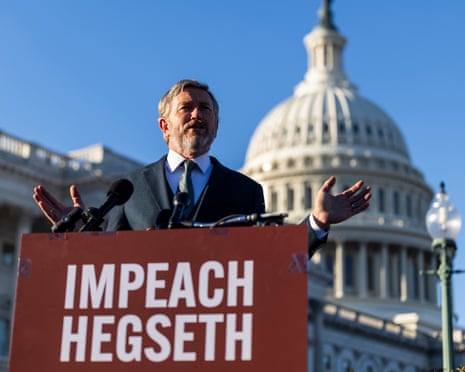
Massie, however, is looking past the current lame-duck session toward the incoming Congress. He warned that if Hegseth remains in office, a Democratic-controlled House will launch a far more expansive inquiry, bringing forward military whistleblowers who served under the defense secretary. Such an investigation, Massie suggested, would likely result in a robust, multi-article trial in the Senate. While removing an official via impeachment requires a steep two-thirds majority (67 votes) in the upper chamber—a threshold that a nascent Democratic majority would struggle to reach without significant Republican defections—the political damage of a prolonged Senate trial could prove fatal to Hegseth’s tenure.
Broader Economic and Geopolitical Ramifications
The timing of the impeachment push coincides with multiple compounding crises for the administration. Beyond the ongoing military entanglements in the Middle East and the Caribbean, the federal government faces a hard funding deadline of December 11, when current stopgap spending measures expire. Failure to pass a continuing resolution before the new Congress is sworn in risks a government shutdown.
Additionally, the administration is navigating sensitive diplomatic talks regarding the Iran conflict, highlighted by President Trump’s recent discussions with Qatari Prime Minister Sheikh Mohammed bin Abdulrahman bin Jassim Al Thani. While the White House maintains that naval blockades and defensive operations have stabilized the region, critics argue that domestic political instability—highlighted by rogue legislative actions from conservative lawmakers like Massie—undermines America’s strategic coherence abroad.
As the House prepares to dispose of the impeachment resolution, the vote will serve as a definitive litmus test for Republican loyalty, executive accountability, and the shifting balance of power in Washington as the nation transitions toward a divided government.