Trump promotes immigration hardliner Stephen Miller to White House chief of staff amid a post-midterms political and market fallout

The political landscape of Washington underwent a dramatic shift as President Donald Trump announced the appointment of Stephen Miller, a long-serving policy adviser and architect of the administration’s aggressive immigration and deportation agenda, as the new White House chief of staff. The transition, scheduled to take effect on Monday, November 9, 2026, comes in the immediate wake of a sweeping Democratic victory in the midterm elections, which resulted in the Republican party losing control of both chambers of Congress.
Miller’s elevation replaces outgoing chief of staff Susie Wiles, who has managed a decade-long presence in Trump’s inner circle and co-managed his successful 2024 presidential campaign. While Wiles transitions to leadership roles within the president’s broader political operations—including the aligned Super PAC Maga Inc.—Miller’s ascent signals a hardening of the administration’s core ideological priorities despite a historical electoral defeat that Democrats have characterized as a clear public rebuke of current executive policies.
The announcement has triggered immediate and fierce reactions across the political spectrum, intensifying legislative friction as a newly empowered Democratic congressional majority prepares to assume office.
A Post-Midterm Shakeup and the Transition of Power
The timing of the staff reshuffle underscores the deep turbulence facing the executive branch following the midterm elections. On Friday, November 6, 2026, President Trump spoke to reporters while traveling to Cape Canaveral, Florida, explaining that the decision to promote Miller stemmed from a simple desire to alter course.
"Susie has done a very good job, Stephen’s been great, and we gotta make moves," Trump remarked, adding that Miller had remained steadfastly by his side since the inception of his political movement. "Sometimes in life you have to make moves."
Susie Wiles, reflecting on her departure in a statement posted to social media, described her tenure as "the honor of a lifetime," highlighting administration milestones such as border security measures, tax cuts, and economic initiatives. However, her exit follows a pattern of high-level administration departures, including former press secretary Karoline Leavitt and her short-lived successor, Katie Zacharia, who stepped down after a turbulent introductory briefing earlier in the year.
Political analysts note that the transition reflects competing internal pressures. Former insiders, such as Calley Means—a former senior adviser to Health Secretary Robert F. Kennedy Jr. who resigned weeks prior to the midterms—have publicly alleged that executive policy decisions were heavily influenced by short-term fundraising goals aimed at financing the midterm campaigns. Means asserted on social media and podcast appearances that the administration’s strategic focus had drifted away from grassroots policy objectives to satisfy donor networks, intensifying internal debates over the direction of the executive branch.
Legislative Outcry and Congressional Investigations
The appointment of Stephen Miller—widely recognized for shaping restrictive immigration policies, travel bans, and mass deportation frameworks—drew swift and condemnation from Democratic leaders poised to take control of the House of Representatives and the Senate.
Representative Hakeem Jeffries, projected to become the next Speaker of the House, did not mince words, describing Miller as a "dangerous xenophobe and reckless extremist" and calling for his immediate removal from public service. Similarly, Representative Robert Garcia, positioned to chair the House Oversight Committee in the upcoming congressional term, issued a stern warning indicating that the panel would expand its scrutiny of executive actions.

"Stephen Miller should lawyer up," Garcia stated, confirming that House Democrats intend to vigorously investigate past administrative misconduct and mount legislative and legal challenges against the administration’s policy agenda.
Senate leadership joined in the rebukes. Senate Minority Leader Chuck Schumer characterized the appointment as proof that the president had failed to absorb the political message delivered by voters during the midterms.
"Stephen Miller is the architect of the most barbaric, inhumane policies of this administration," Schumer said. "Trump couldn’t have made a worse choice. Our Democratic majorities will fight him every step of the way."
Civil rights organizations also mobilized against the appointment. Derrick Johnson, president of the NAACP, issued a scathing evaluation, asserting that Miller’s policy history represented an authoritarian governance model unsuited for the Oval Office.
Internal Administration Reactions and Solidarity Campaigns
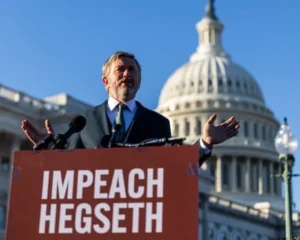
Conversely, staunch loyalists within the administration rallied around Miller’s promotion. Defense Secretary Pete Hegseth, currently navigating separate political challenges and facing a potential impeachment vote, utilized social media channels to endorse the new chief of staff. Posting a collaborative meme featuring the caption "Stand. Fight. Defend the Republic," Hegseth signaled alignment with Miller’s hardline approach.
Health and Human Services Secretary Robert F. Kennedy Jr. similarly voiced strong support, highlighting Miller’s alignment with the "Make America Health Again" (MAHA) initiative. "Next to me, Stephen Miller is the strongest MAHA supporter in the administration," Kennedy wrote online. "It’s time to unleash the Kraken."
Broad Economic and Institutional Fallout
The political tremors coincided with severe market volatility. Wall Street experienced a significant downturn, with the Nasdaq recording its steepest decline in months. Investors expressed mounting anxiety over the potential for increased regulatory scrutiny on the technology sector—particularly artificial intelligence—following the shift in congressional power.
Simultaneously, prominent administration-backed initiatives faced immediate judicial hurdles. A federal judge in Washington D.C., U.S. District Judge Tanya Chutkan, issued a temporary restraining order halting construction plans for a proposed 250-foot triumphal arch championed by the president to reshape the capital’s landscape. The ruling represents another legal setback for executive infrastructure projects, which are expected to face heightened oversight once the new Congress convenes.
At the state and local levels, the electoral shift prompted immediate policy realignments. In Texas, where Democrats achieved historic statewide gains, Houston Mayor John Whitmire announced an executive order limiting local police cooperation with Immigration and Customs Enforcement (ICE) during routine traffic stops. The policy shift highlights the widening chasm between federal enforcement priorities and local governance in major metropolitan areas.
Broader Implications for Governance
As Washington prepares for a divided government and a restructured executive leadership team under Stephen Miller, the political climate remains intensely polarized. With control of both legislative chambers transitioning to the Democratic Party for the first time during Trump’s tenure, the stage is set for profound constitutional clashes over executive authority, regulatory enforcement, immigration policy, and congressional oversight in the remaining years of the term.