High Gas Prices Fail to Spark American EV Surge as Consumers Pivot Toward Hybrid Alternatives

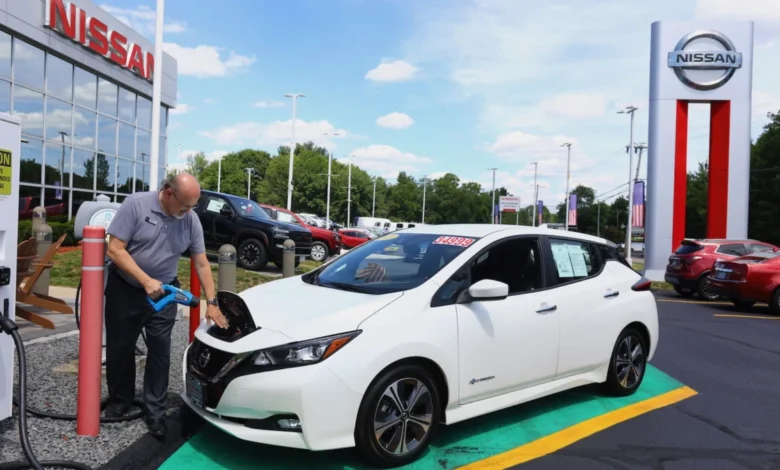
Despite a persistent climb in fuel costs across the United States, the anticipated surge in electric vehicle (EV) adoption failed to materialize this spring, with new data revealing a surprising decline in sales during the month of April. While energy market volatility and geopolitical tensions in the Middle East have historically served as catalysts for green energy transitions, American consumers appear to be bypassing fully electric platforms in favor of hybrid powertrains. This divergence from global trends—where Europe and China continue to see robust EV growth—highlights a significant disconnect between environmental policy goals and the practical economic realities facing the American commuter.
According to the latest market analysis from Edmunds, an automotive research firm, sales of new EVs plummeted by approximately 18 percent between March and April. A separate report from Cox Automotive offered a slightly more conservative but still downward estimate, pegging the decline at roughly 6 percent. Regardless of the specific metric, the consensus among industry analysts is clear: the traditional correlation between high gasoline prices and immediate EV interest has weakened. While consumers are expressing curiosity, that interest is not translating into closed deals at the dealership level.
The Financial Barrier: Analyzing the Upfront Cost Hurdle
The primary deterrent remains the significant price premium associated with battery-electric vehicles (BEVs). Although the long-term operational costs of an EV are generally lower than those of an internal combustion engine (ICE) vehicle, the initial investment remains a formidable obstacle for the average household. Data from Cox Automotive indicates that the average transaction price for a new EV in April was $6,214 higher than its gasoline-powered counterpart.
For many buyers, the "payback period"—the time it takes for fuel savings to offset the higher purchase price—is becoming increasingly difficult to justify. With national average gas prices reaching $4.56 per gallon in late May, a consumer would need to drive more than 40,000 miles to recoup the initial $6,000 premium, assuming their alternative was a fuel-efficient gasoline car getting 30 miles per gallon. This calculation, however, does not account for the additional costs often associated with EV ownership, such as the installation of a Level 2 home charging station, which can range from $500 to $2,000, or the higher insurance premiums frequently charged for electric models due to their higher repair costs and specialized parts.
Ivan Drury, director of insights at Edmunds, noted that while "window shopping" for EVs spiked as gas prices rose, the actual "tire-kicking" and purchasing phases saw a notable lull. "It’s very difficult for people to wrap their head around the idea that spending $55,000 today might save them money over five years," Drury said. "It requires a bit more math than most people want to go through when they are already feeling the pinch of inflation."
The Hybrid Moment: A Pragmatic Middle Ground
As EV sales falter, hybrid vehicles have emerged as the primary beneficiaries of the current economic climate. Utilizing a combination of a traditional internal combustion engine and a small battery-powered motor, hybrids offer a 25 to 45 percent improvement in fuel economy without the "range anxiety" or charging infrastructure requirements of a full EV.
Edmunds data shows that hybrid sales have surged 20 percent year-over-year. More tellingly, since February—coinciding with the escalation of the U.S.-Iran conflict and subsequent energy market jitters—hybrid sales have jumped nearly 50 percent. In comparison, traditional gasoline vehicle sales rose by a modest 11 percent during the same period.
Automakers have been quick to capitalize on this shift. Toyota, a long-time proponent of hybrid technology, has aggressively transitioned its most popular models to hybrid-only configurations. The 2025 Toyota Camry, a staple of the American midsize sedan market, is now exclusively available as a hybrid. The RAV4, currently the best-selling non-pickup vehicle in the United States, has followed a similar trajectory, with its hybrid variants seeing record-breaking demand. Other manufacturers are following suit; for instance, the Honda CR-V Hybrid now accounts for a massive portion of that model’s total sales volume, offering 37 mpg compared to the 29 mpg of the standard gasoline version.
Geopolitical Pressures and the Global Context
The stagnation of the U.S. EV market stands in stark contrast to international developments. In Europe, EV sales experienced a significant leap in April as the war in the Middle East and concerns over the Strait of Hormuz pushed petrol prices to new heights. Simultaneously, China set a new record for EV exports in April, according to BloombergNEF, as its domestic manufacturers continue to scale production and lower costs.
The difference in adoption rates can be attributed to several factors, including more aggressive government subsidies in Europe, a more robust public charging network in Chinese urban centers, and generally higher fuel taxes abroad that make the EV "payback period" much shorter than in the United States. In the U.S., the transition is increasingly being driven by "edge-case" buyers—early adopters and high-income individuals who were already predisposed toward electric technology. For the broader mass market, however, the "nudge" provided by high gas prices is currently steering them toward the more familiar and affordable hybrid option rather than a total shift to electric.
A Bright Spot in the Secondary Market
While new EV sales have struggled, the used EV market is showing signs of vitality. Stephanie Valdez Streaty, director of industry insights at Cox Automotive, pointed to a 3 percent increase in used EV sales from March to April. Crucially, the price premium for a used EV over a used gasoline vehicle has narrowed to just $1,096, making the entry point for electrification far more accessible.
"Used EVs are selling very efficiently," Valdez Streaty noted. "They are spending fewer days on the lot than their gas-powered counterparts." This trend is expected to continue throughout the year as a "glut" of EVs from three-year leases—initiated during the 2021-2022 EV boom—return to the market. This influx of inventory could provide the necessary price correction to bring more middle-income buyers into the electric ecosystem.
Timeline of Market Shifts: February to May 2024
To understand the current state of the market, it is essential to look at the chronology of the past quarter:
- February 2024: Geopolitical tensions rise in the Middle East, specifically involving Iran and the Strait of Hormuz. Global oil markets begin to price in risk, leading to a steady increase in U.S. retail gasoline prices.
- March 2024: Gas prices surpass the $4.00 per gallon mark in many states. Search traffic for "electric cars" and "fuel-efficient vehicles" hits a 12-month high on consumer automotive sites.
- April 2024: Despite the interest, new EV sales data reveals a month-over-month drop (18% per Edmunds; 6% per Cox). Conversely, hybrid sales continue a trajectory that sees them up 50% from February levels.
- May 2024: The national average for gasoline hits $4.56. Toyota and Honda report record hybrid inventory turnover, while some domestic EV manufacturers announce production adjustments to align with slower-than-expected demand.
Implications and Future Outlook
The current trend suggests that the "EV Revolution" in the United States may be entering a period of consolidation rather than exponential growth. Industry experts suggest that the "low-hanging fruit"—consumers who are wealthy, have home charging capabilities, and are environmentally conscious—has largely been harvested. The next wave of adoption will require addressing the "cost hurdle" and the psychological barriers of range and infrastructure.
The Biden administration’s revised EPA tailpipe emission standards and the continued rollout of the National Electric Vehicle Infrastructure (NEVI) Formula Program aim to address these long-term issues. However, in the immediate term, the American consumer’s response to high gas prices is one of pragmatic incrementalism.
"I think this is going to be a hybrid moment," said Valdez Streaty. "There are a lot of options now, and for many families, a hybrid offers the best of both worlds: lower fuel costs without the perceived risks of going fully electric."
As the summer travel season approaches and energy prices remain volatile, the automotive industry will be watching closely to see if the used EV market can maintain its momentum and if the "hybrid moment" evolves into a long-term shift in the American automotive landscape. For now, the "math" of the American commuter remains firmly rooted in the middle ground, favoring the efficiency of the hybrid over the high-voltage promise of the full EV.