US Electric Vehicle Sales Decline Despite Rising Fuel Costs as American Consumers Pivot Toward Hybrid Alternatives

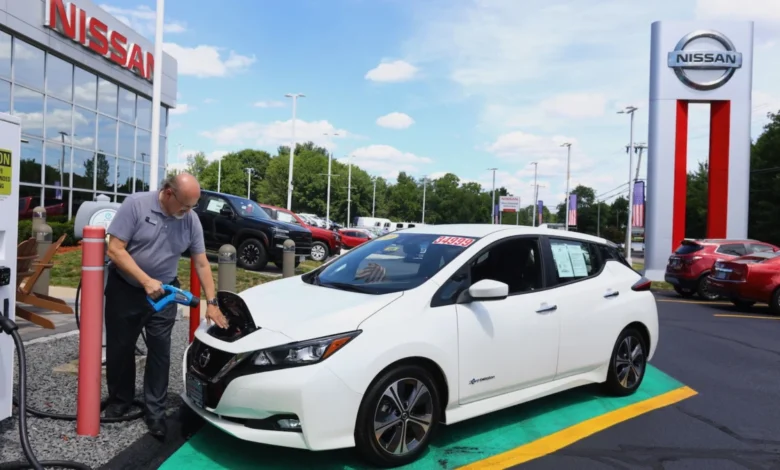
The traditional correlation between surging gasoline prices and a corresponding spike in electric vehicle (EV) adoption appears to be decoupling in the United States. Despite a steady climb in the cost of fuel at the pump, driven by geopolitical instability and the onset of the summer travel season, domestic sales of new electric vehicles experienced a notable contraction in April. This trend stands in stark contrast to global markets, particularly in Europe and China, where EV momentum continues to accelerate. Instead of transitioning fully to battery-electric platforms, American motorists are increasingly gravitating toward hybrid powertrains, signaling a pragmatic shift in the consumer landscape that prioritizes fuel efficiency without the steep upfront costs or infrastructure concerns associated with pure EVs.
According to the latest market intelligence from the automotive research firm Edmunds, sales of new electric vehicles in the United States fell by approximately 18 percent from March to April. While data from Cox Automotive suggested a more moderate decline of roughly 6 percent, the consensus among industry analysts is clear: the anticipated "rush" to EVs prompted by high gas prices has failed to materialize. This stagnation suggests that the American automotive market has reached a critical juncture where the "early adopter" phase has concluded, and the broader mass market remains hesitant to commit to fully electric technology.
The Financial Chasm: Price and the Payback Period
The primary deterrent for the average American consumer remains the significant price premium required to enter the EV market. While the long-term operational costs of electric vehicles—including lower fuel expenses and reduced maintenance—are lower than those of internal combustion engine (ICE) vehicles, the initial investment remains a formidable hurdle. Cox Automotive reported that the average transaction price for a new EV in April was $6,214 higher than its gasoline-powered counterparts.
Stephanie Brinley, a principal automotive analyst at S&P Global Mobility, noted that this "cost hurdle" is difficult for many households to overcome, especially in an era of high interest rates and inflationary pressure. "You don’t know how long it’s going to take to get that back," Brinley remarked, highlighting the uncertainty surrounding the total cost of ownership.
To put the financial math into perspective, with the national average for gasoline hovering around $4.56 per gallon, a consumer purchasing a new EV would need to drive more than 40,000 miles just to break even on the price difference when compared to a fuel-efficient gasoline vehicle averaging 30 miles per gallon. While maintenance savings, such as the elimination of oil changes and exhaust system repairs, can shorten this timeline, other hidden costs often extend it. Higher insurance premiums for EVs, which can be significantly more expensive to repair after a collision, and the necessity of installing a Level 2 home charging station—which can cost anywhere from $500 to $2,000 including labor—further complicate the value proposition.
Ivan Drury, director of insights at Edmunds, observed that while interest in EVs remains high, it is not translating into sales. "There was a lot of window shopping," Drury said, noting that online searches for electrified vehicles were robust throughout the spring. "It did not translate to tire-kicking and purchases. It requires a bit more math than most people want to go through."
The "Hybrid Moment" and the Success of Pragmatism
As EV sales faltered, hybrid vehicles emerged as the primary beneficiary of the search for fuel economy. Hybrids, which utilize a combination of a traditional internal combustion engine and a small battery-electric system to improve fuel efficiency by 25 to 45 percent, offer a middle ground that requires no change in consumer behavior. Unlike plug-in electric vehicles, standard hybrids do not require a dedicated charging infrastructure, alleviating "range anxiety" while still providing significant relief at the pump.
The data reflects a surge in hybrid popularity. Edmunds reported that hybrid sales have increased by 20 percent year-over-year and nearly 50 percent since February. This growth coincided with the escalation of tensions in the Middle East, specifically the U.S.-Iran conflict, which sparked fears of a prolonged energy crisis. During the same two-month period, sales of traditional gasoline-powered vehicles rose by a comparatively modest 11 percent.
Automakers that have leaned heavily into hybrid technology are reaping the rewards. Toyota, in particular, has positioned itself as a leader in this transition. The Japanese automaker recently made the strategic decision to discontinue the gasoline-only version of the Camry, the best-selling sedan in America, making it a hybrid-exclusive model. The 2026 RAV4, one of the most popular SUVs in the world, has followed a similar trajectory. This strategy aligns with the current consumer sentiment that seeks efficiency without the perceived risks of a fully electric lifestyle.
"I think this is going to be a hybrid moment," said Stephanie Valdez Streaty, director of industry insights at Cox Automotive. She noted that the proliferation of hybrid options across various vehicle segments—from compact cars to full-sized pickup trucks—has made the technology more accessible than ever before.
Used EVs: A Growing Secondary Market
While the new EV market faced headwinds, the used electric vehicle segment provided a rare bright spot in the April data. Sales of pre-owned EVs rose by 3 percent from March to April. Perhaps more importantly, the price premium for a used EV over a used gasoline vehicle has shrunk to just $1,096. This near-parity has made used EVs an attractive option for budget-conscious buyers looking to capitalize on high gas prices without the "new car" markup.
Data indicates that used EVs are selling faster than their gasoline-powered counterparts, suggesting a healthy demand for affordable electric options. Analysts expect this trend to continue as a "glut" of EVs enters the secondary market. Many of the EVs leased during the initial surge of 2021 and 2022 are reaching the end of their terms, which will increase inventory levels and likely keep prices competitive.
"They’re really selling efficiently," Valdez Streaty added, noting that the increased availability of used inventory will be a key factor in maintaining EV interest among lower-income demographics throughout the remainder of the year.
Geopolitical Pressures and Global Disparities
The divergence between U.S. and international EV sales is largely attributed to differing economic incentives and infrastructure readiness. In Europe, where gasoline prices are significantly higher than in the U.S. and public charging networks are more mature, EV sales experienced a "leap" in April. Similarly, China reported a record-breaking month for EV exports, according to BloombergNEF, as domestic manufacturers continue to scale production and lower costs.
In the United States, however, the energy market remains volatile. Iran’s ongoing control over the Strait of Hormuz—a vital chokepoint for global oil transit—has kept energy markets on edge. With the summer driving season approaching, analysts predict that gasoline prices will remain elevated or continue to climb. Under normal circumstances, this would serve as a catalyst for EV sales. However, the current U.S. market appears to be limited to what analysts call "edge-case people"—those who were already planning to buy an EV and were simply waiting for a final nudge.
"Dramatic pump readings might nudge them because they were already in that direction," said Stephanie Brinley. "But what we’re unlikely to see is a shift in current internal combustion car owners just fundamentally making that change simply because of gas prices."
Analysis of Implications for the Automotive Industry
The April sales data suggests a potential "reality check" for the ambitious electrification targets set by both the federal government and several major automakers. While the Biden administration has pushed for EVs to account for half of all new vehicle sales by 2030, the current consumer preference for hybrids suggests that the transition may be slower and more incremental than originally forecasted.
For automakers, this shift necessitates a delicate balancing act. Companies that transitioned too quickly away from internal combustion and hybrid technology to focus exclusively on EVs may find themselves with excess inventory and declining margins. Conversely, companies like Toyota and Honda, which were criticized by some environmental groups for their slower move toward full electrification, now find themselves perfectly positioned to capture the current wave of hybrid demand.
Furthermore, the "hybrid moment" highlights a significant gap in the U.S. charging infrastructure. Until public charging stations become as ubiquitous and reliable as gas stations, the mass-market consumer is likely to view the hybrid as the more rational choice. The data from April 2024 serves as a reminder that while environmental concerns and high gas prices are powerful motivators, the American consumer’s final decision is almost always dictated by the immediate bottom line and the convenience of daily use.
As the year progresses, the industry will be watching closely to see if the decline in EV sales is a temporary seasonal fluctuation or a sign of a deeper structural plateau. For now, the "electrification of America" continues, but it is doing so with a gasoline-assisted engine under the hood.