Wildfires Force Shutdown of NASA’s Madrid Deep Space Network Complex Amidst Escalating Global Communication Challenges

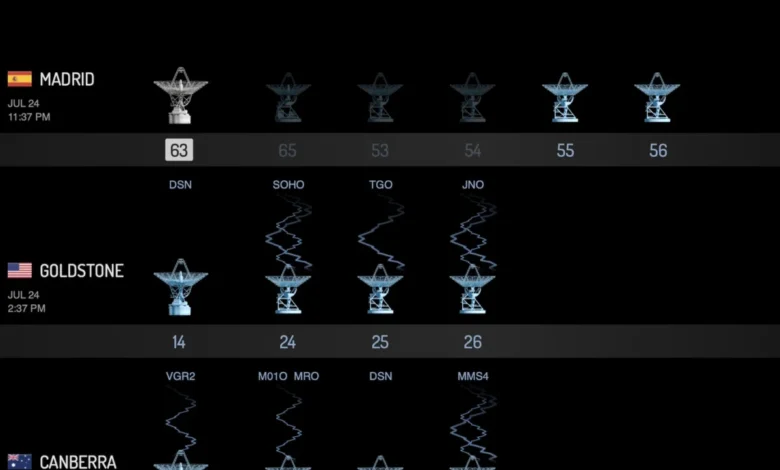
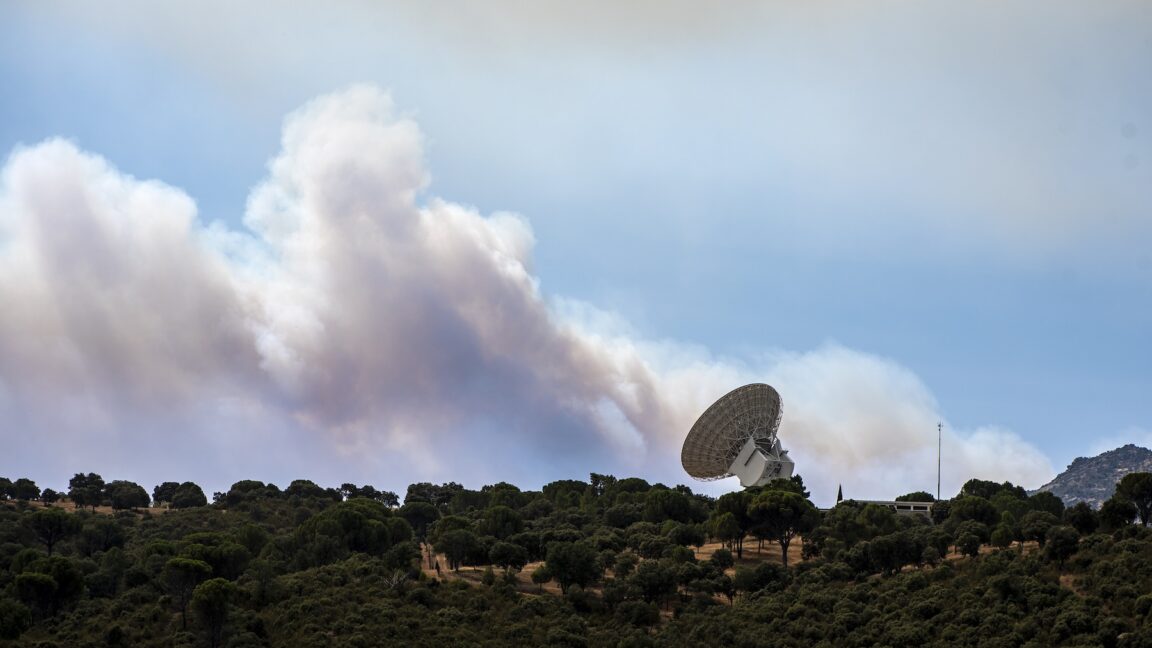
A critical node in humanity’s window to the cosmos, the Madrid Deep Space Communications Complex (MDSCC), part of NASA’s indispensable Deep Space Network (DSN), has been forced offline due to encroaching wildfires in Spain. The abrupt cessation of operations at the facility, located near Robledo de Chavela in the mountains west of Madrid, underscores the growing vulnerability of essential scientific infrastructure to climate-related natural disasters. On Friday afternoon, a NASA website dedicated to providing real-time status updates on DSN complexes visibly displayed no activity at the Madrid site, a stark contrast to the bustling communication streams emanating from its sister stations in California and Australia, which continued to maintain vital links with distant spacecraft such as Voyager 2, journeying through interstellar space, and Juno, diligently orbiting Jupiter.
The Deep Space Network, managed by NASA’s Jet Propulsion Laboratory (JPL), is a global triumvirate of radio antenna facilities strategically positioned approximately 120 degrees of longitude apart. This geographical distribution — at Goldstone, California; Madrid, Spain; and Canberra, Australia — ensures continuous, 24/7 communication with spacecraft across the solar system and beyond, regardless of Earth’s rotation. These immense antennas, some reaching 70 meters (230 feet) in diameter, are the lifeblood for dozens of robotic missions, enabling the reception of scientific data, the transmission of commands, and the precise tracking of spacecraft trajectories over millions, and even billions, of miles. The unexpected shutdown in Madrid leaves the network significantly impaired, especially given pre-existing operational challenges at another key site.
The Genesis of the Crisis: Wildfires in Central Spain
The wildfires that prompted the evacuation and shutdown of the Madrid DSN complex are part of a broader, escalating crisis gripping parts of Spain and other European nations. Fuelled by a persistent summer heatwave and chronic drought conditions, the region west of Madrid has become a tinderbox, leading to rapid fire propagation and posing immediate threats to communities and critical infrastructure. Reuters reported on Friday that Spanish authorities had ordered the evacuation of over 19,000 people from various towns in the affected mountainous areas. The scale of the emergency necessitated the deployment of more than 2,000 firefighting personnel and 10 aircraft, including water-bombing planes and helicopters, in a desperate bid to contain the blazes.
The situation is part of a worrying trend across Southern Europe, where climate change is increasingly manifesting through more frequent, intense, and prolonged heatwaves, exacerbating arid conditions and creating ideal environments for devastating wildfires. Data from the European Forest Fire Information System (EFFIS) consistently highlights Spain as one of the most affected countries in Europe by wildfires, with hundreds of thousands of hectares burned annually in recent years. The current fires near Madrid, while localized, are indicative of a systemic vulnerability that threatens not only human settlements and natural ecosystems but also high-tech scientific installations designed for global endeavors.
Parallel Impact: ESA’s Cebreros Station Evacuated
The severity of the wildfires in the region was further underscored by the evacuation of another crucial space tracking facility: the Cebreros tracking station. This station, owned and operated jointly by the Spanish government and the European Space Agency (ESA), is a vital component of ESA’s Estrack network and is located mere miles from NASA’s DSN facility. The close proximity of these two critical deep space communication hubs meant that both faced an immediate and synchronized threat from the advancing flames, necessitating parallel evacuation procedures.
The Estrack network, much like NASA’s DSN, provides essential communication services for ESA’s missions, ranging from Earth observation satellites to interplanetary probes like BepiColombo, currently en route to Mercury, and the Gaia observatory, meticulously mapping the Milky Way. The simultaneous incapacitation of both the Madrid DSN and ESA’s Cebreros station represents a significant, albeit temporary, reduction in Europe’s deep space communication capabilities, forcing both agencies to re-evaluate mission scheduling and data acquisition strategies.
NASA’s Response and Priority on Personnel Safety
In the wake of the forced shutdown, NASA promptly issued a statement prioritizing the well-being of its staff. "The safety and well-being of our personnel is our highest priority and our thoughts are with the families and neighbors who are also experiencing the impact of the wildfires in the surrounding communities," NASA stated. The agency affirmed its commitment to transparency, adding, "We will provide updates as conditions evolve." This emphasis on human safety is standard protocol in such emergencies, reflecting the profound human element behind even the most advanced technological operations. While the operational impact on space missions is significant, the immediate concern remains the protection of lives and livelihoods in the affected Spanish communities.
A Network Under Strain: The Goldstone Anomaly
The temporary loss of the Madrid complex due to the wildfires comes at an already challenging time for the Deep Space Network. For nearly a year, the 70-meter radio antenna at the Goldstone Deep Space Communications Complex in California, another cornerstone of the DSN, has been offline. This crucial antenna, known as Deep Space Station 14 (DSS-14) or "Mars," sustained significant damage in an unusual incident involving an "over-rotation" of the structure. The precise mechanics of the over-rotation have not been fully detailed, but the incident led to severe damage to critical infrastructure, including internal cables and water lines. The latter resulted in a substantial environmental hazard, flooding the base of the antenna with an estimated 200,000 gallons of water contaminated with glycol, an antifreeze agent.
The repair and cleanup operation for DSS-14 is a complex and costly undertaking. Initial projections estimate the expenses to range between $4.1 million and $4.6 million. NASA officials have strategically opted to combine these essential repairs with already-planned upgrades to the antenna’s systems, aiming to enhance its longevity and capabilities once it returns to service. However, this integrated approach means the antenna is not expected to be fully operational until well into 2028. This long-term outage at Goldstone has already placed considerable pressure on the remaining DSN sites, particularly the 70-meter antenna at Canberra, Australia, which has had to shoulder an increased workload.
The Cumulative Impact: A Precarious Global Posture
With both the Madrid 70-meter antenna temporarily offline and the Goldstone 70-meter antenna out of commission until 2028, the Deep Space Network is currently reduced to a precarious operational posture. The network’s primary heavy-lifting capability, represented by its largest 70-meter dishes, is now almost entirely reliant on a single facility: the Canberra Deep Space Communication Complex in Australia.
While each DSN complex also houses several smaller 34-meter antennas, these dishes, though numerous and versatile, have inherent limitations compared to their 70-meter counterparts. The larger parabolic surface of a 70-meter antenna provides significantly higher gain, enabling stronger signal reception from extremely distant spacecraft and supporting much higher data rates. This is particularly crucial for missions at the outer reaches of the solar system, like Voyager 1 and 2, or for those transmitting large volumes of high-resolution imagery and scientific data, such as the Mars Perseverance rover or the Juno mission at Jupiter.
The current situation creates a logistical bottleneck. Mission controllers at JPL and other space agencies now face a greatly constrained scheduling environment. The reduced capacity means:
- Delayed Data Downlinks: Missions may experience longer waits to transmit their accumulated scientific data back to Earth, potentially affecting research timelines.
- Reduced Data Rates: For some missions, the achievable data rates might be lower, extending the time required for critical data transfers.
- Increased Competition for Resources: With only one fully operational 70-meter antenna, competition among active missions for prime communication windows will intensify. This could lead to difficult prioritization decisions.
- Limited Redundancy: The network’s inherent redundancy, designed to mitigate localized failures or outages, is severely compromised. A problem at the Canberra site, even a minor one, could have cascading effects on global deep space communication.
Engineers and mission planners are undoubtedly working overtime to reconfigure communication schedules, optimize data compression techniques, and explore alternative relay options where possible. However, for missions operating at extreme distances, the 70-meter antennas are often irreplaceable for specific high-bandwidth or low-signal-strength communications.
Artemis Missions: A Timely Reprieve, For Now
Amidst the current operational challenges, there is a silver lining regarding NASA’s ambitious Artemis program, which aims to return humans to the Moon. The Artemis missions, particularly those involving human spaceflight, place exceptionally high demands on the DSN. These missions require continuous, high-bandwidth telemetry for critical health and safety monitoring of astronauts, real-time command uplinks, and massive data downlinks for high-resolution imagery and video.
Fortunately, the most resource-intensive phases of the Artemis program are still several years away. The next mission, Artemis III, is now planned to fly in low-Earth orbit to test the Orion capsule with commercial Moon landers from SpaceX and Blue Origin, rather than a direct lunar landing. The first planned lunar landing with astronauts, Artemis IV, is targeted for no earlier than 2028. This timeline provides a crucial window for NASA to repair the Goldstone 70-meter antenna and, hopefully, for the Madrid complex to resume full operations well before human lunar missions begin to strain the DSN to its maximum capacity.
However, even with this buffer, the margin for error is narrowing. The 2028 target for Artemis IV coincides with the projected return-to-service date for the Goldstone antenna. Any further delays in Goldstone’s repair, or any prolonged outages at the other DSN sites due to unforeseen circumstances, could potentially impact the ambitious Artemis schedule.
Looking Ahead: Resilience and Modernization
The dual blows of the Madrid wildfire shutdown and the ongoing Goldstone repair highlight the critical need for resilience in global space infrastructure. As humanity ventures further into the cosmos, the ground segment — the antennas, control centers, and communication networks — must be robust enough to withstand both technical failures and environmental threats.
NASA and JPL are continually investing in DSN upgrades and modernization efforts. These include enhancing the capabilities of the 34-meter antennas, improving network automation, and exploring new communication technologies like optical communication (laser communication), which could offer significantly higher data rates in the future. Furthermore, international cooperation, such as the long-standing collaboration with ESA’s Estrack network, becomes even more vital in times of crisis, allowing for potential resource sharing and mutual support.
The events unfolding in Spain serve as a potent reminder of the interconnectedness of Earth-bound events and humanity’s reach into space. While the immediate focus is on extinguishing the wildfires and ensuring the safety of communities, the long-term implications for deep space exploration and communication underscore the broader challenges of maintaining a fragile global scientific enterprise in an era of accelerating environmental change. The world watches, both the fires on Earth and the silent signals from distant spacecraft, hoping for a swift resolution to the immediate crisis and a strengthened future for our cosmic connections.