The Unseen Power Grid: How Artificial Intelligence is Reshaping America’s Energy Infrastructure

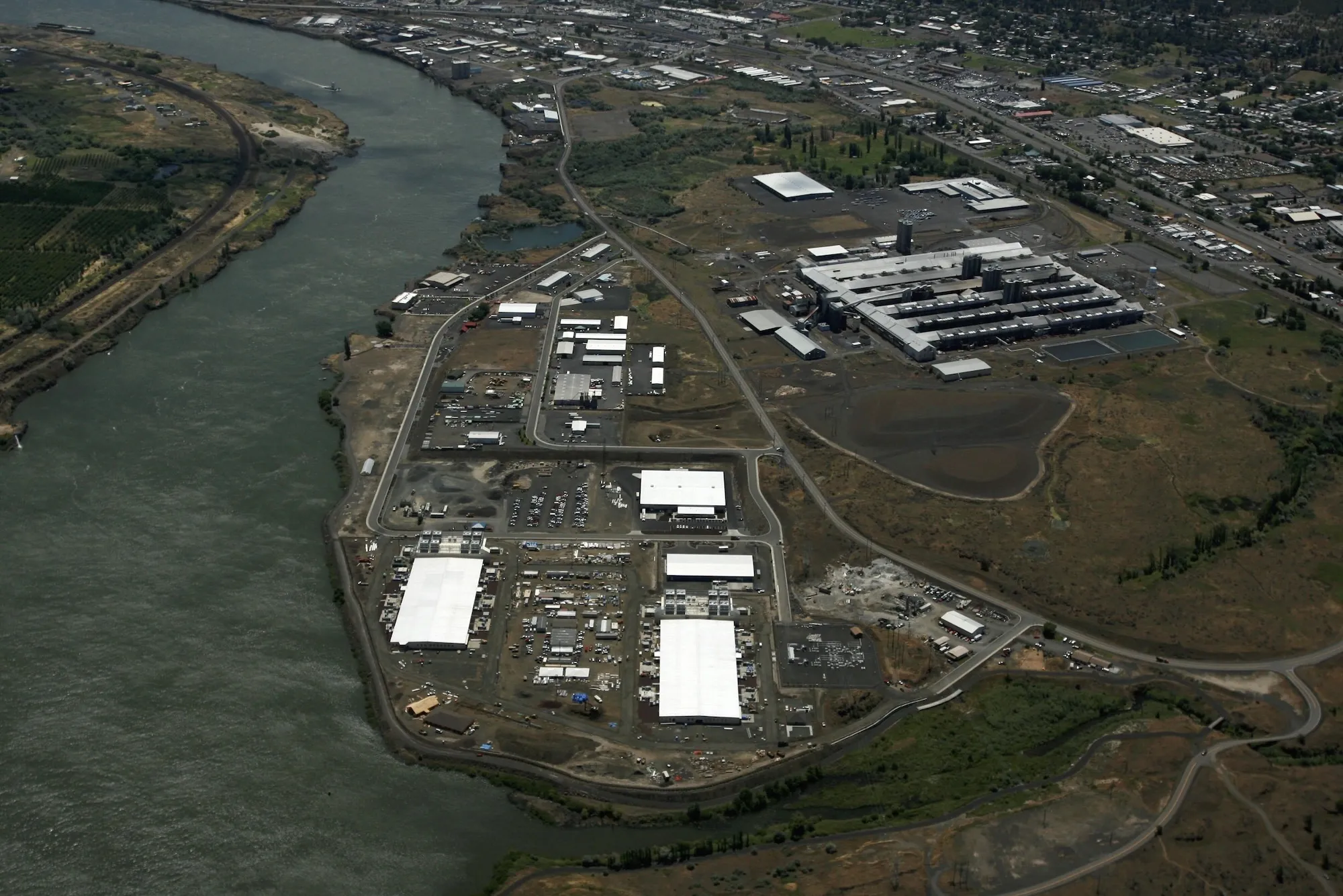
The massive, sprawling computing campuses that underpin the current artificial intelligence boom represent a voracious new class of industrial energy consumer. Powering these facilities requires immense quantities of electricity to run high-performance servers, facilitate complex networking, and maintain the cooling systems necessary to prevent hardware failure. Despite the rapid proliferation of these sites, quantifying their exact electricity consumption has remained a significant challenge for policymakers, largely because data-center operators are notoriously reluctant to disclose granular usage data.
A groundbreaking study published this week in Nature Sustainability, led by researchers at Harvard University, has finally begun to pierce this veil of opacity. By cataloging the locations and physical footprints of 403 hyperscale data centers across the United States, researchers have provided the most comprehensive look to date at the industry’s energy footprint. The authors estimate these facilities consume approximately 82 terawatt-hours (TWh) of electricity annually—a figure equivalent to the total power consumption of nearly 8 million American households. This massive demand is estimated to result in 26 million metric tons of carbon dioxide emissions each year, highlighting a direct link between the progress of generative AI and the acceleration of greenhouse gas output.
The Geography of Energy Demand
While the national average of data-center electricity usage sits at approximately 2 percent of the U.S. total, this aggregate figure masks significant state-level disparities. In certain regions, the energy burden of these facilities has reached levels that threaten to overwhelm local grids and reshape energy economics.
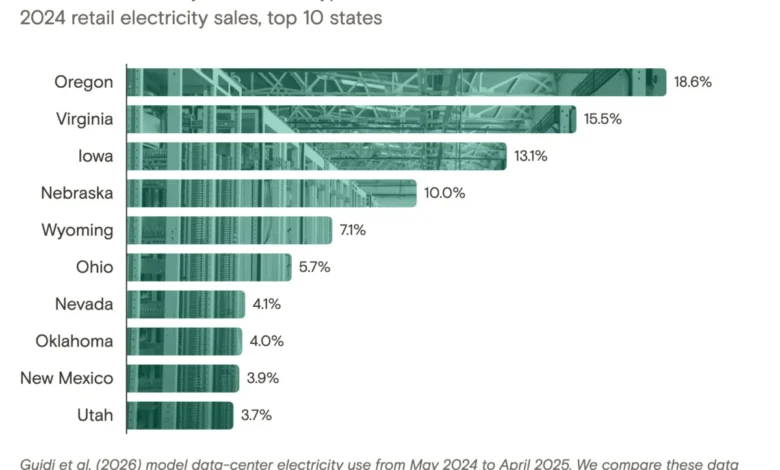
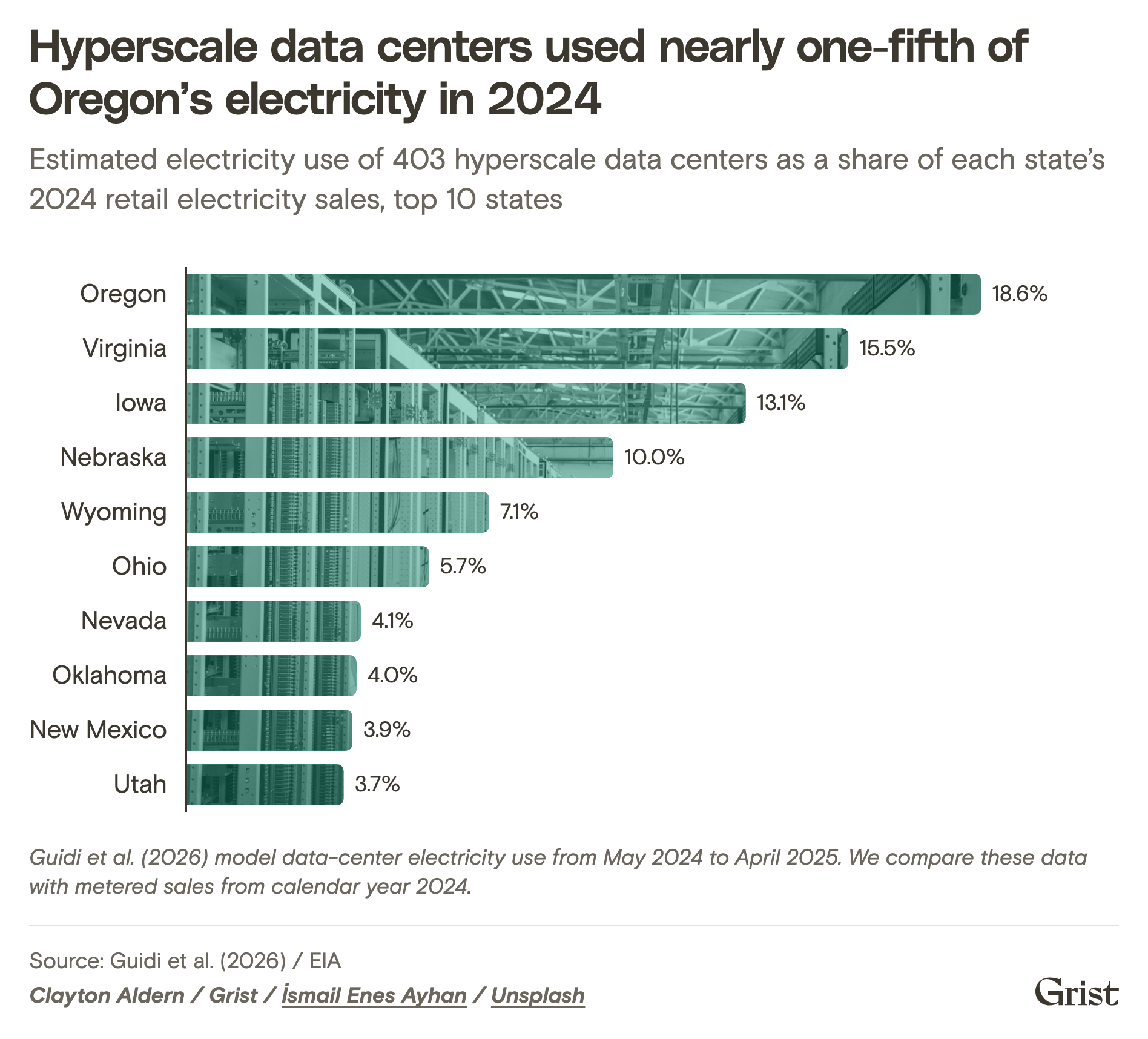
According to the study, which utilized retail electricity sales data from the Energy Information Administration (EIA), Oregon stands at the epicenter of this trend. In 2024, data centers in Oregon consumed the equivalent of 18.6 percent of the state’s total retail electricity sales. Virginia and Iowa followed closely, with data centers accounting for 15.5 percent and 13.1 percent of their respective state loads.
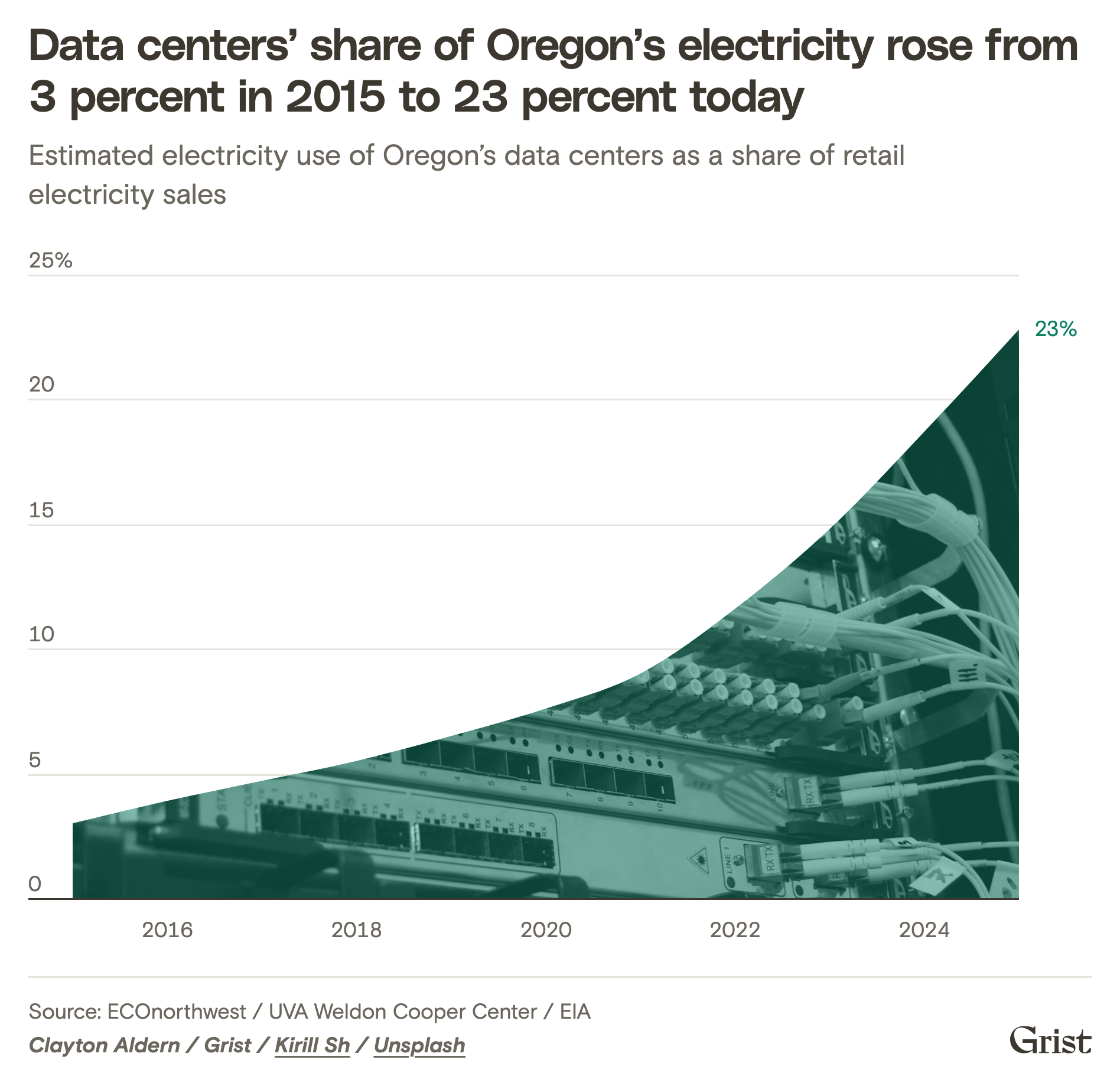
The growth in these states has been exponential. In Oregon, for instance, data centers represented a mere 3 percent of electricity demand in 2015. By 2025, that figure had ballooned to 23 percent. Analysis from the energy economics firm ECOnorthwest suggests that data centers were responsible for nearly 96 percent of the state’s total electricity sales growth between 2020 and 2025. This rapid, industry-driven demand surge has left state regulatory bodies scrambling; the Oregon Department of Energy recently acknowledged in its biennial report that the state currently lacks the policy mechanisms required to address the emissions associated with such localized load growth.
A Lack of Federal Oversight
The current regulatory vacuum is a primary concern for lawmakers. Because utility surveys categorize energy consumption under broad labels—such as residential, commercial, industrial, or transportation—data centers are often hidden within the "commercial" or "industrial" categories, preventing a clear view of their individual impact.
This lack of transparency led Senators Elizabeth Warren and Josh Hawley to address a formal inquiry to the EIA earlier this year. In their letter, the senators argued that without granular reporting, "policymakers, utility companies, and local communities are operating in the dark." Legislative efforts are now underway to correct this. The Bipartisan American Affordability and Jobs Act, currently under consideration in the Senate, includes provisions that would direct the EIA to explicitly track and measure data-center electricity consumption. Such a move would provide the data necessary for states to integrate these high-intensity loads into their long-term energy planning and carbon-reduction goals.
The Carbon Consequence
The climate impact of this energy consumption is inextricably linked to the energy mix of the state in which the facility resides. The Harvard researchers utilized federal power-plant data to calculate the emissions intensity for each of the 403 cataloged facilities. The results are stark: a data center operating in Washington state, which relies heavily on hydroelectric power, produces roughly 10 grams of CO2 per kilowatt-hour. Conversely, a facility in Virginia, which relies on a grid with a higher concentration of fossil fuels, results in roughly 325 grams of CO2 per kilowatt-hour.
Collectively, the emissions generated by the identified hyperscale centers exceed the annual carbon output of entire nations, including Jordan, Kenya, and Guatemala. As these facilities continue to expand, the pressure on the U.S. power grid is expected to intensify, particularly as utilities struggle to balance the needs of AI infrastructure with the decarbonization mandates of the energy transition.
The Rise of "Behind-the-Meter" Power
Perhaps the most significant challenge to tracking this energy surge is the emerging trend of "behind-the-meter" power. To circumvent the constraints of the public grid and secure reliable electricity, many data-center operators are now constructing their own on-site power plants—often gas-fired generators located directly on or adjacent to their campuses.
Because these generators feed electricity directly into the facility, bypassing the public distribution system, their usage often disappears from standard utility metrics. According to the Environmental Integrity Project (EIP), this trend is accelerating rapidly. As of June 2026, approximately 2 gigawatts (GW) of gas generation were already powering data centers across the country, including major sites such as Elon Musk’s xAI facility in Memphis, Tennessee.
Even more alarming to energy planners is the pipeline of future projects. The EIP has identified 143 GW of proposed gas-fired capacity intended to support data centers. This proposed capacity is geographically decoupled from the existing hyperscale map. For example, West Virginia, which hosts none of the 403 facilities identified in the Nature Sustainability study, is now seeing a massive influx of proposals, with over 15 GW of gas capacity currently planned. This suggests a shifting geography of energy infrastructure, where the heaviest industrial energy use is migrating toward states with lower regulatory barriers and easier access to fossil fuel infrastructure.
Implications for the Future
The potential for a massive influx of on-site gas power poses a significant risk to the integrity of U.S. climate policy. While not all proposed projects will reach completion—only about two dozen of the 74 plants currently tracked by the EIP have received permitting under the Clean Air Act—the sheer volume of applications indicates that the hyperscale industry is preparing for a long-term, high-energy future.
Gianluca Guidi, the lead author of the Nature Sustainability study, emphasized that his team’s findings should be viewed as a baseline rather than a final assessment. "What we’re seeing is already striking, but it’s only a snapshot of a rapidly expanding industry," Guidi stated. "The electricity and emissions estimates offered by our team could already be substantially larger now in 2026."
For state officials and utility regulators, the takeaway is clear: the era of viewing data centers as marginal consumers is over. As AI continues to scale, these facilities are becoming the dominant drivers of electricity demand. The ability to monitor this demand, regulate its environmental impact, and integrate it into a sustainable energy future will be one of the most significant infrastructure challenges of the next decade. Without coordinated federal data collection and state-level policy innovation, the growth of the digital economy risks coming at an unsustainable cost to the American power grid and the national climate strategy.