Why the left hemisphere of the human brain governs the right side of the body, and the right hemisphere controls the left, remains one of the most enduring enigmas in neuroscience. This contralateral organization—a fundamental design feature of the vertebrate nervous system—has long puzzled researchers, who often look for functional advantages to explain why such a seemingly counterintuitive arrangement persists. A groundbreaking study published in the journal Frontiers in Neuroanatomy suggests that this anatomical quirk is not necessarily a product of selective advantage, but rather an ancient evolutionary inheritance tracing back over 500 million years to the earliest visual systems of ancestral vertebrates.
The Researchers and the Hypothesis
The study, led by Dr. Martin Wessendorf, a neuroscientist and associate professor emeritus at the University of Minnesota, alongside cognitive neuroscientist Daniel Wang, posits that the brain’s "crossed" connections are a structural byproduct of how evolution built complex neural circuits around the existing optic architecture of early vertebrates. By examining neural pathways in four-limbed animals (tetrapods), the researchers argue that the brain’s contralateral wiring is a conservative evolutionary legacy—a blueprint that was laid down in the primordial oceans of the Cambrian Period and has remained remarkably stable throughout the history of vertebrate life.
The Cambrian Foundation: A Chronology of Connectivity
To understand why the body is cross-wired, one must look at the dawn of the vertebrate lineage. Approximately 538 to 486 million years ago, during the Cambrian Period, the first jawless fish developed rudimentary nervous systems. Central to this development was the optic chiasm—the point where optic nerves from the eyes partially cross.
When light enters the eye, the lens reverses the image, projecting the right visual field onto the left retina and vice versa. To make sense of this, the brain evolved to route information from the right visual field to the left hemisphere, and the left field to the right hemisphere. This required a crossing point, or decussation, at the optic chiasm.
Wessendorf and Wang hypothesize that this established a "template" for how neural pathways should be organized. As subsequent sensory and motor circuits evolved—such as the systems for touch, pain, and movement—the nervous system utilized the existing cross-wired framework as a scaffold. Instead of evolving a new, more "logical" ipsilateral (same-side) connection system, evolution repeatedly repurposed the established contralateral architecture, entrenching it into the vertebrate body plan.
Mapping the Sensory Pathways
The researchers focused on two primary sensory pathways that demonstrate this phenomenon: the dorsal column pathway and the spinothalamic tract.
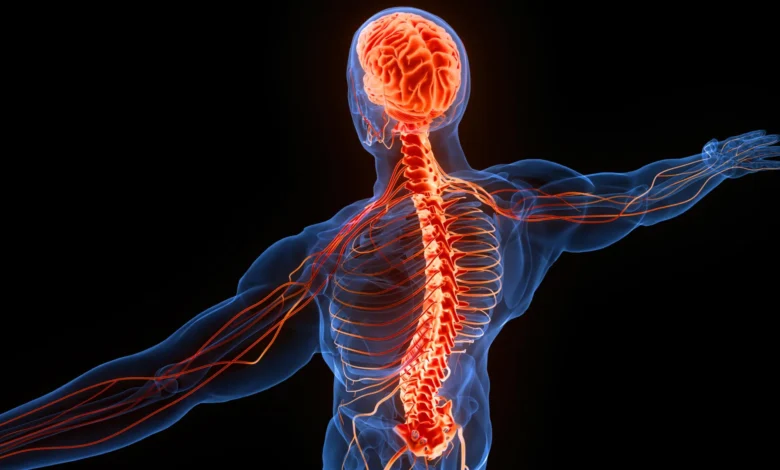
The dorsal column pathway carries high-fidelity information regarding fine touch, vibration, and proprioception (the sense of body position). In tetrapods, these signals travel up the spinal cord and cross to the opposite side at the brainstem. While fish lack this specific pathway, its presence across amphibians, reptiles, birds, and mammals suggests that the arrangement solidified early in the transition to land-dwelling life.
In contrast, the spinothalamic tract, which transmits signals related to pain and temperature, crosses the midline within the spinal cord itself. This pathway has even deeper roots, appearing not only in tetrapods but also in cartilaginous fish such as sharks and rays. The existence of these crossed pathways in widely divergent species underscores a fundamental truth in neurobiology: once a biological "solution" is established, evolution rarely replaces it with an entirely new mechanism if the existing one is functional.
Motor Control and the Tectospinal Connection
The crossed arrangement is equally prevalent in motor control, which governs how the brain commands the body to act. The optic tectum, a midbrain structure known as the superior colliculus in mammals, is a primary site for processing sensory information and initiating rapid movement.
The tectospinal pathway exemplifies this. When an unexpected stimulus—such as a sudden movement in one’s peripheral vision—occurs, the optic tectum processes the location of that stimulus and triggers an immediate physical response. Because the optic tectum represents the opposite visual field, the resulting motor command is automatically directed to the opposite side of the body. This allows an animal to rapidly turn toward a threat or a potential food source. This "reflexive" mapping is found in most tetrapods and serves as a classic example of how sensory and motor systems were co-developed to prioritize efficiency in the face of environmental threats.
The Corticospinal Tract and the Rise of Human Dexterity
Perhaps the most significant development in this evolutionary chain is the corticospinal tract, which is essential for the fine motor control required for human tasks, such as playing a musical instrument or surgical precision.
In the evolution of the cerebral cortex—the six-layered outer covering of the brain unique to mammals—the corticospinal tract began as a system for regulating sensory input. However, in primates and humans, this pathway evolved to reach deep into the spinal cord, directly influencing the neurons that control skeletal muscles.
Wessendorf and Wang suggest that the complex motor skills seen in humans are not the result of a "new" invention, but the adaptation of an ancient sensory-regulatory circuit. By co-opting a pathway that was originally designed to process sensations from the body, evolution granted humans the ability to exert precise, cross-hemispheric control over their limbs. This indicates that human neurological sophistication is layered upon, and constrained by, structures that existed long before the emergence of mammals.
Implications: Inheritance Over Optimization
The study challenges a long-standing teleological assumption in biology: that every feature of the organism must be optimized for a specific survival advantage. Some have argued that crossed wiring might offer benefits for binocular vision or coordination, but Wessendorf and Wang’s findings suggest a more pragmatic reality.
If the crossed wiring were a matter of simple survival optimization, one might expect to see different configurations in various species as they adapted to different niches. Instead, we see a remarkably rigid conservation of this trait across hundreds of millions of years. This suggests that the nervous system is a "historical" organ. It is built in stages, and each new level of complexity must integrate with the levels that preceded it.
Future Directions for Research
The hypothesis presented by the researchers provides a testable framework for future studies in paleoneurobiology. By analyzing the endocasts (the internal impressions of the brain cavity) of fossilized jawless fish, scientists may be able to confirm whether the optic chiasm and optic tectum existed in the configurations predicted by the theory. If fossil evidence confirms these structures in early Cambrian vertebrates, it would provide definitive proof that the cross-wired brain is a 500-million-year-old architectural decision.
Broader Impact on Neurobiology
The implications of this study extend beyond evolutionary theory. Understanding that the brain’s basic organization is a result of historical contingency rather than absolute functional necessity has significant consequences for how we approach neurodegenerative diseases and brain injury recovery.
If our neural pathways are constrained by ancient structures, it suggests that the "plasticity" of the brain—the ability to rewire itself—may have inherent limitations dictated by the very pathways that have persisted since the dawn of vertebrate life. For clinical researchers, this perspective emphasizes the importance of mapping the brain not just as a computer, but as a cumulative evolutionary project.
Ultimately, the work of Wessendorf and Wang serves as a reminder that the human brain is a palimpsest. Every movement of our fingers, every reaction to a sudden noise, and every perception of the world around us is mediated by circuits that were first written into the biological record during the Cambrian Period. We are, quite literally, operating on an ancient, legacy system that has been refined, but never entirely replaced, over the last half-billion years.