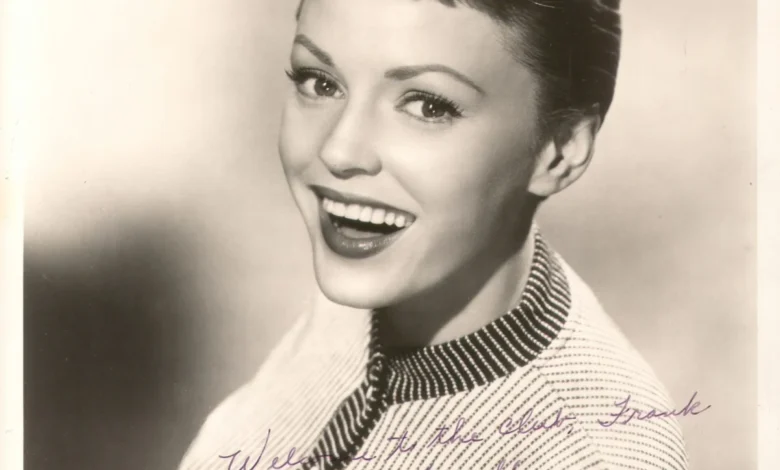
The death of the beloved performer, who was affectionately known to millions as "Pretty Perky Peggy King," occurred on Sunday at the Saunders House Assisted Living facility in Wynnewood, Pennsylvania. Her passing, which followed a protracted battle with Alzheimer’s disease, was officially confirmed by her long-time publicist, Alan Eicher. Her departure marks the end of a prolific career that spanned the transition of American media from the intimacy of radio to the expansive reach of television.
A Career Defined by Mid-Century Stardom
Peggy King’s professional trajectory is inextricably linked to the rise of the variety show format in the 1950s. She first captured the national imagination as a recurring guest on The George Gobel Show, which aired from 1954 to 1957. It was the show’s star, George Gobel, who bestowed upon her the moniker "Pretty Perky Peggy King," a descriptor that captured her infectious energy and became synonymous with her brand for the remainder of her decades-long career.
Her influence during this period was significant, earning her an Emmy Award nomination for Best Female Singer in 1955. That same year, she demonstrated her industry standing by performing the song "Count Your Blessings" at the 27th Academy Awards. By 1958, her status as a household name was solidified when she served as a co-host for the Emmy Awards, a rare achievement for a performer of her era.
Early Life and The Path to Fame
Born on February 16, 1930, in Greensburg, Pennsylvania, to Floyd Henry King and Margaret Finan, Peggy King’s journey toward the limelight began long before she reached national television. Raised in an era where local radio served as the primary cultural gateway, she honed her vocal talents in Cleveland, eventually securing a regular spot on The Mel Torme Show for CBS.
Her early professional life was characterized by a rapid ascent. After moving to California, she signed an MGM contract in 1952. This period provided her with a diverse portfolio of work, including a cameo in the classic Vincente Minnelli film The Bad and the Beautiful, where her vocal contributions were featured on the soundtrack. She also ventured into the comedic sphere, appearing in the cult classic Abbott and Costello Meet the Mummy, proving her versatility across mediums.
The Columbia Records Era and the "Cry Me a River" Connection
King’s recording career reached its zenith under the guidance of legendary producer Mitch Miller at Columbia Records. Miller, known for his discerning—and sometimes controversial—ear, signed King to a long-term contract that resulted in two commercially successful albums and a string of hit singles.
One of the most enduring anecdotes of her career involves the iconic song "Cry Me a River." Composer Arthur Hamilton specifically wrote the torch song for King, envisioning her as the definitive interpreter of the piece. However, in a decision that remains a subject of historical interest among music historians, Mitch Miller famously refused to let her record the song. The track was later famously recorded by Julie London, becoming a jazz standard. Despite this missed opportunity, King’s tenure at Columbia established her as a premier vocalist of the "Great American Songbook" tradition.
A Chronology of Television and Film Appearances
King’s television resume reads like a history of the medium’s golden age. Her ability to transition between music, comedy, and drama kept her in constant demand. A partial chronology of her notable television appearances includes:
- 1954–1957: The George Gobel Show (Regular performer)
- 1955: Academy Awards (Featured performer)
- 1957: Zero Hour! (Feature film role alongside Dana Andrews)
- 1958: Emmy Awards (Co-host)
- 1958–1960s: Frequent appearances on The Tonight Show Starring Johnny Carson, The Steve Allen Show, The Perry Como Show, The Garry Moore Show, The Jack Benny Program, and What’s My Line?
Beyond variety shows, she showcased her acting range in dramatic television programs such as Maverick and Dragnet. Her work in television musicals was particularly well-regarded, notably starring alongside Tab Hunter in Hans Brinker or the Silver Skates and appearing in a celebrated musical adaptation of Jack and the Beanstalk with Joel Grey, Celeste Holm, and Cyril Ritchard.
Cultural Impact and Professional Legacy
The legacy of Peggy King extends beyond her filmography and discography. She was among the inaugural group of entertainers to receive a star on the Hollywood Walk of Fame, an honor that recognized her pivotal role in the development of televised entertainment. In 2010, the Broadcast Pioneers Hall of Fame officially inducted her, acknowledging her contributions to the industry during its formative years.
Her longevity in the performing arts was rare; she continued to perform regularly in Philadelphia, New York, and Los Angeles as late as 2014. Her final studio effort, Songs a la King, was released in 2016, a testament to her enduring passion for music.
Industry Reflection and Broader Implications
The loss of Peggy King represents the closing of a chapter in 20th-century entertainment. As a bridge between the big-band era and the rise of televised pop culture, her work reflected the optimism and professional polish of post-war America. Industry analysts often cite the "variety era" as a time when performers were required to be "triple threats"—capable of singing, dancing, and acting at a high level on a live stage. King’s ability to move from a dramatic role in a thriller like Zero Hour! to a lighthearted musical segment with George Gobel exemplifies the high standards of the era’s performers.
Her death has prompted an outpouring of remembrance from those who recall the warmth and professional dedication she brought to the screen. While there has been no formal statement from the Academy of Television Arts & Sciences as of press time, her impact on the medium remains a subject of study for those documenting the history of American broadcast television.
Personal Life and Survivors
Despite the glamour associated with her career, King maintained a grounded connection to her roots, spending her later years in the Philadelphia area. She is survived by her daughter, Suzy Rudofker, and her son-in-law, Dwain Goforth.
The passing of Peggy King leaves behind a void in the history of American music and television. She remains a fixture of the "Golden Age," a performer whose voice and presence offered a sense of continuity to generations of viewers. Her life and career serve as a historical marker for a time when the television set was the center of the American living room and performers like King were the trusted companions of the viewing public. As the industry looks back on her life, the consensus remains that "Pretty Perky Peggy King" was not merely a nickname, but an accurate reflection of the spirit she shared with the world.