Humanity Hits Ecological Deficit as Earth Overshoot Day 2025 Falls on Earliest Date Ever Recorded

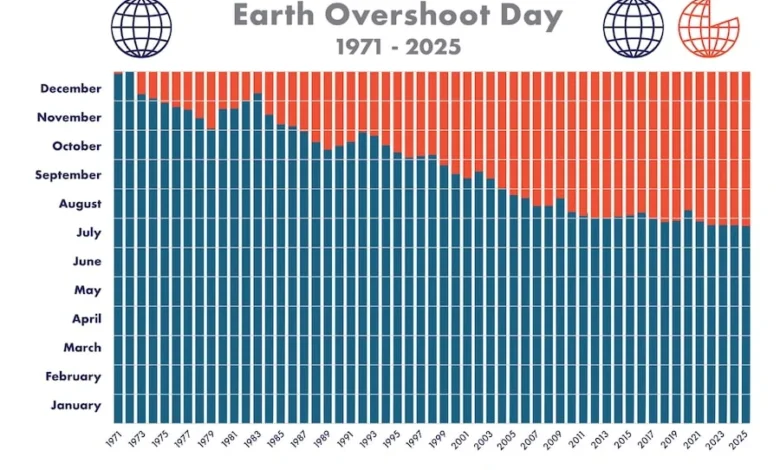
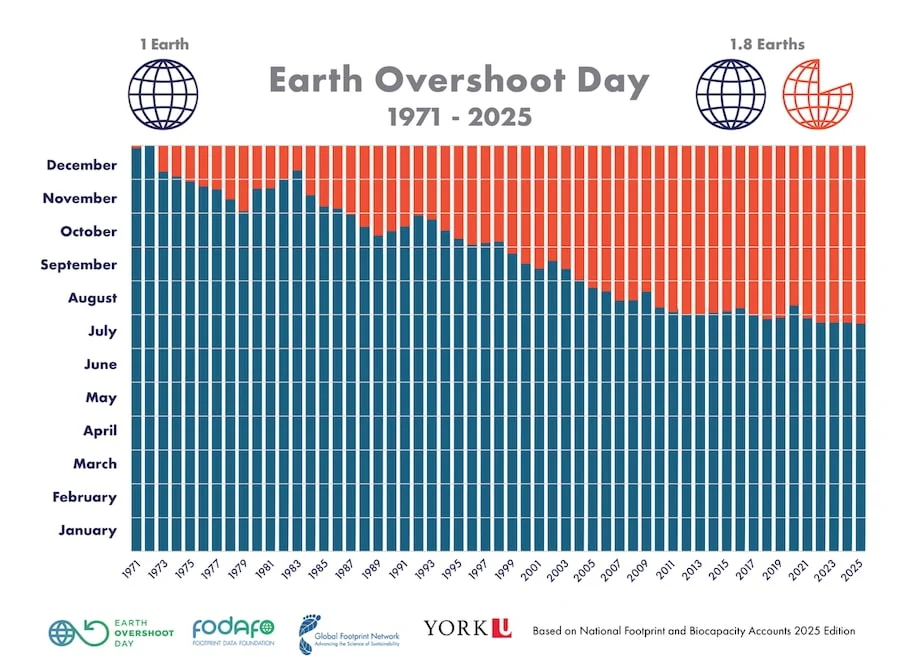
The global community has officially surpassed the planet’s capacity to regenerate its natural resources for the year, marking July 24, 2025, as the earliest Earth Overshoot Day since the metric was first established. This grim milestone serves as a scientific indicator that human consumption of materials—ranging from timber and seafood to freshwater—and the emission of carbon dioxide have fundamentally outpaced the Earth’s biological ability to renew itself. By this date, humanity had already exhausted the budget of natural resources that the planet can sustainably provide for the entire calendar year.
According to data provided by the Global Footprint Network, the organization responsible for calculating this annual threshold, the global population is currently consuming resources at a rate 1.8 times faster than the Earth’s ecosystems can replenish. This means that to sustain current consumption patterns, humanity would require the equivalent of nearly two Earths.
The Historical Context and Evolution of Overshoot
The concept of Earth Overshoot Day was pioneered in 2006 by Andrew Simms, a political economist and campaigner, in partnership with the Global Footprint Network. The objective was to create a tangible, time-based metric that could communicate the abstract complexities of ecological footprinting to a broader audience. Since its inception, the date has consistently drifted earlier in the calendar, illustrating a persistent and accelerating trend of environmental depletion.
To ensure long-term analytical accuracy, the Global Footprint Network recently conducted a comprehensive audit, recalculating data points as far back as the early 1970s. This retrospective analysis reveals a stark decline in planetary health. In 1972, the world was essentially living within its means, hitting the "overshoot" threshold on December 31. By 1979, the date had shifted to November 3. The 1980s saw further degradation, with the date creeping into October. By the time the metric was formally launched in 2006, the world had already moved the date to August 22.
The trajectory continued downward throughout the early 21st century. The July threshold was crossed for the first time in 2018. While brief, anomalous dips—such as the 2020 pandemic-induced slowdown—offered a temporary reprieve, the date has remained firmly in July for the past several years, with the previous record of July 25 being set in both 2022 and 2023.

The Mechanics of Ecological Deficit
The calculation of Earth Overshoot Day is derived from the "National Footprint and Biocapacity Accounts," which track the demand for and supply of nature. The demand side, or Ecological Footprint, includes the land and sea area required to provide the food, fiber, timber, and livestock products we consume, as well as the forest area needed to sequester carbon emissions from fossil fuel use. The supply side, or biocapacity, represents the regenerative capacity of the planet’s ecosystems.
The disparity is driven by three primary categories of consumption:
- Carbon Emissions: The largest component of the ecological footprint is the carbon sequestered by forests. Excessive burning of fossil fuels creates a deficit that the planet’s current forest cover cannot balance.
- Resource Depletion: The over-extraction of biological materials—such as the collapse of certain fisheries and the rapid deforestation of tropical biomes—leaves ecosystems without the necessary time or biomass to recover.
- Freshwater Scarcity: While often harder to map globally, the depletion of aquifers and the contamination of surface water limit the capacity for natural systems to support human and agricultural needs.
Implications of Planetary Boundary Breaches
The urgency of this year’s date is amplified by the broader scientific consensus regarding "Planetary Boundaries." Research from the Stockholm Resilience Centre and other environmental bodies suggests that humanity has already pushed past seven of the nine identified planetary boundaries—safe operating spaces for climate change, biodiversity loss, land-system change, and chemical pollution, among others.
When humanity operates in a state of permanent overshoot, the effects are cumulative. It is not merely that we use more than we produce in a single year; we are effectively liquidating the Earth’s "natural capital." This results in the loss of biodiversity, the thinning of topsoil, and the destabilization of weather patterns that are essential for global food security.
Lewis Akenji, a board member of the Global Footprint Network, emphasized the intergenerational gravity of this trend. "We are stretching the limits of how much ecological damage we can get away with," Akenji stated. "It is now a quarter into the 21st century, and we owe the planet at least 22 years of ecological regeneration, even if we stop any further damage now. If we still want to call this planet home, this level of overshoot calls for a scale of ambition in adaptation and mitigation that should dwarf any previous historical investments we have made."
Pathways to Recovery: The Power of Possibility
Despite the severity of the data, the Global Footprint Network maintains that the trend is not inevitable. Through its "Power of Possibility" campaign, the organization has identified structural changes that could significantly push the date back into the latter half of the year.

Policy analysts suggest that a 50% reduction in global carbon emissions could shift the date by approximately three months, representing the single most impactful lever available to policymakers. Other high-impact strategies include:
- Food Waste Mitigation: Reducing global food waste by 50% would shift the date by 13 days, addressing the massive ecological cost of producing food that is never consumed.
- Renewable Energy Transition: Generating 75% of global electricity from renewable sources would push the date forward by 26 days.
- Systemic Economic Reform: Implementing a global-scale "Green New Deal" could shift the date by as much as 42 days, suggesting that policy-driven, systemic change has a greater impact than individual consumption choices alone.
The Choice Between Design and Disaster
The discourse surrounding Earth Overshoot Day has shifted from a call for awareness to a demand for systemic action. Mathis Wackernagel, co-founder of the Global Footprint Network, frames the current predicament in stark, binary terms. "Because of the nature of physics, overshoot cannot last," Wackernagel noted. "It will end either by deliberate design or dumped-on disaster. It should not be too hard to choose which one is preferable, particularly in light of so many possible choices."
The challenge for the remainder of the 2025 calendar year and beyond lies in the translation of these metrics into legislative action. As nations grapple with the economic impacts of climate change, the data provided by the Global Footprint Network serves as a ledger of the planet’s remaining assets. Whether the international community can pivot toward a circular, regenerative economy before the natural capital base is irreparably eroded remains the central question of the modern era.
The implications of July 24 are not merely environmental; they are economic and social. As the date continues to arrive earlier, the volatility in global commodity markets, the rise in food prices, and the intensification of climate-induced migration are expected to become more pronounced. For governments and private sector leaders, the challenge is clear: the current model of infinite growth on a finite planet is mathematically unsustainable. The transition toward a "one-planet" economy is no longer a matter of environmental preference, but one of fundamental necessity for the stability of human civilization.
Related posts: