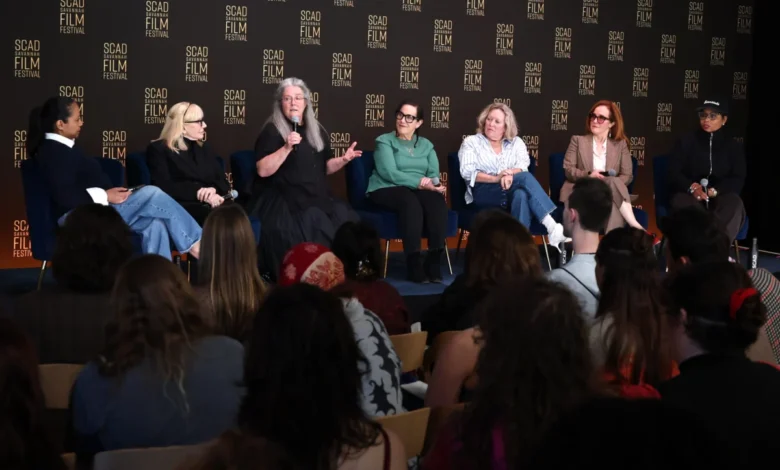
The artistry of costume design remains one of the most misunderstood disciplines in the filmmaking process, frequently reduced to a superficial exercise in retail therapy. However, as industry experts recently affirmed at the SCAD Savannah Film Festival, the reality of the craft is rooted in deep psychological profiling, historical research, and structural storytelling. During the festival’s Costume Design Roundtable, moderated by Variety’s Senior Artisans Editor Jazz Tangcay, a panel of industry veterans—including Molly Rogers, Ellen Mirojnick, Arianne Phillips, Linda Muir, Amy Roth, and Marci Rodgers—dispelled the myth that costume design is synonymous with shopping, instead framing it as a vital pillar of character development.
The Myth of the Stylist versus the Designer
Molly Rogers, a central figure in the aesthetic legacy of The Devil Wears Prada and its highly anticipated sequel, provided a sobering reality check for aspiring designers. For Rogers, the notion that a costume designer’s primary function is to curate high-end fashion is a fallacy that can undermine the integrity of a film. "When someone comes up to me and says, ‘I really want to learn and work with you. I love to shop,’ that’s an automatic exit," Rogers stated.
This sentiment resonates across the industry, where designers must act as anthropologists rather than personal shoppers. The roundtable participants emphasized that while aesthetics are essential, they must serve the narrative arc. If a costume does not communicate the internal state of a character or the socioeconomic reality of their environment, it fails the production, regardless of how "fashionable" it may appear on screen.
Historical Context and the Evolution of the Craft
The role of the costume designer has evolved significantly over the last several decades, shifting from purely functional wardrobe management to an essential element of visual storytelling. Ellen Mirojnick, whose illustrious career includes iconic work on Wall Street, Basic Instinct, and Fatal Attraction, highlighted the dual nature of contemporary design. According to Mirojnick, the challenge lies in capturing the zeitgeist of a specific era while maintaining the heightened reality of cinema.
"In the beginning of my career, I did a lot of contemporary costume, and I loved it," Mirojnick reflected. "I loved being able to document what New York was like at that period, because yes, it was for film, but it also documented the history of what we were like, even if it was an elevated contemporary character."
This historical documentation serves as a critical bridge for audiences. When a character is dressed in a way that reflects the true texture of their time—whether it is the grit of a 1980s New York street or the precise color-coding of a mythological kingdom—the costume becomes a primary source of information for the viewer, often conveying exposition more efficiently than dialogue.
Case Studies in Character Architecture
The roundtable provided a detailed look at how these designers translate scripts into tangible wardrobes. Marci Rodgers, reflecting on her early work on Spike Lee’s She’s Gotta Have It, described the necessity of immersion. Recognizing that her Chicago roots did not align with the specific pulse of New York fashion, she engaged in field research during background casting sessions. For the character of Nola Darling, she sought to reflect personal identity rather than status. By identifying the character’s affinity for Prince, she integrated subtle "tidbits of purple" into a wardrobe sourced largely from thrift stores, successfully avoiding the tropes of luxury retail.
Similarly, Arianne Phillips, whose work on The Invite and Nocturnal Animals has garnered critical acclaim, discussed the friction between creative vision and the influence of studio executives. In an era where films are increasingly reliant on luxury brand financing and product placement, designers are frequently pressured to prioritize corporate partnerships over narrative authenticity. Phillips noted that when executives—who are often disconnected from the lived experience of the average person—dictate wardrobe choices, the character’s authenticity is compromised. "Costume design can be disrespected so easily by people sitting behind desks moving numbers around and not giving you the support you need," she observed.
Technical Precision and Creative Constraints
The panel also delved into the rigorous technical demands of modern filmmaking. Ellen Mirojnick’s work on Christopher Nolan’s The Odyssey involved the production of over 5,300 individual costumes. Her methodology for dressing Anne Hathaway’s Queen Penelope demonstrated a sophisticated use of color and structure to signify character strength. By utilizing "burned red" as a recurring theme for the House of Ithaca, she maintained visual continuity. The climactic reveal—a blue dress designed to function as "armor"—employed fine, tight pleats and a solitary golden necklace to evoke the imagery of a woman standing her ground against long-standing adversity.
Linda Muir’s research for projects like The Northman and Werwulf highlighted the extreme lengths to which designers go to ensure period accuracy. Her deep dive into the historical significance of wool in Viking society—where it functioned as a form of currency and a status symbol—informed the visual language of the films. Muir emphasized that the scarcity of materials in a historical setting often dictates the design process. The struggle to source authentic fabrics, buttons, and accessories is not just a logistical hurdle but a requirement for maintaining the audience’s suspension of disbelief.
The "Sequel Curse" and Reimagining Icons
Molly Rogers shared insights into the psychological weight of reviving beloved projects, specifically addressing the return to the world of The Devil Wears Prada. The challenge of the sequel is maintaining the "perfect storm" of the original while allowing the characters to grow. In one instance, Rogers navigated the iconic "cerulean sweater" from the first film, choosing to recontextualize it as a vest. This creative decision was a direct response to the actor’s performance, proving that the best costume designs are collaborative, living entities that evolve alongside the actors themselves.
Amy Roth’s experience with I Play Rocky further illustrated the burden of cultural memory. Because the original film lacked a dedicated costume designer, Roth had to function as a visual historian, reconstructing the iconic look of Rocky Balboa from a mixture of archival data and collective cultural memory. By sourcing an original vintage jacket on eBay and working closely with actor Anthony Ippolito to replicate the physical posture and presence of Sylvester Stallone, she demonstrated that costume design is as much about kinetic performance as it is about fabric.
The Broader Impact on Film Finance and Production
The intersection of costume design and corporate financing represents the most significant shift in the landscape of the industry. As brands move from being simple product placement partners to becoming essential financiers, the autonomy of the costume designer is increasingly at risk. The panel warned that the future of cinema requires a stronger alliance between directors and designers to ensure that the integrity of the story is not sacrificed for the sake of a brand logo.
The implications of this trend are profound. If costume designers are forced to abandon their role as character architects in favor of acting as brand ambassadors, the medium of film will lose a vital layer of storytelling. The participants in the SCAD Savannah Film Festival roundtable collectively underscored a single, urgent truth: when a costume is chosen for a brand rather than a character, the audience perceives the dissonance immediately.
As the industry continues to navigate the complexities of modern financing and global distribution, the insights provided by these designers offer a roadmap for success. By prioritizing the internal life of the character, utilizing rigorous historical and psychological research, and resisting the pressures of commercial encroachment, costume designers continue to prove that they are the architects of the cinematic experience, responsible for translating the abstract intentions of a screenplay into the tangible, visual truth of the screen.