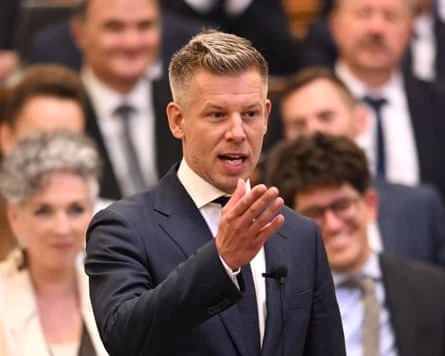
In a pivotal moment reshaping the trajectory of Hungarian governance, President Tamás Sulyok has agreed to step down from his office, effective immediately, after affixing his signature to a landmark constitutional amendment. This transformative legislation, spearheaded and passed by the newly dominant Tisza party of Prime Minister Péter Magyar, marks an unprecedented period of political upheaval and legislative reform in the Central European nation. The amendment, the seventeenth to Hungary’s constitution, explicitly terminates Sulyok’s term, citing a "serious loss of confidence" in a leader who had been elected by lawmakers from former Prime Minister Viktor Orbán’s nationalist Fidesz party as recently as early 2024.
Sulyok, a former constitutional court judge, conveyed his profound reservations regarding the process, stating he felt compelled to "rubber-stamp" the legislation out of respect for the letter of the law, despite his grave concerns. In a poignant statement released on Saturday, he issued a stark warning that the reform had inflicted considerable damage upon the rule of law in Hungary. "The seventeenth amendment to the constitution has marked a watershed in Hungary’s constitutional democracy," Sulyok declared. "By removing public office holders in a manner that openly violates the rule of law… it sets a negative precedent that inflicts a deep wound on the constitutional values of democracy, the separation of powers and the rule of law." His words underscore the profound implications of these changes, signalling a potential erosion of established democratic norms and a contentious redefinition of presidential authority.
The Unprecedented Constitutional Overhaul
The constitutional amendment signed by President Sulyok represents a radical departure from traditional governmental transitions, asserting the right to immediately remove public office holders based on a perceived societal loss of confidence. This mechanism, critics argue, could be weaponized to bypass due process and undermine the stability of institutional roles, including that of the presidency. Sulyok’s background as a seasoned legal scholar and former President of the Constitutional Court lends particular weight to his critique, suggesting that even a commitment to legal adherence could not fully mitigate the systemic risks he identified. His reluctant compliance, juxtaposed with his strong moral and legal admonition, paints a picture of a leader caught between constitutional duty and a fundamental disagreement with the spirit of the new law.
The legislation’s immediate impact on the highest office of the state, barely two years after Sulyok assumed the presidency, highlights the rapid and dramatic shift in Hungary’s political power dynamics. Sulyok had been elected in February 2024 following the resignation of his predecessor, Katalin Novák, who stepped down amidst a scandal involving a controversial presidential pardon. At the time, Sulyok was seen as a safe, technocratic choice, a figure aligned with the Fidesz establishment. His swift removal, therefore, is not merely a change in leadership but a symbolic severing of ties with the previous political era and a clear demonstration of the new government’s intent to consolidate power and dismantle the structures of the former regime.
Magyar’s Ascent and the Dismantling of Orbán’s Legacy
The constitutional amendment is intrinsically linked to Prime Minister Péter Magyar’s ambitious drive to dismantle what he terms Viktor Orbán’s "bastions of power." Magyar’s rise to the premiership in April 2026 followed an unexpected and decisive election landslide that saw his centre-right Tisza party sweep to power, effectively ending Orbán’s formidable 16-year tenure as prime minister. This victory represented a seismic shift in Hungarian politics, with Tisza emerging as a potent force that successfully capitalized on public disillusionment with the long-reigning Fidesz party and its perceived autocratic tendencies.
Magyar, a former insider who broke with Fidesz, quickly became a charismatic opposition figure, galvanizing a broad coalition of voters tired of corruption allegations, perceived democratic backsliding, and the entrenchment of Fidesz loyalists across state institutions. His campaign promised a return to genuine democracy, the strengthening of rule of law, and a more transparent and accountable government. The constitutional amendment and the forced resignation of President Sulyok are among the first major legislative actions of his administration, signalling a robust and uncompromising approach to reforming the state apparatus.
"With these decisions, we are restoring something that the Orbán regime spent many years trying to take away from the Hungarian people," Magyar stated in a Facebook post, outlining his vision for the future. "The certainty that power can be constrained, that public assets can be recovered and that the state can once again serve its citizens, frees Hungarian citizens." This declaration underscores the ideological battle lines drawn between the new Tisza government and the former Fidesz administration, framing the current reforms as a necessary restoration of democratic principles.
The Reaction from the Former Power
The drastic political changes have, predictably, drawn sharp criticism from the ousted Fidesz party and its long-serving leader, Viktor Orbán. Orbán, who critics often accused of systematically weakening democratic institutions during his extensive time in power, took to Facebook to denounce the reforms. His statement carried a chilling warning: "Tyranny is no longer a threat but reality. If this could be done to the president, tomorrow, no one will be safe." Orbán’s rhetoric suggests a profound concern that the new government’s actions, while framed as democratic renewal, could themselves set dangerous precedents for the arbitrary exercise of power.

Indeed, Fidesz has been reeling from its election defeat in April 2026. The party has faced a series of high-profile resignations and a significant decline in public support, marking a stark contrast to its previous near-unassailable dominance. Orbán’s remarks reflect the party’s struggle to adapt to its new role in opposition and to counter the narrative of systemic corruption and democratic erosion propagated by the Tisza government. The speed and scope of Magyar’s reforms appear to be a direct response to Orbán’s long tenure, during which Fidesz solidified its control over the judiciary, media, and various state institutions, leading to frequent clashes with the European Union over rule of law concerns.
The Mechanics of the Transition and Further Reforms
With the Tisza party now commanding a formidable two-thirds majority in the Hungarian Parliament – a supermajority that grants it the power to change any laws, including the constitution – the path is clear for the new government to implement its ambitious reform agenda. Following Sulyok’s resignation, Prime Minister Magyar announced that the parliament speaker, Ágnes Forsthoffer, would assume the role of interim president from Monday. The parliament is then expected to elect a new president, who will serve either until a new constitution takes effect, should Tisza decide to embark on such a comprehensive re-founding, or for a maximum term of five years under the existing framework.
Beyond the presidency, the constitutional amendment encompasses other significant changes aimed at reining in governmental power and reforming key state institutions. It imposes a 12-year term limit on lawmakers, a measure intended to prevent the entrenchment of political figures and encourage fresh perspectives in legislative chambers. Furthermore, it sets a retirement age of 70 for constitutional court judges. This particular provision is expected to have an immediate and impactful consequence, forcing the current president of the constitutional court, Péter Polt – a long-standing ally of Viktor Orbán – into retirement, as reported by Reuters. This move is a clear strategic effort by the Tisza government to depoliticize and rebalance the judiciary, an institution that critics argued had become unduly influenced by the previous Fidesz administration.
Magyar had consistently called on Sulyok to step down even before the constitutional amendment, accusing him of failing to represent national unity on major issues and of serving the interests of Orbán and his government. This sustained pressure highlights the new government’s commitment to ensuring that all branches of power are aligned with its vision of a revitalized, independent democratic state.
Historical Context and Precedents
Hungary’s post-communist democratic journey, since the fall of the Iron Curtain in 1989, has been marked by periods of robust multi-party democracy interspersed with increasing concerns over democratic backsliding, particularly during Viktor Orbán’s extended premiership from 2010 to 2026. Orbán’s Fidesz party, known for its nationalist and conservative ideology, systematically centralized power, implemented numerous constitutional amendments, reformed the judiciary, and exerted significant control over public media. These actions frequently drew criticism from the European Union, which raised concerns about the erosion of the rule of law, judicial independence, and media freedom. The EU initiated several infringement procedures and even withheld funds, highlighting the deep divisions between Brussels and Budapest over democratic values.
The current events, therefore, can be seen as a direct counter-response to the Orbán era. Péter Magyar’s movement, born out of this context, positioned itself as a champion of democratic restoration. However, the methods employed by the new government, particularly the constitutional amendment facilitating the immediate removal of a president, also raise questions about the potential for a new form of power consolidation. While framed as necessary to undo previous damage, such rapid and profound changes, especially those touching upon the fundamental principles of the constitution and the separation of powers, inevitably invite scrutiny.
Broader Implications for Hungarian Democracy and the EU
The swift and comprehensive constitutional overhaul initiated by Prime Minister Péter Magyar’s Tisza government carries significant implications for Hungarian democracy and its relationship with the European Union. On one hand, supporters argue that these reforms are essential to dismantle an entrenched system of power that had, over years, weakened democratic checks and balances. The removal of a president perceived as a remnant of the old regime, along with the imposition of term limits and judicial retirement ages, could be viewed as crucial steps towards revitalizing democratic institutions and fostering greater accountability. Magyar’s promise to restore "certainty that power can be constrained" resonates with a segment of the population that felt disenfranchised by the previous administration.
On the other hand, the manner in which these changes have been enacted, particularly the immediate termination of a presidential term via a constitutional amendment, could set a controversial precedent. Critics, echoing President Sulyok’s warnings, fear that such actions, even if aimed at correcting past wrongs, could inadvertently undermine the very principles of rule of law and constitutional stability they purport to restore. The rapid pendulum swing from one powerful government to another, each leveraging its parliamentary majority to reshape fundamental laws, raises questions about the long-term resilience of Hungary’s democratic framework.
For the European Union, the developments in Hungary present a complex scenario. For years, the EU grappled with Viktor Orbán’s government over rule of law issues, often finding itself in a stalemate. The arrival of a new, seemingly pro-European and reform-minded government under Péter Magyar could open a new chapter, potentially alleviating some of the tensions. However, the EU will undoubtedly scrutinize the nature of these reforms, ensuring that they genuinely strengthen democratic institutions and uphold European values, rather than simply replacing one form of consolidated power with another. The international community will be closely watching to see if Magyar’s government can navigate this delicate balance, delivering on its promise of democratic renewal while strictly adhering to constitutional principles and due process. The future of Hungary’s political landscape, now under the stewardship of the Tisza party, remains a subject of intense domestic and international interest and analysis.
Chronology of Key Events Leading to Sulyok’s Resignation
- February 2024: Katalin Novák resigns as President of Hungary following a public outcry over a controversial presidential pardon. Tamás Sulyok, a former constitutional court judge and ally of the Fidesz government, is elected by the Fidesz-dominated Parliament to succeed her.
- Late 2024 – Early 2026: Péter Magyar, a former Fidesz insider, emerges as a prominent opposition figure, forming the Tisza party. His movement gains significant momentum, capitalizing on public dissatisfaction with the Fidesz government and allegations of corruption and democratic backsliding.
- April 2026: In a stunning electoral upset, the Tisza party, led by Péter Magyar, achieves a landslide victory in the general election, securing a two-thirds majority in the Hungarian Parliament. Viktor Orbán’s 16-year premiership comes to an end, and Péter Magyar assumes the role of Prime Minister.
- Immediately Following April 2026 Election: The new Tisza government, now with a supermajority, swiftly moves to introduce a series of legislative reforms aimed at dismantling the structures of the previous administration. Among these is the seventeenth constitutional amendment.
- Date of Article’s Events (Presumed April/May 2026): President Tamás Sulyok, under intense political pressure and facing a constitutional amendment that effectively removes him, signs the legislation. He then announces his resignation, expressing profound concerns about the rule of law implications of his removal. Prime Minister Péter Magyar announces Parliament Speaker Ágnes Forsthoffer as the interim president.
- Ongoing: The Tisza government begins the process of electing a new president and implementing other reforms outlined in the constitutional amendment, including term limits for lawmakers and a mandatory retirement age for constitutional court judges.
Related posts: