What Is Global Payroll
What is Global Payroll? A Comprehensive Guide for Businesses
Global payroll refers to the process of managing payroll operations for employees who are located in multiple countries. It encompasses a wide range of activities, including calculating wages, deducting taxes and social security contributions, processing payments, and ensuring compliance with local labor laws and regulations across different jurisdictions. For businesses with international operations, or those looking to expand globally, a robust and efficient global payroll system is critical for smooth operations, employee satisfaction, and legal adherence. This complexity arises from the fact that each country has its own unique tax codes, statutory deductions, payment frequencies, reporting requirements, and currency exchange rates, all of which must be meticulously managed.
The core function of global payroll is to accurately and promptly compensate employees worldwide while navigating the intricate web of international compliance. This involves more than just sending out paychecks. It demands a deep understanding of varying employment laws, tax treaties, benefits structures, and reporting obligations in each country where a business has employees. Failure to adhere to these regulations can result in severe penalties, including fines, legal action, and reputational damage. Therefore, establishing a streamlined and compliant global payroll process is paramount for any organization with an international workforce.
Understanding the fundamental components of global payroll reveals its multifaceted nature. Firstly, there’s the calculation of gross pay. This involves determining base salary, hourly wages, overtime pay, bonuses, commissions, and any other forms of remuneration. Each country will have specific rules regarding overtime calculations, minimum wage requirements, and the definition of working hours, all of which must be factored in. Secondly, deductions form a significant part of the payroll process. This includes statutory deductions such as income tax, social security contributions (e.g., pension, healthcare, unemployment), and mandatory insurance. Additionally, voluntary deductions like health insurance premiums, retirement plan contributions, and union dues must also be managed according to local legislation and employee agreements.
Thirdly, net pay calculation follows the deductions, determining the actual amount an employee receives. This necessitates understanding currency conversions and local banking practices. Fourthly, payment processing involves the secure and timely transfer of funds to employees’ bank accounts, adhering to country-specific payment methods and timelines. This can involve local bank transfers, international wire transfers, or even specialized payment solutions. Fifthly, reporting and compliance are ongoing and critical aspects. This includes generating payslips, submitting tax filings to relevant authorities, providing end-of-year tax reports, and maintaining accurate payroll records as per local legal requirements.
The complexity of global payroll is amplified by several key factors. Varying Tax Regulations are a primary driver. Each country has its own progressive or flat tax rates, different thresholds for taxability, and unique rules for taxing different types of income. Tax treaties between countries can also influence how income is taxed, requiring careful consideration to avoid double taxation. Social Security and Statutory Contributions differ significantly. The types of contributions, contribution rates for both employers and employees, and the eligibility criteria for benefits vary widely. For instance, a country might have a comprehensive healthcare system funded by mandatory contributions, while another might have a more limited social safety net.
Employment Laws and Labor Regulations present another significant challenge. These cover aspects like minimum wage, working hours, overtime rules, paid time off (vacation, sick leave, parental leave), termination procedures, and employee benefits mandated by law. Compliance with these laws is non-negotiable and often requires local expertise. Currency Exchange Rates and Fluctuations add another layer of complexity, especially when dealing with multiple currencies. Businesses must manage the risk associated with fluctuating exchange rates to ensure accurate payment to employees and control costs. Local Banking and Payment Practices also vary. Some countries might prefer direct deposit, while others might still rely on checks or specific payment gateways. Understanding these local preferences and requirements is crucial for timely and efficient payment.
Data Privacy and Security are paramount in global payroll. Regulations like GDPR in Europe, and similar data protection laws in other regions, mandate strict controls on how employee data is collected, stored, processed, and transferred. Ensuring compliance with these diverse regulations is a significant undertaking. Reporting and Filing Requirements are also country-specific and can be highly detailed. Businesses need to understand the specific forms, deadlines, and formats required by tax authorities and labor departments in each jurisdiction. This often involves regular filings, as well as annual or ad-hoc reports.
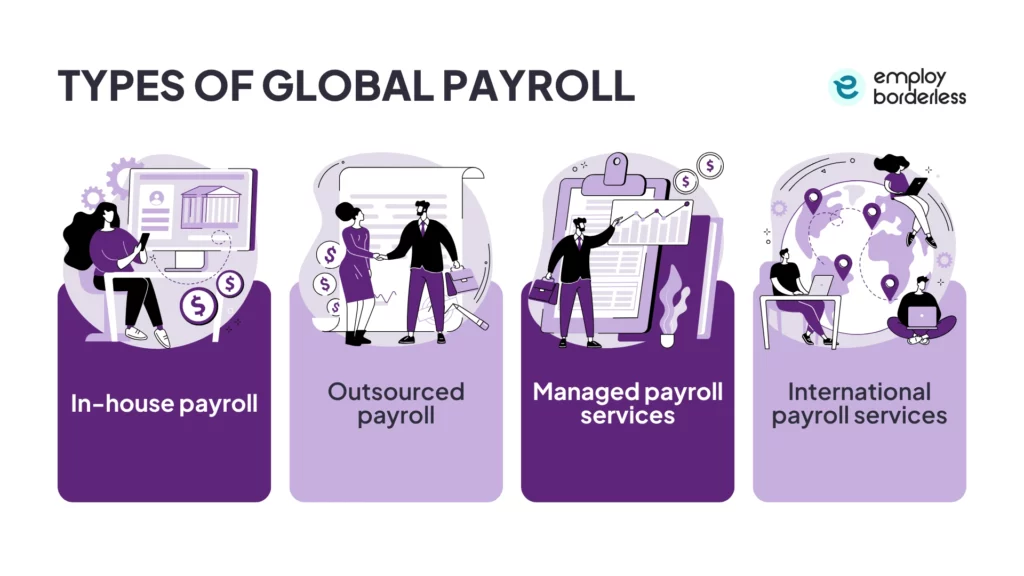
Managing global payroll can be approached in several ways, each with its own advantages and disadvantages. In-house management involves building an internal team with expertise in international payroll. This offers maximum control but requires significant investment in talent, technology, and ongoing training to keep pace with evolving regulations. It is often suitable for very large organizations with a strong global presence and the resources to dedicate to this function. Outsourcing to a global payroll provider is a common and often more practical solution. These providers specialize in managing payroll across multiple countries, offering expertise, technology, and economies of scale. They can handle everything from calculations and compliance to payments and reporting.
Another approach is to use a combination of in-house expertise and local partners. For instance, a company might manage its core payroll processes internally but engage local accountants or payroll specialists in specific countries for tax filing and compliance. This can offer a balance of control and specialized local knowledge. The choice of approach depends on factors such as the company’s size, the number of countries it operates in, its budget, and its risk tolerance.
The benefits of an effective global payroll system are substantial. Improved Compliance is perhaps the most significant. By partnering with experts or utilizing specialized software, businesses can significantly reduce the risk of non-compliance with diverse and complex regulations, thereby avoiding costly penalties and legal issues. Enhanced Employee Satisfaction is another key advantage. Accurate, timely, and transparent payroll processing contributes to employee trust and morale. When employees are paid correctly and on time, it fosters a positive work environment and reduces administrative queries related to pay.
Increased Operational Efficiency is also a major gain. Automating processes, standardizing procedures where possible, and leveraging technology can streamline payroll operations, freeing up internal resources to focus on more strategic initiatives. Cost Reduction can be achieved through optimized processes, avoiding penalties, and potentially benefiting from economies of scale offered by global payroll providers. Furthermore, accurate payroll data provides valuable Business Insights. Comprehensive payroll data can be analyzed to understand labor costs, workforce distribution, and compensation trends, informing strategic business decisions.
Implementing a global payroll solution often involves several key steps. Firstly, assessing current payroll processes and identifying gaps. This involves a thorough review of existing systems, workflows, and compliance procedures in each country. Secondly, selecting the right global payroll model. This could be in-house, fully outsourced, or a hybrid approach, based on the company’s specific needs and resources. Thirdly, choosing appropriate technology. This might involve investing in specialized global payroll software or partnering with a provider that offers a robust platform.
Fourthly, developing a comprehensive data management strategy. This includes ensuring data accuracy, security, and compliance with privacy regulations across all jurisdictions. Fifthly, establishing strong vendor management if outsourcing is chosen. This involves selecting reliable partners, clearly defining service level agreements (SLAs), and maintaining open communication. Sixthly, training and change management are crucial for successful implementation. Ensuring that relevant teams are trained on new processes and technologies, and managing the transition effectively, is vital.
The landscape of global payroll is continuously evolving, driven by technological advancements and regulatory changes. Globalization and Remote Work are major drivers, increasing the need for flexible and compliant payroll solutions for distributed workforces. Technological Innovations, such as artificial intelligence (AI) and automation, are transforming payroll processing, enabling greater accuracy, efficiency, and real-time data analysis. Data Analytics and Reporting Tools are becoming more sophisticated, providing deeper insights into labor costs and workforce management.
Increased Scrutiny and Regulatory Changes demand continuous vigilance. Governments are increasingly focusing on tax compliance and labor law adherence, making it imperative for businesses to stay abreast of all legislative updates. The rise of Gig Economy and Freelance Workforce also presents new payroll challenges, requiring solutions that can accommodate different payment structures and tax implications.
In conclusion, global payroll is a complex but essential function for any business with an international presence. It demands a meticulous approach to managing wages, taxes, compliance, and payments across diverse regulatory environments. By understanding the intricacies involved and adopting a strategic approach, businesses can ensure accurate compensation, maintain legal compliance, and foster a positive and productive global workforce. The choice between in-house management, outsourcing, or a hybrid model should be carefully considered based on organizational size, global reach, and resource availability. Investing in a robust global payroll system is not merely a back-office function; it is a strategic imperative that underpins operational success, employee well-being, and long-term business growth in the interconnected global economy.