Best It Asset Management Software
The Definitive Guide to Best IT Asset Management Software: Maximizing Value and Minimizing Risk
IT Asset Management (ITAM) software is no longer a discretionary expense; it is a fundamental necessity for organizations of all sizes seeking to optimize their technology investments, mitigate security vulnerabilities, and ensure regulatory compliance. Effective ITAM streamlines the entire lifecycle of hardware and software assets, from procurement and deployment to maintenance, retirement, and disposal. This comprehensive guide explores the critical features, benefits, and leading software solutions that define the best IT asset management platforms available today, enabling organizations to achieve greater control, efficiency, and cost savings.
The core objective of ITAM software is to provide a centralized, accurate, and real-time repository of all IT assets. This includes physical hardware such as servers, laptops, desktops, mobile devices, and network equipment, as well as software licenses, cloud subscriptions, and even intangible assets like intellectual property related to software development. Without a robust ITAM system, organizations operate in a state of perpetual uncertainty, facing risks like unauthorized software installations, license non-compliance, underutilized hardware, and delayed or costly hardware refreshes. The best ITAM solutions offer comprehensive discovery capabilities, automatically identifying and cataloging assets across the network through various methods, including network scanning, agent-based deployment, and integration with existing IT infrastructure components like Active Directory or cloud management platforms. This automated discovery process is paramount to establishing a single source of truth for all IT assets, eliminating manual data entry errors and ensuring data integrity.
A key differentiator among ITAM software is its ability to manage the entire asset lifecycle. This begins with procurement, where ITAM tools can integrate with purchasing systems to track assets from the point of order. Following procurement, deployment tracking ensures that assets are assigned to the correct users, departments, or locations, facilitating efficient rollout and accountability. Maintenance management is another critical function, allowing organizations to log maintenance schedules, track repair history, and manage warranties. For software assets, license management is a paramount concern. Best-in-class ITAM software provides detailed inventory of all software licenses, tracks usage against entitlements, and identifies opportunities for license optimization, preventing costly over-licensing or the risk of audits due to under-licensing. This capability is particularly crucial in today’s complex software licensing landscape, which includes perpetual licenses, subscription-based models, and often intricate usage rights.
Financial management is inextricably linked to effective ITAM. By providing a clear overview of asset costs, depreciation, and ongoing expenses, ITAM software empowers organizations to make informed financial decisions. It aids in budgeting for hardware refreshes, software renewals, and new technology acquisitions. Furthermore, by identifying underutilized or redundant assets, ITAM can unlock significant cost savings through reallocation or disposal. The ability to generate detailed reports on asset inventory, depreciation, and total cost of ownership (TCO) provides valuable data for financial planning and justification of IT expenditures. This financial transparency is vital for demonstrating the ROI of IT investments and for optimizing IT budgets.
Security and compliance are increasingly driving the adoption of ITAM software. A comprehensive asset inventory is the foundational element for any effective cybersecurity strategy. By knowing what assets are connected to the network, organizations can identify and address vulnerabilities more effectively. ITAM tools can often integrate with vulnerability scanning solutions to correlate asset data with security risks. Furthermore, for industries with strict regulatory requirements (e.g., HIPAA, GDPR, SOX), ITAM software is essential for demonstrating compliance. It provides an auditable trail of asset ownership, usage, and disposal, which is often a prerequisite for audits. The ability to track software versions and patch levels across all assets helps ensure that systems are up-to-date and less susceptible to known exploits.
The selection of the best ITAM software hinges on several critical factors, tailored to an organization’s specific needs and complexities. Scalability is paramount; the chosen solution must be capable of growing with the organization, accommodating an increasing number of assets and users without performance degradation. Integration capabilities are also vital. The ITAM software should seamlessly integrate with other existing IT management tools, such as help desk systems (e.g., ServiceNow, Jira Service Management), configuration management databases (CMDBs), endpoint management solutions (e.g., Microsoft Endpoint Manager, SCCM), and financial systems. This interoperability creates a cohesive IT ecosystem, preventing data silos and enhancing overall operational efficiency. User-friendliness and intuitive interfaces are crucial for adoption. If the software is difficult to navigate or requires extensive training, its effectiveness will be diminished. Comprehensive reporting and analytics are non-negotiable. The software should offer a wide range of pre-built reports and the flexibility to create custom reports to meet specific organizational needs for audits, financial reviews, and operational planning.
Vendor support and ongoing development are also important considerations. Organizations should look for vendors with a proven track record, excellent customer support, and a commitment to regularly updating their software with new features and security patches. The total cost of ownership (TCO) should be evaluated, considering not only the initial licensing fees but also implementation costs, training, ongoing support, and potential future upgrades. A well-designed ITAM solution should offer robust security features to protect sensitive asset data, including role-based access controls, data encryption, and audit trails.
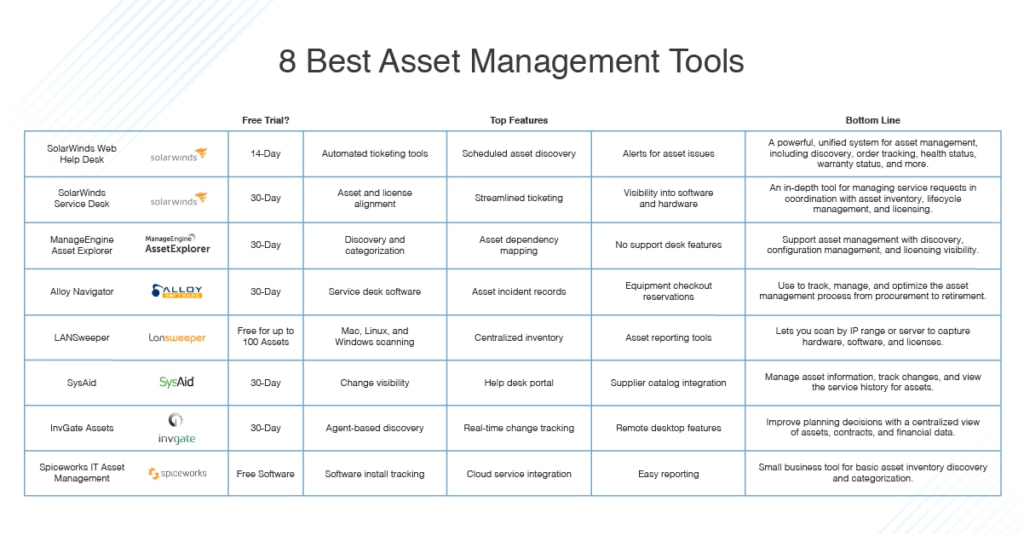
Among the leading IT asset management software solutions, several stand out due to their comprehensive feature sets, scalability, and robust capabilities. ServiceNow IT Asset Management is a prominent player, deeply integrated within its broader IT Service Management (ITSM) platform. Its strengths lie in its extensive automation, workflow capabilities, and deep integration with other ServiceNow modules, making it ideal for large enterprises already invested in the ServiceNow ecosystem. ServiceNow excels in software asset management, license optimization, and contract management, providing a holistic view of the IT asset lifecycle. Its CMDB serves as a central repository, enabling robust dependency mapping and impact analysis.
BMC Helix IT Asset Management offers a powerful and integrated approach to ITAM, part of its broader Helix suite. BMC is known for its robust discovery and inventory capabilities, deep insights into software license compliance, and strong financial management features. Its platform is designed to manage the complexities of hybrid and multi-cloud environments, offering comprehensive visibility across on-premises and cloud-based assets. BMC’s emphasis on automation and AI-driven insights helps organizations proactively manage their IT assets and reduce risks.
Flexera One is a highly regarded solution, particularly for its strengths in software asset management (SAM) and cloud cost optimization. Flexera offers a sophisticated set of tools for managing software licenses across a complex global landscape, identifying savings opportunities, and ensuring compliance. Its ability to track cloud spend and optimize cloud resources makes it a valuable asset for organizations navigating the complexities of cloud migration and management. Flexera’s data intelligence and analytics provide actionable insights for strategic IT decision-making.
Ivanti Neurons for IT Asset Management provides a unified platform that combines hardware and software asset management with endpoint security and management. Ivanti’s strength lies in its ability to discover and manage a vast array of endpoints, including IoT devices, and to automate many ITAM processes. Its integration with Ivanti’s broader IT management suite offers end-to-end visibility and control over the entire IT estate, from procurement to disposal. The emphasis on automation and user experience makes it a strong contender for organizations seeking streamlined IT operations.
Lansweeper is a popular choice for its ease of use, affordability, and comprehensive network discovery capabilities. Lansweeper excels at providing a detailed inventory of hardware and software assets across the network with minimal setup. Its agentless scanning capabilities make it accessible for a wide range of environments. While it might not offer the same depth of advanced license optimization as some enterprise-grade solutions, its strong discovery and reporting features make it an excellent option for small to medium-sized businesses looking for a cost-effective yet powerful ITAM solution.
ManageEngine AssetExplorer offers a comprehensive ITAM solution that integrates hardware and software asset management with IT inventory and license compliance. Known for its user-friendly interface and broad feature set, AssetExplorer provides automated asset discovery, software license management, and contract management capabilities. Its affordability and scalability make it a suitable choice for organizations of various sizes. The platform’s ability to integrate with other ManageEngine products further enhances its value proposition.
CDW Amplify IT Asset Management is a service-oriented solution that can complement internal ITAM efforts or serve as a complete outsourced ITAM function. CDW leverages its expertise and technology platforms to provide asset tracking, lifecycle management, and disposal services. This option is ideal for organizations that may lack the internal resources or expertise to manage a comprehensive ITAM program effectively. The focus on service delivery and end-to-end lifecycle management ensures that assets are handled efficiently and compliantly.
Implementing ITAM software is not just about purchasing a tool; it requires a strategic approach. A well-defined ITAM strategy should encompass clear policies and procedures for asset lifecycle management, including acquisition, deployment, maintenance, and disposal. Training for IT staff on the chosen software and the established processes is crucial for successful adoption and ongoing effectiveness. Regular audits and reviews of the ITAM data are essential to maintain accuracy and identify areas for improvement. The success of any ITAM initiative is ultimately measured by its ability to contribute to the organization’s overall business objectives, whether that be through cost reduction, risk mitigation, improved operational efficiency, or enhanced security posture. By carefully evaluating the features, benefits, and leading solutions discussed, organizations can select the best IT asset management software to navigate the complexities of their IT environment and unlock its full potential.