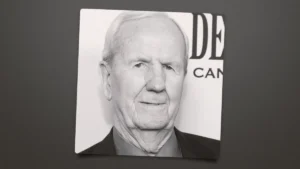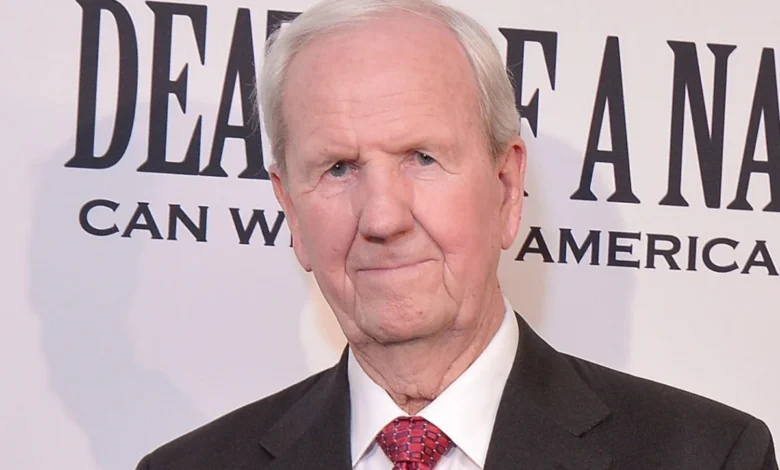
The passing of the veteran filmmaker, who was instrumental in shaping the landscape of modern blockbuster cinema, was confirmed on Sunday by his great-niece, Rachel Lorraine Pullan, through a poignant announcement on Instagram. Her statement reflected not only on his professional accomplishments but also on the personal character that defined his tenure in an industry often defined by fleeting success. "This morning my great-uncle, Gerald R. Molen, passed on to join my great-grandma and his dear wife Pat on the other side of the veil," Pullan wrote. "Uncle Jerry was a man of great moral character and high integrity. He started doing work, moving set pieces and driving at a movie studio and worked his way up to the position of producer."
A Career Built from the Ground Up
Gerald R. Molen’s journey in Hollywood serves as a classic narrative of meritocracy, tracing a path from the labor-intensive realities of film production to the heights of Academy Award recognition. Born in 1935 in Montana, Molen moved to North Hollywood in 1947, a transition that would prove pivotal. His parents, Gerald Sr. and Edith, managed a cafe situated directly adjacent to the Republic Pictures lot in Studio City. This proximity provided young Molen with an early, unfiltered view of the motion picture industry, demystifying the glamour and revealing the mechanical and logistical backbone required to bring a vision to the screen.
Molen did not enter the industry through the traditional routes of film school or executive pedigree. Instead, he occupied roles that required physical labor and operational reliability, including moving set pieces and serving as a driver. This background provided him with a unique perspective on the "below-the-line" challenges of filmmaking, a perspective that would later make him an invaluable asset to directors like Steven Spielberg, who relied on producers capable of managing the immense complexities of large-scale, high-budget productions.
The Spielberg Partnership and the Amblin Era
Molen’s professional trajectory shifted dramatically in 1985 when he began his long-standing collaboration with Steven Spielberg, starting as a unit production manager on the critically acclaimed film The Color Purple. This position established a professional synergy that would define the next three decades of his career. Following his work on The Color Purple, he stepped into an associate producer role for the 1987 film batteries not included, marking the beginning of a prolific run with Amblin Entertainment.
The impact of this partnership on cinema history is difficult to overstate. Throughout the 1990s and early 2000s, Molen served as a primary architect for many of the decade’s most significant cultural touchstones. His credit appears on Jurassic Park (1993), Schindler’s List (1993), The Lost World: Jurassic Park (1997), Hook (1991), and Minority Report (2002).
The 1994 Academy Awards stand as the zenith of this period. Schindler’s List, a harrowing and essential account of the Holocaust, won the Oscar for Best Picture. Molen, alongside Spielberg and producer Branko Lustig, accepted the award, cementing his status as a master of both the blockbuster spectacle and the serious, historical drama.
Chronology of a Storied Filmography
Molen’s career can be categorized into three distinct phases: his early logistical work, his tenure at the helm of Amblin’s major features, and his later-career role as a seasoned executive producer.
- 1947–1984: Early immersion in the industry, including set management and logistical operations at various studio lots.
- 1985–1989: Entry into the inner circle of Spielberg and Amblin, starting with The Color Purple and moving into associate production on batteries not included.
- 1990–1999: The Golden Decade, producing Hook, Jurassic Park, Schindler’s List, The Flintstones, The Little Rascals, Casper, Twister, and The Lost World: Jurassic Park.
- 2000–2024: Continued contributions to the industry, including executive production on Minority Report, Just Like Heaven, The Meg franchise, and The Best Christmas Pageant Ever.
Beyond his work with Spielberg, Molen demonstrated a wide range of producing talents, contributing to hits such as Rain Man (1988), which won Best Picture, and Days of Thunder (1990), highlighting his ability to navigate both high-stakes prestige dramas and adrenaline-fueled action films.
Industry Context and Statistical Significance
Molen’s career spanned a period of massive transition in the film industry, from the decline of the studio system’s old guard to the rise of the modern, franchise-driven blockbuster. As a producer, he was responsible for managing budgets that often reached into the hundreds of millions of dollars. For instance, the original Jurassic Park remains a benchmark for the use of practical effects and CGI integration, a feat that required immense coordination and financial oversight—areas where Molen’s expertise in set management was most valuable.
His death follows the passing of his wife of nearly 70 years, Pat, who died in January 2024 at the age of 86. Their partnership was frequently described as a cornerstone of his life, providing stability throughout his demanding career.
The Broader Impact on Filmmaking
The professional legacy of Gerald R. Molen lies in his approach to the role of the producer. In an era where producers are sometimes seen as purely financial entities, Molen represented the "hands-on" tradition. He understood the physical realities of the set, the labor of the crew, and the technical requirements of the camera. This "boots-on-the-ground" mentality allowed him to facilitate the visionary, and often logistically impossible, requests of directors like Spielberg.
Industry analysts note that producers of Molen’s generation played a critical role in the growth of the blockbuster model. By maintaining quality control while scaling production to a global level, they ensured that films could be both artistic successes and commercial behemoths. The consistency of his filmography—rarely missing the mark on major projects—suggests a level of institutional knowledge that is increasingly rare in a fragmented media landscape.
Reflection and Legacy
While public statements from Spielberg have not yet been released, the industry at large is mourning the loss of a figure whose name became synonymous with a specific brand of American cinematic excellence. The "moral character" mentioned by his great-niece is a recurring theme among those who worked with him; Molen was known for his steady temperament, an essential quality when managing the egos and pressures of a massive film set.
His departure marks the end of an era for the Amblin team. The films he produced are not merely pieces of entertainment; they are cultural artifacts that shaped the expectations of generations of moviegoers. As the industry looks toward the future of filmmaking, the methodologies and the high standards of integrity that Molen championed serve as a reminder of the discipline required to translate complex ideas into the global language of cinema.
Gerald R. Molen’s life—from the cafe next to the Republic Pictures lot to the Oscar stage—remains a profound testament to the power of perseverance, technical mastery, and the enduring nature of collaborative storytelling. He leaves behind a filmography that will continue to be studied and screened for decades, ensuring that his influence on the medium remains a permanent fixture of motion picture history.