Chiwetel Ejiofor Reflects on a Storied Career and the Unpredictable Nature of Cinema at the Torino Film Festival

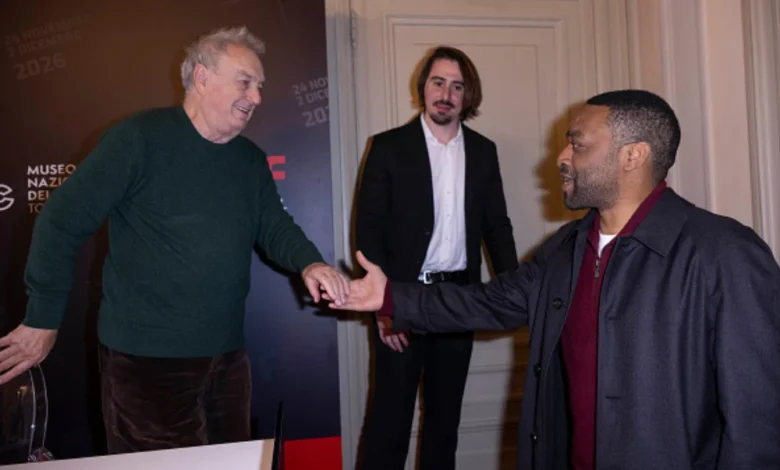
The trajectory of a performer’s career is rarely a straight line, but for British actor Chiwetel Ejiofor, the path has been defined by an early encounter with the pinnacle of Hollywood success. Speaking at the prestigious Torino Film Festival in Italy, where he was honored with the Stella della Mole award for lifetime achievement, Ejiofor offered a candid reflection on his journey—a narrative that began with a blockbuster collaboration and evolved into a multi-hyphenate career spanning theater, screen acting, and directorial work.
The Spielberg Paradox: A Debut at the Summit
Ejiofor’s cinematic entry was unconventional by any standard. While most actors spend years navigating minor roles and auditions, Ejiofor secured his first film credit in Steven Spielberg’s 1997 historical drama Amistad. Portraying James Covey, a translator for the Mende people, Ejiofor was thrust into the orbit of one of the world’s most influential directors before he had even fully established his professional identity.
Reflecting on this experience in Turin, Ejiofor admitted to the inherent anxiety of such an auspicious beginning. "I was definitely worried about it at the time," he noted, explaining that he feared he had reached his ceiling before he had truly begun. "You feel that there are stages to how you develop as an actor and the opportunities you get, and you think they might follow a very linear path. But of course, my first film role was with Steven Spielberg. I realized then, very early on, that it’s a deeply unpredictable profession."
This realization became a foundational philosophy for the actor. Rather than viewing the erratic nature of the entertainment industry as a source of instability, Ejiofor learned to embrace the "sporadic" nature of the work. He emphasized that the capacity to adapt to the changing landscape of opportunities is not merely a survival skill but the very essence of a creative life.
From the West End to the World Stage
Despite the global visibility afforded by his Spielberg debut, Ejiofor’s heart remained firmly rooted in the British theater circuit for over a decade. His background was steeped in the traditions of the National Theatre and the West End. His dedication to the stage was validated in 2008 when he received the Laurence Olivier Award for Best Actor for his portrayal of Othello, a performance widely considered a masterclass in Shakespearean interpretation.
For years, Ejiofor balanced his stage commitments with film work, yet he resisted the label of "film actor" well into the early 2000s. The shift in his perception occurred through the lens of director Stephen Frears. The 2002 thriller Dirty Pretty Things, which was screened at the Torino Film Festival this year as part of a retrospective on the actor’s career, served as the catalyst.
"I think it was around that time when I started to fall in love with film as well, with film acting and the rhythm and poetry of cinema," Ejiofor explained. The technical collaboration with Frears and cinematographer Chris Menges provided him with a new vocabulary for performance—one that was distinct from the immediacy of the stage. This period marked a transition, transforming film from a secondary pursuit into a primary passion.
The Pivot to Directing and Artistic Evolution
The mid-2010s marked another significant shift in Ejiofor’s career trajectory as he transitioned from behind the camera as a writer and director. This move, while fulfilling, naturally constrained the time he could dedicate to his theatrical roots. His directorial credits, including the 2019 feature The Boy Who Harnessed the Wind and the more recent Rob Peace, illustrate a move toward narrative control and thematic depth.
"It was when I became more involved in writing and directing that it started taking up a lot of my time outside of acting in films," he said. "Historically, this would have been the time I spent on stage." Despite these demands, Ejiofor maintains that his passion for live theater remains undimmed. He confirmed during his visit to Italy that he is currently in active discussions for a return to the stage, with a potential project slated for late next year.
The Legacy of 12 Years a Slave
No retrospective of Ejiofor’s work is complete without examining his Academy Award-nominated performance in Steve McQueen’s 12 Years a Slave. Released in 2013, the film chronicled the harrowing true story of Solomon Northup, a free Black man from New York kidnapped into slavery.
The film, which also featured at the Torino Film Festival, stands as a benchmark in modern historical cinema. Ejiofor’s recollection of the project reveals the gravity with which he approached the role. "I hadn’t heard of his story at all. When I was sent the script, I was incredibly moved and shocked by it," he said. Upon reading Northup’s original 1853 memoir, Ejiofor recognized an "extraordinary tale" that needed to be told with the utmost fidelity to the human cost of the period.
The success of 12 Years a Slave—which won the Oscar for Best Picture—was, in Ejiofor’s eyes, a victory for the story itself. "At its heart, it was always a story about human respect and human dignity," he remarked. His admiration for director Steve McQueen was evident, noting the filmmaker’s "phenomenal" vision and his ability to maintain a "cinematic heart" even when depicting the most traumatic chapters of human history.
Chronology of Key Career Milestones
- 1997: Professional film debut in Steven Spielberg’s Amistad.
- 2002: Critical acclaim for his lead role in Stephen Frears’ Dirty Pretty Things.
- 2008: Awarded the Laurence Olivier Award for Best Actor for his performance in Othello at the Donmar Warehouse.
- 2013: Leads the cast of Steve McQueen’s 12 Years a Slave, garnering an Academy Award nomination for Best Actor.
- 2019: Makes his feature film directorial debut with The Boy Who Harnessed the Wind.
- 2024: Receives the Stella della Mole award at the Torino Film Festival, cementing his status as a titan of contemporary cinema.
Implications of the Torino Recognition
The awarding of the Stella della Mole is a recognition of the broader impact Ejiofor has had on the industry. It signals a shift from viewing him merely as a performer to acknowledging his influence as an auteur who bridges the gap between classic theater and modern cinematic storytelling.
From a critical standpoint, Ejiofor’s career trajectory offers a roadmap for contemporary actors: the importance of artistic patience. By refusing to be siloed into a single medium, he has successfully cultivated a body of work that is as diverse as it is respected. His ability to move between the blockbuster scale of the Marvel Cinematic Universe—where he portrays Karl Mordo—and the intimate, character-driven narratives of his own directorial projects underscores a level of professional agency that is rare in the modern studio system.
As he looks toward his future, which includes a return to the stage and further directorial efforts, Ejiofor remains characteristically pragmatic about the "unpredictable" nature of his profession. He views the lack of a linear path not as a flaw, but as the engine of his longevity. In an era where the film industry is constantly evolving, the lesson offered by Ejiofor’s career is clear: the ability to "roll with it" is the most vital tool in an artist’s kit. Whether through the lens of a historical epic or the boards of a West End theater, Ejiofor’s focus remains consistent: a pursuit of stories that demand to be heard and a commitment to the dignity of the characters he portrays.