Trump defends banning CNN, MS Now and Politico from White House: I don’t think a court should allow fake news

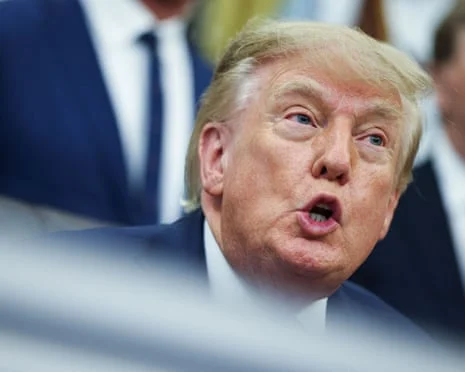
The ongoing friction between Donald Trump’s administration and the mainstream American media escalated sharply as the president doubled down on his decision to bar several prominent news organizations from the White House. Speaking during an Oval Office briefing ostensibly convened to announce adjustments to federal healthcare pricing and drug cost policies, the president defended the unprecedented restrictions against CNN, MS Now, and Politico. He asserted that judicial intervention should not protect what he characterizes as continuously falsified reporting, drawing immediate and intense condemnation from legal scholars, press freedom advocates, and congressional Democrats who view the move as a direct violation of constitutional protections.
The public confrontation began when NBC News correspondent Kelly O’Donnell, a former president of the White House Correspondents’ Association, challenged the administration’s actions by reminding the president of the constitutional oath to uphold the First Amendment. Trump dismissed the constitutional argument, expressing profound frustration with the tone and content of contemporary political journalism. Warning that additional media outlets could soon face identical exclusions, the president explicitly named the New York Times and the Washington Post as organizations under similar scrutiny. When pressed by reporters regarding legal precedents—specifically the 2018 federal court ruling that forced the administration to restore press credentials to CNN correspondent Jim Acosta—Trump rejected established facts, attempting to frame the prior legal defeat as a voluntary discrediting of the reporter rather than a judicial mandate.
Escalating Tensions and White House Restrictions
The sequence of events leading up to the Oval Office exchange began earlier in the week when Trump utilized his personal social media platform to announce the immediate barring of CNN, Politico, and MS Now, the network formerly known as MSNBC. The executive proclamation claimed that these specific media entities perpetually manufactured fiction and lies when reporting on the executive branch and national governance. The administration’s sudden clampdown marked a significant hardening of executive posture toward non-partisan media outlets, contrasting sharply with the president’s vocal praise for partisan, right-wing platforms such as Breitbart and portions of Fox News, which he credited with providing fairer coverage.
During Friday’s chaotic press conference, reporters sought clarification regarding the practical implementation of the ban. Questions regarding whether badges would be confiscated, press pool access revoked, or correspondents physically barred from the grounds elicited a rambling response from the president. After initially expressing confusion over the scope of the restrictions, Trump clarified that the policy meant he did not want targeted journalists inside his office or the White House complex. He indicated that the ban would extend as far as legally and logistically possible unless the targeted organizations altered their reporting standards. Furthermore, the president threatened additional legal action against these media organizations, reiterating unverified grievances regarding past coverage and international reporting.
Constitutional Backlash and Legal Objections
The administrative ban triggered immediate legal and political fallout across Washington. Civil liberties organizations and legal experts swiftly mobilized to denounce the action as a flagrant breach of constitutional law. Jameel Jaffer, executive director of the Knight First Amendment Institute at Columbia University, issued a formal statement emphasizing the established legal boundaries constraining executive power. Jaffer noted that the First Amendment explicitly prohibits a president from penalizing journalists or organizations based on editorial viewpoints or critical coverage, drawing parallels to unlawful government retaliation against educational institutions or private businesses.

Legislative leaders similarly condemned the directive. Senate Democratic Leader Chuck Schumer posted a scathing critique on social media, accusing the president of emulating historical authoritarian tactics. Other prominent Democrats, including Illinois Governor JB Pritzker and Arizona Senator Ruben Gallego, characterized the White House directive as a desperate maneuver by an unpopular administration seeking to suppress unfavorable reporting ahead of critical upcoming midterm elections. Pritzker argued that barring independent journalists was a transparent effort to shield a failing legislative and executive record from public scrutiny, while Gallego labeled the directive as a playbook maneuver typical of authoritarian regimes.
Broader Domestic and Foreign Policy Developments
The controversy over media access unfolded against a backdrop of severe domestic and international challenges for the Trump administration, coinciding with the official commencement of early voting for the 2026 midterm elections. Across several states, including Virginia, Minnesota, Idaho, and South Dakota, voters began casting ballots amidst widespread economic anxiety. Recent financial and economic indicators highlight mounting pressures on the electorate, with mortgage rates hovering near 7 percent, year-over-year consumer inflation registering at 3.4 percent, and gasoline prices climbing toward levels not seen since 2022. These economic headwinds have significantly depressed public approval ratings for the administration, heightening Republican vulnerability as control of both the House and Senate hangs in the balance.
Simultaneously, foreign policy crises continue to strain executive bandwidth. The ongoing military conflict with Iran, which surpassed its sixth month after initial objectives to swiftly topple the regime dissolved into a broader regional stalemate, remains a major political liability. Recent investigative reporting by the Washington Post revealed that the official Pentagon tally of 18 American service member deaths may be an undercount, with internal officials estimating true fatalities at 22 or higher due to peripheral casualties in the operational theater. The protracted conflict has choked key global shipping lanes, including the Strait of Hormuz and Red Sea passages, fueling inflationary pressures on energy supplies and compounding domestic economic discontent.
In a related diplomatic controversy, the administration’s national security apparatus faced scrutiny following reports that FBI Director Kash Patel temporarily suspended operational cooperation with the Royal Canadian Mounted Police. The friction reportedly stemmed from anger over internal language guidelines issued by Canada’s editorially independent public broadcaster, the CBC, regarding its historical references to the September 11 terrorist attacks. Although the broadcaster subsequently revised its policy, the temporary severing of ties between traditional law enforcement partners underscored the volatile nature of cross-border relations, particularly amid an ongoing trade dispute involving sweeping U.S. tariffs on Canadian imports—tariffs that a recent Washington Post-Schar School poll revealed are deeply unpopular among over 60 percent of voters in the vital swing state of Michigan.
Implications for Governance and Press Freedom
The convergence of executive crackdowns on independent media, escalating foreign entanglements, and high-stakes domestic elections marks a turbulent period for American governance. Legal analysts predict that the administration’s latest attempts to restrict press credentials will rapidly wind their way through the federal court system, likely resulting in injunctions similar to those that thwarted prior exclusion efforts. However, the willingness of the executive branch to repeatedly test constitutional limits regarding freedom of the press signals a sustained strategy of political polarization. As the nation moves closer to the November midterm elections, the battle over institutional norms, media access, and the boundaries of executive authority remains a central pillar of the national political discourse.