This scientific breakthrough, detailed in the journal Nature Biotechnology, marks a significant departure from the current standard of care in cellular immunotherapy. By utilizing lipid nanoparticles (LNPs) to deliver genetic instructions directly to natural killer (NK) cells in vivo, the team at the Massachusetts Institute of Technology has bypassed the cumbersome, multi-week laboratory manufacturing process that has defined the field of chimeric antigen receptor (CAR) therapy for the past decade.
The Evolution of Cellular Immunotherapy
To understand the magnitude of this development, one must consider the trajectory of CAR T-cell therapy. Since the U.S. Food and Drug Administration (FDA) approved the first CAR T-cell therapy in 2017, the medical community has viewed these treatments as a "living drug" capable of achieving remarkable remissions in patients with otherwise incurable blood cancers.
The process, however, is notoriously resource-intensive. It requires leukapheresis—a procedure to remove blood from the patient to isolate T cells—followed by shipping the cells to a centralized clean-room facility. There, the cells are genetically modified using viral vectors, expanded in a laboratory setting for several days or weeks, and then infused back into the patient. This cycle is not only expensive—often exceeding $400,000 per patient—but also creates a significant "vein-to-vein" time delay, during which a patient’s disease may progress.
The MIT team, led by senior author Daniel Anderson, a professor in the Department of Chemical Engineering and a member of the Koch Institute for Integrative Cancer Research, sought to eliminate this bottleneck. By redirecting the engineering effort from the laboratory bench to the patient’s own biological environment, they aim to transition from a highly bespoke, artisanal manufacturing model to a scalable, "off-the-shelf" delivery system.
The Advantage of Natural Killer Cells
While T cells have been the workhorse of current immunotherapies, they present specific limitations, particularly when targeting T-cell malignancies or T-cell-driven autoimmune disorders. If a clinician attempts to engineer a T cell to attack another T cell, the therapeutic cells often exhibit "fratricide," where the modified cells recognize and destroy one another, rendering the treatment ineffective.
Natural killer cells offer a distinct physiological advantage. As a separate lineage of immune cells, NK cells do not possess the same markers that would lead them to kill their own kind in a CAR-engineered context. By programming NK cells to identify and eliminate rogue T cells—such as those involved in T-cell lymphoma or autoimmune hepatitis—researchers can achieve targeted destruction without the self-sabotage that plagues CAR T-cell approaches.
Technical Mechanics: The LNP Delivery System
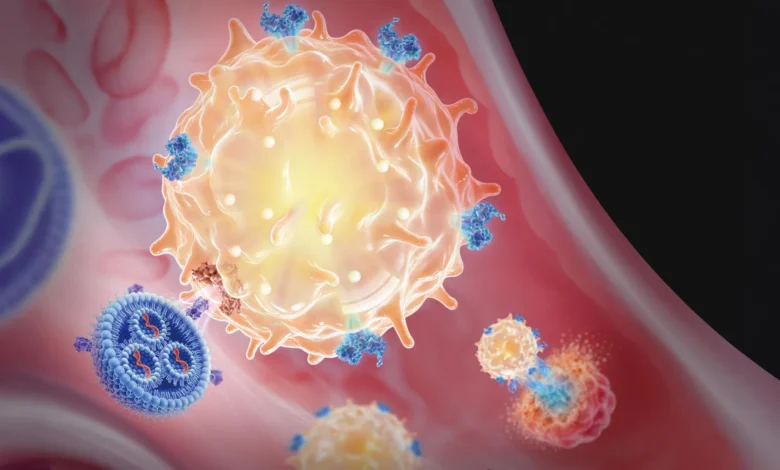
The core of this innovation lies in the design of the delivery vehicle. The researchers engineered lipid nanoparticles—the same technology used in several mRNA COVID-19 vaccines—to act as biological couriers. These particles are coated with specific antibody fragments that function as a homing beacon. When introduced into the bloodstream, these fragments ensure the nanoparticles bind exclusively to receptors on the surface of NK cells.
Once attached, the nanoparticles are internalized by the NK cell. The mRNA payload is then released into the cytoplasm, where the cell’s own machinery translates the genetic code into a chimeric antigen receptor (CAR). This receptor is then expressed on the cell surface, effectively transforming the NK cell into a targeted assassin programmed to seek out and destroy specific disease-associated proteins, such as CD19 or CD3.
Chronology of the Research and Experimental Outcomes
The study, which spanned several years of iterative development, involved a rigorous validation process. Lead authors Yuang Chen, Julia Monkovic, and Haseeb Mughal, under the guidance of Anderson and MIT Professor Robert Langer, first demonstrated the efficiency of this in vivo reprogramming in mouse models.
- Phase 1: Validation of Delivery: The team injected the functionalized nanoparticles into mice and observed that approximately 80% of the target NK cells were successfully reprogrammed, a high rate of efficiency for in vivo gene delivery.
- Phase 2: Solid Tumor Combat: In models of aggressive melanoma, the team observed complete tumor remission in 60% of the treated subjects (three out of five mice).
- Phase 3: Humanized Mouse Models: To bridge the gap between rodent biology and human clinical relevance, the team utilized "humanized" mice, which possess a reconstituted human immune system. In these animals, the treatment successfully eradicated T-cell lymphoma, with results comparable to conventional, ex vivo-manufactured CAR NK cells.
- Phase 4: Reversing Autoimmune Damage: In a demonstration of versatility, the team addressed autoimmune hepatitis. By targeting the autoreactive T cells that damage liver hepatocytes, a single injection of the nanoparticles resulted in the total clearance of the harmful immune cells and the subsequent healing of the liver tissue.
Broader Implications and Future Clinical Applications
The potential clinical impact of this technology extends far beyond cancer treatment. If the safety and efficacy profile can be replicated in humans, it could revolutionize the treatment of systemic autoimmune conditions, such as multiple sclerosis (MS) and rheumatoid arthritis. In these conditions, the immune system turns against healthy tissue; the ability to use nanoparticles to "reset" or redirect the immune response without the need for toxic, systemic immunosuppressants would represent a massive improvement in patient quality of life.
From a health economics perspective, the implications are equally profound. By removing the need for specialized cellular manufacturing facilities, the cost of therapy could theoretically be reduced by orders of magnitude. The treatment could be administered in a standard outpatient infusion clinic, significantly increasing global access to advanced immunotherapy.
However, researchers remain cautious regarding the path to the clinic. While the results in mice are encouraging, the human immune system is significantly more complex. Key hurdles remain, including the potential for immunogenicity (where the body might recognize the nanoparticles as foreign and attack them before they reach their target) and the need for rigorous dose-escalation studies to ensure the treatment does not cause an over-activation of the immune system, commonly referred to as a "cytokine storm."
Expert Perspectives and Next Steps
The involvement of Robert Langer, a pioneer in the field of controlled-release drug delivery, adds significant weight to the study. His assessment—that this work highlights the transformative power of nano-delivery systems—suggests that this platform could become a foundational technology in the next generation of precision medicine.
Industry observers note that the success of this study places pressure on traditional biotech manufacturing pipelines to evolve. While it is unlikely that this technology will immediately replace existing CAR T-cell therapies, it provides a clear roadmap for a "distributed" manufacturing model. If the technology matures, it would represent the transition of gene therapy from a high-cost, centralized service to a routine pharmaceutical product.
The research team is now focused on optimizing the longevity of the engineered NK cells and testing the delivery system in non-human primates to further assess safety profiles. As the scientific community looks forward, the focus will be on whether these mRNA-loaded nanoparticles can navigate the complexities of the human lymphatic system and successfully reprogram cells amidst the chaotic, inflammatory environment of a full-scale tumor.
For now, the MIT study stands as a proof-of-concept that fundamentally changes how we think about immune cell modification. Instead of treating the patient as a source of cells for a factory, the factory is now effectively inside the patient, waiting for the right instruction set to begin the fight against disease.