Melania Trump Announces $7.2 Million Foster Care Scholarship Endowment at LSU Ahead of Rivalry Showdown

First Lady Melania Trump traveled to Baton Rouge, Louisiana, on Saturday to announce a landmark $7.2 million scholarship endowment dedicated to supporting young Americans who have transitioned out of the foster care system. The announcement, hosted at Louisiana State University (LSU), coincided with one of the most high-profile college football weekends of the autumn season: the annual Southeastern Conference (SEC) rivalry showdown between the LSU Tigers and the Alabama Crimson Tide.
The first lady’s visit seamlessly blended philanthropic advocacy with the vibrant pageantry of college athletics. Against a backdrop of purple-and-gold tailgating crowds and cheering student sections, Trump’s visit served as both a celebration of higher education access and a high-profile platform for her ongoing national initiative, "Fostering the Future." The event drew prominent state and federal political figures, university leadership, donors, and athletic icons, underscoring the broad institutional and community support surrounding the initiative.
The Mechanics of the $7.2 Million Endowment Fund
The newly established permanent endowment is designed to provide comprehensive financial stability for students who have experienced the foster care system, addressing a vulnerable population that often faces systemic barriers to higher education completion. According to LSU financial administrators, the funding structure is robustly supported by both major corporate philanthropy and individual donor contributions.
The core of the funding comprises a $5 million leadership commitment from MMR Group, a prominent industrial electrical and instrumentation contractor led by LSU alumnus James B. "Pepper" Rutland. Complementing this anchor donation is an additional $2.2 million raised collectively by 75 distinct contributors through the LSU Foundation. Krista Raney, president and CEO of the LSU Foundation, confirmed that ongoing contributions have pushed the total valuation of the scholarship fund past the $7.2 million threshold and noted that the fund continues to grow.
LSU President Wade Rousse detailed the logistical impact of the financial package, explaining that the $5 million leadership gift alone is projected to generate approximately $200,000 annually. This recurring revenue stream will directly offset critical student expenses, including tuition, mandatory university fees, required textbooks, and on-campus room and board.
During her address inside Patrick F. Taylor Hall, Trump emphasized the transformative power of sustainable educational opportunities. "This achievement will give young people from foster care an anchor of stability, a strong educational foundation, and a chance to build a wonderful life," Trump told the gathered audience, which included university officials, civic leaders, and the scholarship recipients themselves.
Background and Evolution of the Fostering the Future Initiative
The initiative in Baton Rouge represents a significant expansion of "Fostering the Future," a programmatic branch of the broader "BE BEST" campaign originally launched by the first lady during her initial tenure in 2021. The program’s primary mission is to secure vocational training, professional certifications, and traditional college scholarships for young adults aging out of the foster care system—a demographic historically vulnerable to homelessness, lower educational attainment, and economic instability.
Statistical analyses from child welfare advocacy organizations indicate that hundreds of thousands of children reside within the American foster care system at any given time, with tens of thousands aging out annually upon reaching the age of majority, typically 18 or 21 depending on the jurisdiction. Without the safety net of familial financial support or stable housing, these young adults frequently struggle to access post-secondary education.
Trump’s initiative seeks to bridge this structural gap by partnering directly with institutions of higher learning across the United States. According to White House and foundation disclosures, the program has successfully scaled to include 27 participating universities nationwide, collectively supporting approximately 100 "Fostering the Future" scholars during the current academic semester.
The integration of corporate partners has further amplified the scope of the program. Earlier strategic alliances, including collaborative agreements with major media and corporate entities, have helped elevate public awareness and encourage private sector matching funds. The Louisiana rollout stands as one of the most financially substantial single-institution endowments secured under the umbrella of the initiative to date.
Pageantry, Football Culture, and Official Recognition

The Baton Rouge event capitalized heavily on the cultural magnitude of SEC college football. Saturday’s visit was meticulously integrated into the weekend’s athletic events, reflecting the deep cultural integration of university sports in the American South.
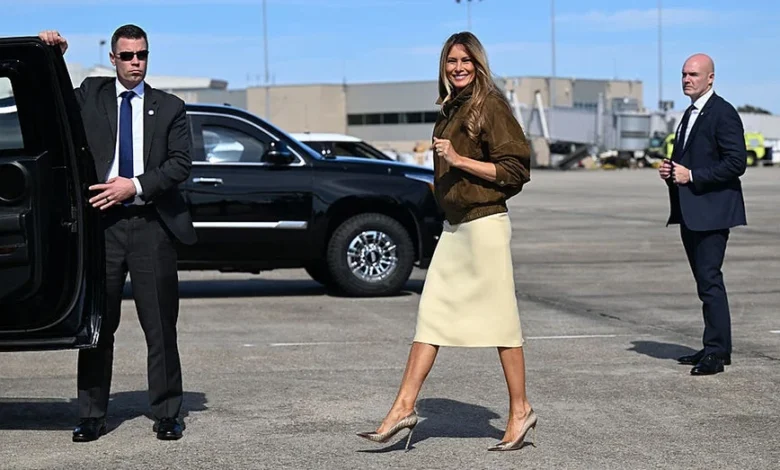
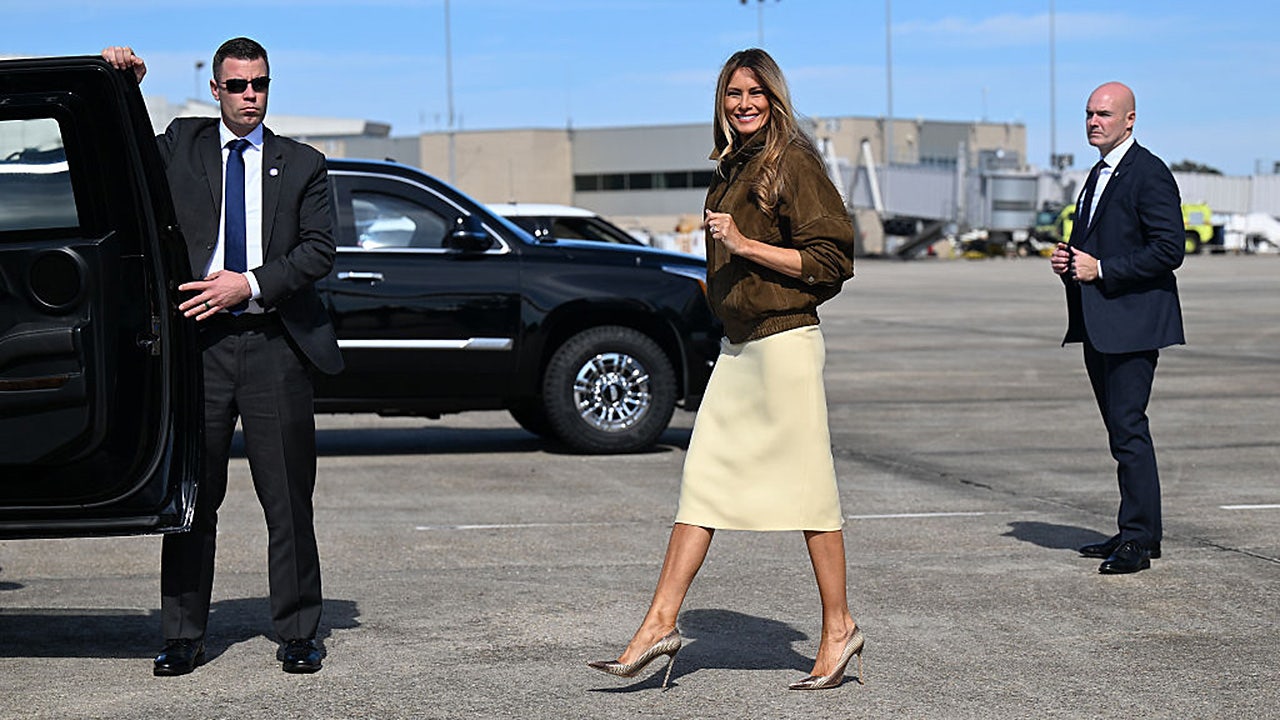
Arriving at Baton Rouge Metropolitan Airport ahead of the main campus events, Trump made her public entrance wearing a tailored Dalma suede bomber jacket by Nour Hammour, paired with an Adam Lippes skirt and Manolo Blahnik BB pumps—a wardrobe choice that bridged formal political visibility with casual weekend styling.
On campus, the first lady was greeted by an array of university representatives and sports figures. LSU cheerleaders flanked the stage, while the university’s live mascot, Mike the Tiger, participated in the presentation wearing a custom "BE BEST" T-shirt. Former LSU head football coach Ed Orgeron—widely known to fans as "Coach O"—joined university leaders to present Trump with a commemorative, handcrafted football produced by Big Game USA, a manufacturer owned by LSU alumnus Chris Calandra.
The symbolic integration extended onto the athletic field itself. SEC officials authorized a series of unique recognitions for the evening matchup, including a specially minted Melania Trump challenge coin to be utilized for the official pre-game coin toss. Furthermore, LSU players incorporated commemorative helmet decals and jersey patches, while coaching staff, cheer squads, and fans utilized branded stadium towels highlighting the initiative.
During the formal presentation of gifts, Trump received a custom purple-and-gold LSU jersey bearing her name and the number 14, alongside a custom Tigers helmet featuring the "BE BEST Fostering the Future" insignia. University officials also presented her with a handcrafted wooden bowl carved from a fallen limb of one of LSU’s historic campus oak trees, symbolizing enduring growth and legacy.
Political Representation and Institutional Rivalry
The high-profile event drew a significant delegation of regional and national political figures. Among those in attendance were Louisiana Governor Jeff Landry, Louisiana First Lady Sharon Landry, and House Majority Leader Steve Scalise, R-La., highlighting bipartisan and regional governmental support for educational access initiatives.

The collegiate atmosphere also injected moments of lighthearted rivalry into the proceedings. During the announcement, Trump noted that Louisiana State University currently supports 14 "Fostering the Future" scholars, whereas the University of Alabama—LSU’s historic athletic adversary—accounts for nine scholars under the same national program.
Krista Raney of the LSU Foundation seized upon the statistic during her remarks, drawing enthusiastic applause from the crowd. "Mrs. Trump, what I heard you say is that LSU has 14 scholarship recipients and Alabama has nine," Raney remarked. "So I think that means we’ve already won the first point."
Despite the sports-themed banter, Trump refocused the audience’s attention on the human element behind the statistics, urging fans and media members attending the evening’s gridiron matchup to extend their enthusiasm beyond the athletic rosters. "While most eyes will be on the athletes today, I encourage you to recognize LSU’s Fostering the Future scholars, who are just as remarkable," Trump said.
Implications and Broader Societal Impact
The announcement at LSU highlights a growing trend of leveraging major collegiate athletic platforms to drive philanthropic engagement and corporate social responsibility. By tying the scholarship endowment announcement directly to an iconic sports weekend, organizers maximized media exposure and public engagement far beyond traditional academic fundraising channels.
From a policy perspective, the expansion of private-public funding models for foster youth reflects ongoing discussions regarding how to best support vulnerable populations as they transition to independence. While government-funded tuition waivers exist in various forms across several states, comprehensive funding that covers ancillary costs such as housing, books, and living expenses remains relatively scarce. Endowments of this scale provide predictable, multi-year financial security that can significantly improve retention and graduation rates among non-traditional and at-risk student cohorts.
As higher education costs continue to rise nationwide, the $7.2 million endowment establishes a localized model for sustainable student support that administrators hope other institutions will replicate. For the recipients in Louisiana, the financial backing translates into tangible opportunities for upward socioeconomic mobility.

Trump concluded her remarks with a direct message directed toward the scholarship beneficiaries in attendance and across the nation, reinforcing the foundational philosophy of her ongoing public advocacy.
"A great education does more than prepare someone for work life," Trump said. "It gives something no one can ever take away."
She added, "To the Fostering the Future scholars here today, and throughout America: I see you. I believe in you. And I will keep working to create new opportunities with you."
Related posts: