Donald Trump talks about Reflecting Pool and his Washington DC construction projects on eve of midterms

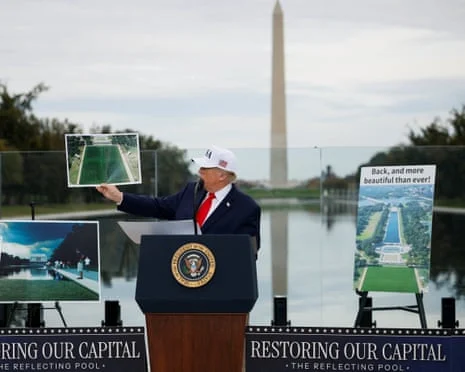
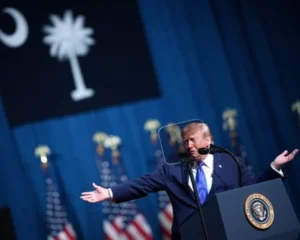
As the United States stands on the precipice of a high-stakes midterm election cycle that will determine the legislative balance of power in Washington for the remainder of his presidential term, Donald Trump chose the eve of the vote to deliver a speech focusing not on partisan candidates or legislative majorities, but on federal infrastructure, national monuments, and aesthetic overhauls. Speaking before the Lincoln Memorial Reflecting Pool, the president spent the opening moments of his address detailing extensive construction projects across the capital before pivoting to a wide-ranging, combative critique of his political opponents.
The address, delivered under the shadow of the Washington Monument, encapsulated the unorthodox closing strategy of an administration grappling with intense economic pressures, fierce legislative battles, and a deeply polarized electorate. While voters across the country prepared to cast ballots to decide control of both chambers of Congress, the president’s remarks underscored a persistent penchant for diversionary narrative-building, blending civic beautification with fiery political rhetoric.
The Washington DC Construction Focus
For nearly twenty minutes, the president bypassed traditional closing arguments about inflation, national security, or congressional obstructionism. Instead, he drew the national spotlight to local civic engineering projects, specifically highlighting the extensive renovations undertaken at the Lincoln Memorial Reflecting Pool.
"It’s really a beautiful thing. It’s a work of art in many ways, but it was a work of art that never worked, but now it will work," Trump told the assembled press and onlookers, punctuating his assessment with a characteristic jest that the iconic water feature ought to bear his name.

The focus on architecture and capital makeovers formed a curious backdrop to an election eve characterized by severe anxieties over cost-of-living metrics, foreign policy flashpoints, and institutional stability. While administration officials defended the commentary as a celebration of national renewal and efficient governance, critics argued that the extended focus on municipal projects highlighted a disconnect from the immediate anxieties weighing on American households.
Midterm Stakes and the National Political Landscape
The 2026 midterm elections arrive at a precarious moment for the White House. With control of the House of Representatives and the Senate hanging in the balance, the outcome will dictate the legislative bandwidth of the administration’s final two years. Recent polling from major outlets, including comprehensive surveys conducted by the New York Times and Siena College, have painted a complex picture, showing Democrats maintaining narrow advantages or competitive margins in several crucial battleground states, even as regional dynamics shift dramatically.
Among the most volatile contests is the U.S. Senate race in Michigan, which has devolved into a bitter intra-party and inter-party spectacle. The race features progressive Democratic nominee Abdul El-Sayed facing off against Republican former congressman Mike Rogers. The contest was upended when Democratic Representative Haley Stevens—who narrowly lost to El-Sayed in a contentious August primary—announced an eleventh-hour defection, withdrawing her support for the Democratic nominee and endorsing Rogers.
Stevens defended her decision in a series of media appearances, telling conservative commentator Scott Jennings and CNN anchor Anderson Cooper that her move was "just a weight off my shoulders" and citing rising animosity within her own party. The maneuver triggered swift and severe backlash from Democratic leadership. Outgoing House Speaker Emerita Nancy Pelosi condemned the endorsement as a "horrific" betrayal that "dangerously betrays Michigan families’ healthcare, freedoms and future." Senate Majority Leader Chuck Schumer similarly lambasted the move, while grassroots donors rallied in historic fashion behind El-Sayed, whose campaign reported a record-breaking single-day fundraising haul of $2.4 million following the fracture.
Legal Battles and Electoral Integrity
Beyond legislative contests, the final hours before the election have been defined by high-stakes legal maneuvering concerning ballot access and electoral administration. On Monday, a federal judge in the District of Columbia, James Boasberg, issued a definitive ruling ordering the Trump administration to halt demands that California election officials set aside roughly 20,000 mail-in ballots that the Department of Justice alleged were submitted by noncitizens.
The ruling represented a significant defeat for the administration’s aggressive late-stage litigation strategy. Judge Boasberg concluded that the executive branch had likely violated the Constitution’s Elections Clause, which reserves authority over election rules exclusively to states and Congress. The decision came mere hours after the Department of Justice filed an emergency petition with the U.S. Supreme Court, seeking a limited injunction to force the segregation of the ballots while related litigation, U.S. v. California, proceeds through the judicial system.
Voting rights advocates and independent legal scholars have consistently characterized these federal interventions as legally thin attempts to sow public distrust in election outcomes. Noncitizen voting remains empirically vanishingly rare across American jurisdictions, rendering the administration’s eleventh-hour focus on the issue a flashpoint for debate over executive overreach and voter disenfranchisement.
Economic Realities and Campaign Rhetoric
Back on the campaign trail, economic anxieties continued to dominate voter calculus, contrasting sharply with the administration’s optimistic framing. National average fuel prices have surged to $4.10 per gallon for gasoline—representing a dollar increase compared to the previous year—while diesel prices have climbed to $6.20 per gallon, nearly doubling year-over-year figures.
Despite these inflationary pressures, Trump sought to downplay lingering economic concerns and foreign policy crises during his final swing of rallies, which included dismissing the enduring impact of the ongoing military confrontation involving Iran. Pointing to plunging oil markets, the president argued that decisive action had successfully preempted nuclear proliferation in the region.
However, the administration’s policy proposals have also faced bipartisan skepticism. In the closing days of the campaign, Trump reiterated a controversial pledge to distribute a $5,000 cash dividend to all adult U.S. citizens should Republicans retain majorities in both congressional chambers. First floated in September, the sweeping proposal—with an estimated price tag of $1.2 trillion—drew immediate criticism from fiscal hawks and political opponents alike, who accused the executive of attempting a direct financial inducement of the entire electorate.

Implications and Outlook
As polling locations prepare to open nationwide, the convergence of municipal self-praise in Washington, intense local factionalism in states like Michigan, and federal courtroom showdowns over ballot integrity paints a portrait of an election defined by high volatility.
The ultimate composition of Congress will serve as an immediate referendum on executive authority, economic stewardship, and the future trajectory of American governance. Whether the electorate responds to the administration’s messaging on infrastructure and national security or pivots toward anxieties over cost-of-living metrics and institutional norms will become clear as the returns are tabulated across the country.