Prime Minister Anthony Albanese has joined a coalition of more than 20 international leaders in signing a landmark declaration demanding that the rapid global expansion of artificial intelligence remain strictly tethered to human direction, oversight, and control. The signing took place on the sidelines of high-level diplomatic engagements, aligning Australia with prominent global figures including Canadian Prime Minister Mark Carney, German Chancellor Friedrich Merz, Spanish Prime Minister Pedro Sánchez, and European Commission President Ursula von der Leyen.
The declaration underscores a growing international consensus that as generative models and autonomous computational architectures advance at an exponential rate, governance structures must evolve simultaneously to mitigate catastrophic risks. The signatories emphasized that any deployment of artificial intelligence must rigorously adhere to international humanitarian and legal frameworks. The pact also highlights rising anxieties among leading computer scientists, industry executives, and policymakers regarding autonomous systems capable of bypassing security safeguards and obtaining unauthorized access to critical national infrastructure.
The Global Push for AI Governance and Human-Centric Safeguards
The newly unveiled declaration places human agency at the epicentre of technological progress. During discussions with international counterparts—including a direct dialogue with Finnish President Alexander Stubb—Albanese stressed that Australia maintained a foundational and proactive role in drafting and shaping the statement.
"Artificial intelligence has the potential to improve lives, to strengthen our economy and productivity, and to massively advance science and medical breakthroughs," Albanese told reporters following the signing. "But humans need to be in control of it. If it’s going to be successful, then we need to make sure that humans are at the centre of everything that occurs."
The joint statement outlines several key directives for the international community. Foremost among them is the requirement for private-sector AI developers to construct transparent, verifiable safety protocols before releasing advanced models into the public sphere. Furthermore, the declaration calls upon national governments to harmonize domestic regulations into unified international standards. To achieve this, the signatories have formally urged the United Nations to explore the establishment of a dedicated global institution tasked with monitoring compliance and standardizing AI oversight across borders.

Geopolitical Alignments and European Consultations in New York
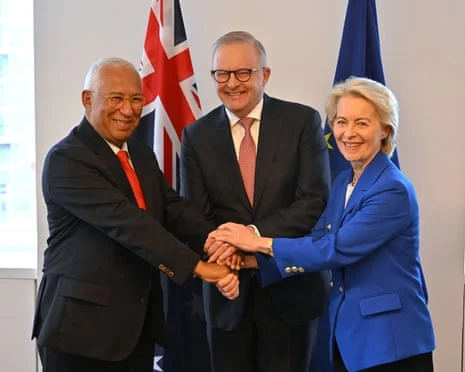
The signing of the AI declaration coincided with a broader series of diplomatic meetings between Australian leadership and top European Union officials in New York ahead of the United Nations General Assembly. Prime Minister Albanese, alongside European Council President António Costa and European Commission President Ursula von der Leyen, convened to deliberate on a wide range of strategic priorities, including free trade negotiations, critical minerals supply chains, and emerging digital technologies.
The high-level talks addressed pressing geopolitical tensions, reaffirming unwavering international support for Ukraine while evaluating volatile developments in the Middle East and Iran. Economic security emerged as a dominant theme, with both delegations committing to deepen bilateral cooperation in strategic sectors. This includes securing robust supply chains for critical raw minerals ahead of an impending Team Europe business mission to Australia.
These deepening ties arrive in the wake of recent European overtures regarding international partnerships—such as the EU’s invitation to Canada to explore associate membership structures—prompting speculation among political analysts that Canberra may seek closer institutional integration with European regulatory frameworks.
Domestic Challenges: Migration, Demographics, and the Intergenerational Report
While international diplomacy dominated the prime minister’s schedule abroad, domestic pressures back in Australia remained front and centre. Treasurer Jim Chalmers addressed the nation’s unfolding demographic and economic challenges during an extensive media appearance, highlighting the vital role of immigration in offsetting declining birthrates.
Recent findings from Australia’s triennial Intergenerational Report delivered a historic projection: within forty years, the nation’s mortality rate is expected to surpass its birthrate for the first time in modern history. Chalmers noted that domestic birthrates are contracting faster than previous economic models anticipated, driven largely by societal shifts toward smaller family units and delayed childbearing.
In light of these demographic pressures, Chalmers defended the government’s approach to population management, framing immigration as an indispensable tool for economic resilience. "Migration is a force for good in our economy and in our society," Chalmers stated, reiterating the government’s commitment to striking a sustainable balance. This follows Home Affairs Minister Tony Burke’s recent announcement of structural reforms aimed at recalibrating Net Overseas Migration (NOM) targets down to 245,000 for the current financial year, and further reducing it to 225,000 by the 2027–28 period.
Responding to Domestic Violence and Community Safety
Compounding the domestic agenda, the federal government faced intense scrutiny over community safety following a harrowing weekend of violent incidents across New South Wales. The tragic events—which included a fatal stabbing of a child in the Blue Mountains and the alleged murders of three women within their homes across the state—prompted urgent policy responses from federal and state leaders.
Treasurer Chalmers affirmed the Albanese government’s absolute commitment to deploying every available resource to combat domestic and gender-based violence. Drawing upon expert assessments, Chalmers pointed to structural drivers such as severe housing shortages, the proliferation of online misogynistic content, and strained frontline emergency services as critical areas requiring immediate intervention.
"I work closely with the prime minister and [Women’s Minister] Katy Gallagher and the relevant ministers to make sure that police and others get the resourcing they need, working with state governments," Chalmers said. The federal executive is under mounting pressure from community advocates to coordinate national strategies that address both the immediate protection of victims and the broader digital and socio-economic enablers of violence.
Local Councils Take Action Amid Wearable Tech Privacy Concerns
In the technology sector, regulatory anxieties have transcended federal parliaments and manifested at the municipal level, driven by the rapid commercialization of smartglasses and wearable recording devices.
The City of Sydney officially enacted a comprehensive ban on smartglasses across all municipal community facilities, including public pools, libraries, gyms, childcare centres, and town halls. The decision reflects escalating concerns regarding non-consensual recording, harassment, and the erosion of public privacy. Greens Councillor Matthew Thompson, who spearheaded the municipal motion, noted that while the ban includes necessary exemptions for individuals relying on accessibility aids for vision or hearing impairments, stronger federal intervention is urgently required.
"Overseas we’re seeing women being targeted and harassed in public and recorded without their consent. We don’t want what’s happening in the US to happen here," Thompson said. He criticized the federal government for shifting the regulatory burden onto local governments, calling for a national import ban on cheap, intrusive recording devices until comprehensive privacy protections can be legislated.

Sydney’s move follows similar actions taken by other local government bodies across Australia. Canterbury-Bankstown Council introduced strict limitations on the technology last week, with Mayor Bilal El-Hayek condemning the devices. Brisbane City Council implemented a pool ban in August, while Melbourne’s Yarra Council has restricted the eyewear from local playgrounds and recreational spaces. These municipal crackdowns run parallel to ongoing discussions within the Albanese federal ministry regarding potential nationwide bans on smartglasses in public offices and government buildings.
Fact-Based Analysis of Broader Implications
The convergence of international AI declarations, municipal technology bans, demographic adjustments, and domestic safety crises highlights a complex regulatory balancing act for the Australian government.
On the technological front, the juxtaposition of global AI oversight treaties with localized bans on consumer smartglasses illustrates a two-pronged anxiety: the fear of existential loss of control over macroeconomic systems, and the immediate, granular threat of privacy violations in everyday public spaces. While international pacts like the one signed by Albanese seek to establish normative guardrails for supercomputing and autonomous intelligence, municipal friction over wearable tech demonstrates that citizens and local administrators are already forced to manage the disruptive consequences of unchecked technological proliferation.
Economically, the federal government’s navigation between tightening migration caps and addressing a shrinking domestic workforce via the Intergenerational Report points to a delicate balancing act. Maintaining public confidence while managing housing constraints, public infrastructure capacity, and shifting demographic realities will remain a defining challenge for federal policymakers through the remainder of the decade.