The Federation Internationale de Football Association (FIFA) has unveiled a revolutionary blueprint for the 2030 World Cup, a tournament designed to honor the centennial of the world’s most prestigious sporting event while pushing the boundaries of modern logistics. In a move that marks a significant departure from traditional hosting models, the 2030 edition will be the first in history to be contested across three continents—Africa, Europe, and South America—incorporating six host nations: Spain, Portugal, Morocco, Uruguay, Argentina, and Paraguay. While the core of the tournament will be centered in the Mediterranean basin, the event will begin with a symbolic homecoming to South America, paying homage to the inaugural 1930 tournament held in Montevideo.
This ambitious cross-continental arrangement is not merely a logistical feat but a calculated effort by FIFA to unify diverse footballing cultures under the banner of the "Centenary World Cup." By integrating the historic roots of the game with the modern infrastructure of Europe and North Africa, FIFA aims to create a global spectacle that reflects the sport’s expansion over the last century. However, the decision has also sparked intense debate regarding player welfare, environmental sustainability, and the logistical complexities of transporting thousands of athletes and millions of fans across the Atlantic Ocean mid-tournament.
A Historic Homecoming: The South American Opening
The 2030 World Cup is scheduled to officially commence on June 8, 2030, in a location that holds unparalleled significance in football history: the Estadio Centenario in Montevideo, Uruguay. It was here, exactly 100 years prior, that the first-ever World Cup final took place. Uruguay, the host of the 1930 tournament, defeated Argentina 4-2 in a match famously remembered for a dispute over which ball to use—a conflict resolved by playing with an Argentine ball in the first half and a Uruguayan ball in the second. In 1983, FIFA designated the Estadio Centenario as the only Historical Monument of World Football, a status that underscores its role as the "cathedral" of the sport.

Following the opening match in Montevideo, the tournament will feature two additional "Centenary" matches in Buenos Aires, Argentina, and Asunción, Paraguay. These three South American nations had originally launched a joint bid to host the entire tournament, but the FIFA Council ultimately opted for the six-nation compromise to balance historical tribute with the commercial and infrastructural advantages of the Euro-African bid. As host nations, Uruguay, Argentina, and Paraguay have all received automatic qualification for the tournament, ensuring their participation in this historic milestone.
The Mediterranean Core: Spain, Portugal, and Morocco
Once the opening celebrations in South America conclude, the focus of the tournament will shift nearly 6,000 miles northeast to the primary host nations: Spain, Portugal, and Morocco. This trio forms the geographical and operational heart of the 2030 World Cup, where the vast majority of the 104 scheduled matches will take place.
Spain, which last hosted the World Cup in 1982, is expected to provide the largest share of venues. Major metropolitan hubs such as Madrid and Barcelona will serve as the tournament’s anchors, utilizing world-class facilities like the newly renovated Santiago Bernabéu and the Spotify Camp Nou. The Spanish football federation is currently finalizing a list of additional host cities, which is expected to include Seville, Bilbao, and Valencia, ensuring a nationwide distribution of the festivities.
Portugal will make its debut as a World Cup host in 2030, having previously hosted the UEFA European Championship in 2004. The Portuguese bid is centered on its "Big Three" stadiums: the Estádio da Luz and Estádio José Alvalade in Lisbon, and the Estádio do Dragão in Porto. These venues are renowned for their modern amenities and high-intensity atmospheres, providing a compact but potent contribution to the tournament’s infrastructure.

Morocco’s inclusion in the hosting group is particularly significant, as it makes the nation only the second African country to host World Cup matches, following South Africa in 2010. Morocco has long sought to host the tournament, having submitted several solo bids in the past. For 2030, the kingdom is planning an aggressive infrastructure expansion across six cities, including Tangier, Casablanca, Rabat, Agadir, Marrakech, and Fez.
The Grand Stade Hassan II: A New Icon for Global Football
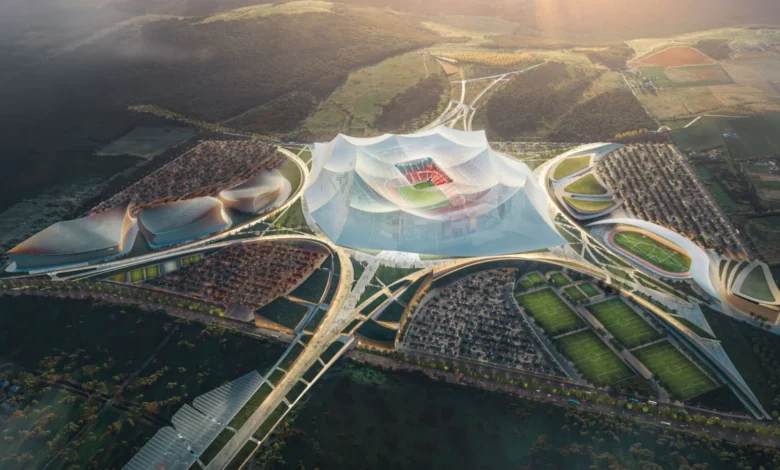
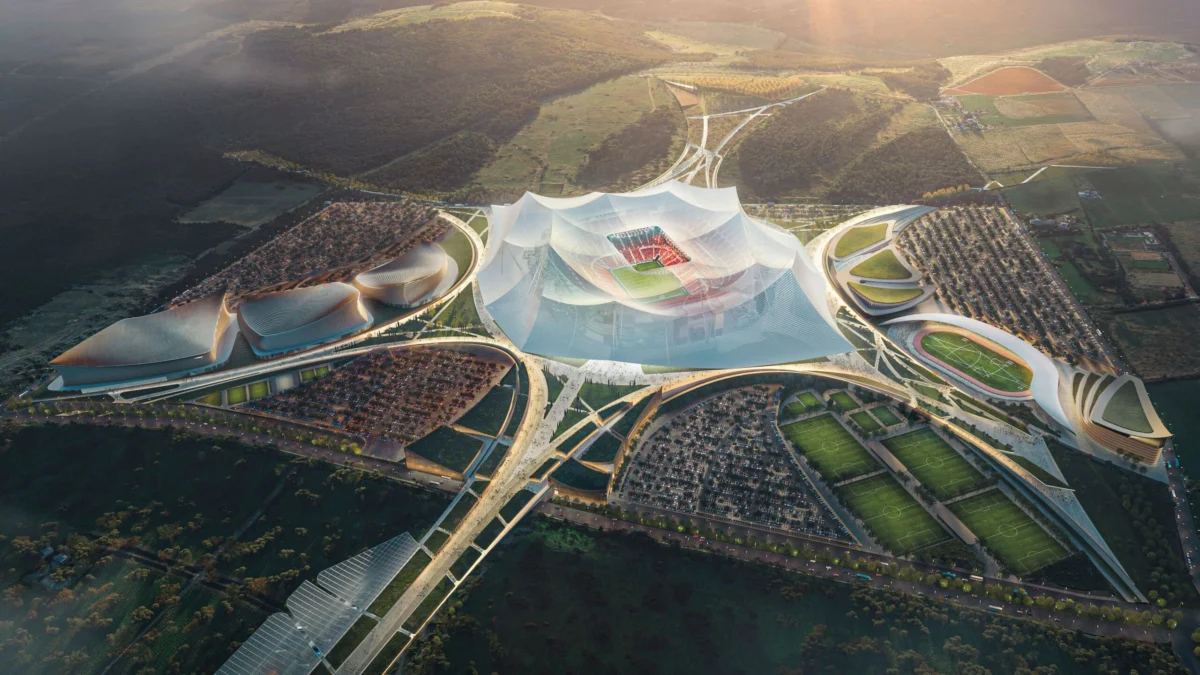
Perhaps the most ambitious project associated with the 2030 World Cup is the construction of the Grand Stade Hassan II in Benslimane, located just outside Casablanca. Designed by the architectural firm Populous in collaboration with Oualalou + Choi, the stadium is envisioned as a 115,000-seat behemoth, which would make it the largest football-specific stadium in the world.
The design of the Grand Stade Hassan II is deeply rooted in Moroccan culture, featuring a massive tented roof structure inspired by traditional "moussem" social gatherings. This architectural marvel is not only intended to be a centerpiece for the 2030 tournament but is also Morocco’s primary leverage in its bid to host the World Cup final. The stadium’s sheer scale and symbolic design represent Morocco’s emergence as a major player in international sports diplomacy.
Logistical Challenges and Player Welfare
The unprecedented decision to span three continents has raised significant concerns among players’ unions and environmental advocacy groups. Traveling from the Southern Hemisphere to the Northern Hemisphere during the group stage introduces challenges related to jet lag, climate acclimation, and recovery time. To mitigate these issues, FIFA has announced that it will build in additional rest days—estimated at 11 to 12 days—between the South American matches and the subsequent games in Europe and Africa.

Environmental critics have also pointed to the carbon footprint associated with such extensive air travel. While FIFA has pledged to make the 2030 World Cup a sustainable event, the necessity of trans-Atlantic flights for teams, staff, and fans presents a contradiction to global climate goals. In response, organizers are emphasizing the high-speed rail links between Spain, Portugal, and Morocco as a way to reduce regional emissions. For instance, the Al Boraq high-speed train in Morocco—the first of its kind in Africa—will allow fans to travel quickly between host cities like Tangier and Casablanca, while the proximity of southern Spain to northern Morocco allows for ferry travel across the Strait of Gibraltar.
Tournament Expansion: 48 or 64 Teams?
The 2030 World Cup will follow the expanded format debuting in 2026, featuring 48 teams and a total of 104 matches played over a six-week period. However, there are ongoing discussions within the global football community regarding further expansion. Alejandro Domínguez, the president of South America’s soccer body (CONMEBOL), has suggested that the field could potentially grow to 64 teams. While FIFA President Gianni Infantino has expressed an openness to hearing these proposals, the current planning remains focused on the 48-team model, which already represents a 50% increase from the 32-team format used between 1998 and 2022.
The Battle for the Final
While the opening match is set for Montevideo, the location of the 2030 World Cup final remains the subject of intense competition. Three iconic venues are currently vying for the honor:
- The Santiago Bernabéu (Madrid): Historically considered the favorite, the Bernabéu is the home of Real Madrid and has a storied history of hosting major finals.
- Spotify Camp Nou (Barcelona): Currently undergoing a massive renovation to increase its capacity and modernize its facilities, Barcelona’s flagship stadium offers a prestigious alternative.
- Grand Stade Hassan II (Casablanca): Morocco’s proposed mega-stadium is the "wild card" in the race, offering FIFA the chance to host a final on the African continent for the first time since the 2010 final in Johannesburg.
Spanish media reports indicate that while Spain initially assumed the final was a certainty for Madrid, the strength of the Moroccan bid and the scale of the Casablanca project have made it a neck-and-neck race. FIFA is expected to make a final decision on the venue for the championship match in December 2026.

Chronology of the 2030 World Cup Development
- 1930: The first FIFA World Cup is held in Uruguay; the hosts defeat Argentina 4-2 in the final.
- 2017: Uruguay and Argentina announce a joint bid for the 2030 Centenary World Cup, later joined by Paraguay and Chile.
- 2023 (March): Morocco joins Spain and Portugal in a rival bid, replacing Ukraine in the partnership.
- 2023 (October): FIFA announces the "United" bid of Spain, Portugal, and Morocco as the sole candidate for 2030, with the addition of three centenary matches in South America.
- 2024: Construction begins on the Grand Stade Hassan II in Morocco; renovations continue at the Bernabéu and Camp Nou.
- Late 2024: The Estadio Centenario in Montevideo is scheduled to close for a 30-month overhaul to increase capacity and add a roof.
- December 2026: FIFA is scheduled to officially confirm the specific host cities and the venue for the World Cup final.
- June 8, 2030: The tournament is set to kick off in Montevideo, Uruguay.
- July 21, 2030: The 2030 World Cup final is scheduled to take place.
Broader Implications and Future Outlook
The 2030 World Cup represents a pivotal moment in the evolution of global sports hosting. By moving away from the single-country or dual-country model, FIFA is embracing a "mega-event" structure that prioritizes broad geopolitical reach and historical symbolism. This model is expected to influence future bids, as evidenced by the awarding of the 2034 World Cup to Saudi Arabia shortly after the 2030 hosting arrangement was ratified.
For the host nations, the tournament offers a significant opportunity for economic growth and international branding. Morocco, in particular, views the World Cup as a catalyst for infrastructure development and a way to solidify its status as a gateway between Africa and Europe. For Spain and Portugal, the event is a chance to showcase their modern, integrated tourism and transport networks to a global audience of billions.
As the world looks toward 2030, the 100th anniversary of the World Cup promises to be more than just a series of football matches. It will be a test of global cooperation, a celebration of a century of sporting heritage, and a bold experiment in the logistics of the modern era. From the historic turf of Montevideo to the futuristic tents of Casablanca, the 2030 World Cup is poised to redefine the scale of international competition.