Georgia State of Emergency Declared as Wildfires Consume Over 27,000 Acres Amidst Record Drought and Hurricane Debris

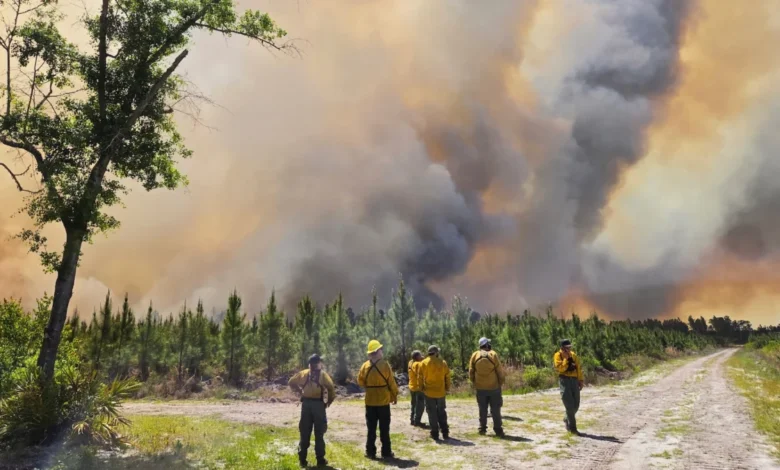
The state of Georgia is currently grappling with a rapidly escalating wildfire crisis that has prompted Governor Brian Kemp to declare a state of emergency for 91 counties. According to the Georgia Forestry Association and state emergency management officials, wildfires have already scorched more than 27,000 acres across the southern portion of the state, fueled by a combination of historic drought conditions and a massive accumulation of dry timber left behind by Hurricane Helene. The situation remains volatile as high winds and low humidity continue to hamper containment efforts, leaving local communities in a state of high alert.
The most immediate threat stems from two major conflagrations: the Brantley Highway 82 fire and the Pinelands Road fire. These blazes have not only consumed vast tracts of commercial and protected forest land but have also encroached upon residential areas, resulting in the destruction of dozens of homes and the displacement of hundreds of residents. As of Wednesday, fire crews from across the state and neighboring Florida are working around the clock to establish containment lines, though officials warn that the environmental conditions are working heavily against them.
The Rapid Escalation of the Brantley Highway 82 Fire
The Brantley Highway 82 fire has emerged as one of the most destructive incidents in recent Georgia history regarding property loss. The fire began on Monday evening under circumstances that are still under investigation. Initially, the fire appeared manageable; by Tuesday morning, it covered several hundred acres and was reported to be 75 percent contained. However, a sudden shift in local weather patterns, characterized by intensifying winds and a drop in relative humidity, caused the fire to "jump" containment lines.
By Wednesday morning, the fire’s footprint had exploded to 5,000 acres, and containment had plummeted to a mere 10 percent. The speed of the spread caught many residents off guard. Local officials in Brantley County confirmed that 54 homes have been destroyed as the fire tore through residential pockets. Despite the rapid destruction of property, there have been no reported fatalities—a fact that local leaders have described as nothing short of miraculous.
Brantley County Manager Joey Cason, speaking at a press conference on Wednesday afternoon, emphasized the harrowing nature of the evacuation process. He noted that emergency responders worked tirelessly to move people out of the fire’s path as the blaze intensified overnight. "I will be very honest with you and say it’s a miracle that there have not been any lives lost," Cason told reporters. The county has since established multiple shelter sites, with local churches and community centers stepping in to provide food, clothing, and temporary housing for those who have lost everything.
The Pinelands Road Fire and the Okefenokee Swamp
While the Brantley fire has caused the most significant property damage, the Pinelands Road fire in Clinch County is currently the largest by acreage. This blaze began over the weekend near the Florida border and has since expanded to cover more than 16,000 acres. Like the Brantley fire, containment remains low, hovering around 10 percent as of Wednesday.
The geography of these fires adds a layer of complexity to the suppression efforts. Both Clinch and Brantley counties are heavily forested and sit on the periphery of the Okefenokee Swamp—the largest blackwater swamp in North America. Clinch County borders the swamp to the west, while Brantley lies to the northeast. Fire behavior in these regions is notoriously difficult to manage because the soil often contains high levels of peat. Peat fires can burn underground for weeks or even months, resurfacing unexpectedly and making traditional containment lines less effective.
The proximity to the swamp also means that firefighting equipment often struggles with terrain that is simultaneously dry on the surface but unstable underneath. The Georgia Forestry Commission has deployed heavy bulldozers to create "fire breaks," but the sheer scale of the Pinelands Road fire requires significant aerial support, including helicopters and fixed-wing tankers dropping water and fire retardant.
Environmental Catalysts: Drought and Hurricane Debris
Experts point to a "perfect storm" of environmental factors that have turned the current season into a powder keg. The primary driver is a severe lack of precipitation. According to the U.S. Drought Monitor, a large swath of South Georgia is currently classified as being in an "exceptional drought"—the D4 category, which is the most severe designation possible. Much of the rest of the state is under "extreme drought" (D3) conditions.
State Forester Johnny Sabo explained that the lack of moisture has depleted the natural barriers that usually slow the progress of wildfires. "Under drought conditions, we have that much less water available either in the water table or in our swamps, ditches, drains, and lakes," Sabo stated. "So the wildfires can spread more rapidly." In a typical year, Georgia’s high humidity and frequent rainfall prevent small sparks from evolving into 10,000-acre infernos. This year, however, the landscape is tinder-dry.
Compounding the drought is the lingering impact of Hurricane Helene, which struck the region in late September 2024. While the hurricane brought devastating winds and flooding, its long-term legacy in the forests has been the creation of "fuel loads." Erin Lincoln, director of the Center for Forest Business at the University of Georgia, noted that the storm downed millions of trees across South Georgia. These fallen trees have had several months to dry out, and they now provide an abundance of fuel that allows fires to burn hotter and longer than they otherwise would. This "dead and down" timber makes it difficult for firefighters to access the interior of burning woods, as the tangled debris blocks roads and creates hazardous conditions for ground crews.
State Response and Executive Action
In response to the growing threat, Governor Brian Kemp’s state of emergency declaration for 91 counties has mobilized the Georgia National Guard and authorized the use of state resources to assist local fire departments. The executive order streamlines the procurement of supplies and allows for a coordinated multi-agency response involving the Georgia Forestry Commission (GFC), the Georgia Emergency Management and Homeland Security Agency (GEMA), and the Department of Natural Resources (DNR).
Tim Lowrimore, president and CEO of the Georgia Forestry Association, issued a statement urging public cooperation. "This is a serious and evolving situation," Lowrimore said. "We urge all Georgians to remain vigilant. Preventing additional fires right now is critical as responders work to manage this emergency."
The state has also implemented a strict burn ban for south and central Georgia. This ban prohibits all outdoor burning, including agriculture burning, debris piles, and campfires. State Forester Sabo reiterated that human activity remains the primary cause of wildfires in the state. "Our number one cause of wildfires in the state are humans, unfortunately—people being careless," he said. Whether it is a stray cigarette, a spark from a lawnmower, or an unattended backyard fire, the margin for error in current conditions is zero.
Regional Impact: Air Quality and Public Health
The impact of the fires is being felt far beyond the immediate evacuation zones. Smoke plumes from the South Georgia blazes have drifted hundreds of miles, reaching as far north as the Atlanta metropolitan area. On Wednesday, air quality in Atlanta was downgraded to "moderate," posing a potential risk to individuals with respiratory issues, such as asthma or chronic obstructive pulmonary disease (COPD).
Further south, in cities like Macon and Columbus, air quality reached "unhealthy" levels. Public health officials have advised residents in these areas to limit outdoor activities and keep windows closed. The fine particulate matter (PM2.5) found in wildfire smoke can penetrate deep into the lungs and enter the bloodstream, causing immediate irritation and long-term health complications for vulnerable populations.
In Florida, officials are monitoring more than 100 smaller fires, as the northern part of that state faces similar drought conditions. The interstate cooperation between Georgia and Florida has been vital, with both states sharing resources and intelligence to manage fires that threaten to cross state lines.
Economic and Ecological Implications
The economic toll of these fires is expected to be substantial. Georgia is a national leader in the timber industry, and the loss of thousands of acres of commercial pine forests represents a significant blow to the state’s agricultural economy. Beyond the immediate loss of timber, the cost of reforestation and the long-term disruption to the supply chain for paper and building materials will be felt for years.
Ecologically, while fire is a natural part of the Southern pine ecosystem, the intensity of these drought-driven fires can be damaging. High-intensity fires can sterilize the soil and destroy the seeds of native plants, making it harder for the forest to recover naturally. The Okefenokee Swamp, a unique habitat for numerous endangered species, is also at risk if the fires penetrate deep into the swamp’s interior, potentially altering its hydrology and plant composition.
Analysis: The Role of Climate Change
The current crisis in Georgia is reflective of a broader global trend where climate change is altering the frequency and intensity of extreme weather events. While Georgia has always experienced periodic droughts and wildfires, the "flash drought" phenomenon—where conditions deteriorate rapidly over a few weeks—is becoming more common. Increased global temperatures lead to higher rates of evaporation, which dries out vegetation more quickly.
When these intensified droughts are paired with extreme weather events like Hurricane Helene, the result is a landscape that is increasingly prone to "megafires." Climatologists warn that the window for "prescribed burns"—a standard forest management tool used to reduce fuel loads—is shrinking as the weather becomes more unpredictable. This creates a feedback loop where fuel continues to build up, leading to more uncontrollable wildfires when a drought eventually hits.
As of Wednesday evening, fire crews continue to battle the blazes in Brantley and Clinch counties. With no significant rainfall in the immediate forecast, the state of emergency remains in effect, and officials are bracing for a prolonged fight to protect lives, homes, and Georgia’s vital natural resources. Residents are encouraged to monitor local news for evacuation updates and to adhere strictly to the statewide burn ban to prevent further strain on emergency services.