Sql Server Management Studio Ssms Guide

SQL Server Management Studio (SSMS) Guide: A Comprehensive Resource for Database Professionals
SQL Server Management Studio (SSMS) is an integrated environment for managing any SQL Server infrastructure, from SQL Server instances to databases. It’s the de facto standard tool for developers and administrators working with Microsoft’s relational database system. This comprehensive guide aims to equip users with the knowledge to effectively leverage SSMS for various database management tasks, enhancing productivity and ensuring efficient database operations. We will explore its core functionalities, essential features, and best practices for optimizing its use, making it an indispensable resource for anyone involved in SQL Server development, administration, or support.
Connecting to SQL Server Instances
The initial and most fundamental step in using SSMS is establishing a connection to a SQL Server instance. Upon launching SSMS, the "Connect to Server" dialog box appears. Key parameters include:
- Server type: Typically "Database Engine" for standard SQL Server instances. Other options include Analysis Services, Reporting Services, and Integration Services.
- Server name: This can be the instance name (e.g.,
SERVERNAMESQLEXPRESS), the IP address, orlocalhostfor a local instance. - Authentication:
- Windows Authentication: Utilizes the current Windows user’s credentials. This is the recommended method for domain-joined environments due to its security and ease of use.
- SQL Server Authentication: Requires a specific SQL Server login and password. This is often used for non-domain-joined servers or when specific SQL logins are provisioned.
Once credentials are provided, clicking "Connect" establishes the link. The Object Explorer pane, usually on the left, then populates with the objects of the connected server instance.
Object Explorer: Navigating Your Database Environment
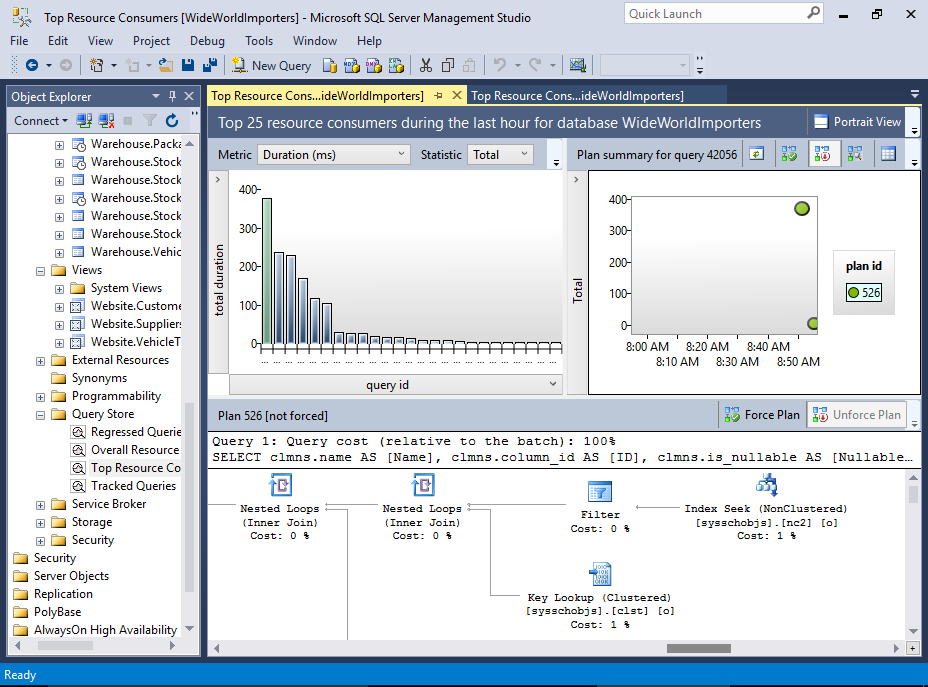
Object Explorer is the central navigation hub within SSMS. It provides a hierarchical view of all database objects on a connected server instance. Key nodes include:
- Databases: This is where you’ll find all user and system databases. Expanding a database reveals its tables, views, stored procedures, functions, schemas, and other components.
- Security: Manages server-level and database-level logins, roles, and permissions.
- Server Objects: Includes linked servers, triggers, and remote logins.
- Replication: Configifies and monitors replication topologies.
- Always On High Availability: Manages Availability Groups and Failover Cluster Instances for disaster recovery and high availability.
- Management: Contains SQL Server Agent jobs, maintenance plans, and policies.
Mastering Object Explorer is crucial for quickly locating and managing specific database elements. Right-clicking on any object provides a context-sensitive menu with relevant actions.
Query Editor: Writing and Executing SQL Code
The Query Editor is the heart of SSMS for writing and executing Transact-SQL (T-SQL) statements. When you open a new query window (File > New > Query with Current Connection), you’re presented with a syntax-highlighted editor.
Key features of the Query Editor include:
- Syntax Highlighting: Differentiates keywords, object names, strings, and comments, improving readability and aiding in error detection.
- IntelliSense: Provides auto-completion for T-SQL keywords, object names, and column names as you type, significantly speeding up query writing and reducing typos. Pressing
Ctrl + Spacecan manually trigger IntelliSense. - Error Highlighting: Underlines syntax errors with a wavy red line, allowing for immediate correction.
- Execution Options:
- Execute (F5): Runs the entire script in the current query window.
- Execute Current Statement (Ctrl + R): Runs only the T-SQL statement currently under the cursor or the selected block of code. This is invaluable for testing individual queries.
- Results Pane: Displays the output of executed queries, whether it’s rows of data, messages, or execution plans.
- Messages Tab: Shows important information about the execution, including row counts, errors, and warnings.
- Execution Plan Tab: Visualizes how SQL Server intends to execute your query, crucial for performance tuning.
Working with Tables and Data
SSMS provides intuitive ways to interact with table data:
- Viewing Table Data: Right-click on a table in Object Explorer and select "Select Top 1000 Rows" or "Edit Top 200 Rows." The former displays data, while the latter allows for direct editing within the grid.
- Designing Tables: Right-click on a table and select "Design." This opens a visual designer where you can add, modify, or delete columns, define data types, constraints (primary keys, foreign keys, unique constraints, checks), and indexes.
- Scripting Objects: Right-click on a table (or any object) and choose "Script Table as > CREATE To > New Query Editor Window." This generates the T-SQL script to recreate the table, essential for backups, migrations, or version control.
Stored Procedures, Functions, and Views
These programmatic database objects are managed within SSMS:
- Stored Procedures: Precompiled T-SQL code blocks that can be executed on demand. They improve performance, security, and modularity. Right-click on "Stored Procedures" to create new ones or modify existing ones.
- Functions: Similar to stored procedures but designed to return a value. They can be scalar (returning a single value) or table-valued (returning a result set).
- Views: Virtual tables based on the result set of a T-SQL statement. They simplify complex queries and can be used for security by restricting access to specific columns or rows.
SQL Server Agent: Automating Tasks
SQL Server Agent is a Windows service that executes scheduled administrative tasks, known as jobs. This is critical for routine maintenance, data backups, and complex data processing.
Key components of SQL Server Agent:
- Jobs: A collection of one or more steps that SQL Server Agent can execute. Each step can be a T-SQL script, an operating system command, an SSIS package, or an Analysis Services script.
- Schedules: Define when jobs should run (e.g., daily, weekly, on system startup).
- Alerts: Trigger jobs or notifications when specific conditions are met (e.g., a certain error number occurs).
- Operators: Define recipients for notifications (e.g., email addresses for job failures).
Creating and managing jobs within SSMS is straightforward: expand SQL Server Agent, right-click on "Jobs," and select "New Job."
Performance Tuning and Monitoring
SSMS offers powerful tools for analyzing and improving query performance:
- Execution Plans: As mentioned earlier, the Execution Plan tab visualizes the query’s execution strategy. Analyzing the plan helps identify bottlenecks, missing indexes, and inefficient operations. Look for costly operators and seek to optimize them.
- Database Engine Tuning Advisor (DATA): A more automated tool for performance analysis. It can analyze query workloads and recommend physical database design changes, such as creating or modifying indexes, indexed views, or partitions.
- Activity Monitor: Provides a real-time overview of processes, resource usage, and data file I/O on the SQL Server instance. It’s invaluable for identifying blocking processes or resource contention.
- SQL Server Profiler: Captures SQL Server events in real-time, allowing you to trace query execution, identify long-running queries, and diagnose performance issues. While still functional, extended events are increasingly the preferred modern alternative.
- Extended Events: A more lightweight and flexible event tracing system than SQL Server Profiler. It allows for granular capture of events and can be configured to minimize performance overhead.
Security Management
Securing your SQL Server environment is paramount. SSMS provides the tools to manage:
- Logins: User accounts used to authenticate to the SQL Server instance. These can be Windows logins or SQL Server logins.
- Users: Mapped to logins within a specific database, granting them access to database objects.
- Roles: Collections of permissions that can be assigned to users, simplifying permission management. There are fixed server roles (e.g.,
sysadmin,securityadmin) and database roles (e.g.,db_owner,db_datareader). - Permissions: Specific rights granted to users or roles on database objects (e.g.,
SELECT,INSERT,UPDATE,DELETE,EXECUTE).
Best practices include using Windows Authentication where possible, granting the least privilege necessary, and regularly reviewing permissions.
Maintenance Plans
SSMS simplifies the creation of automated maintenance tasks through Maintenance Plans. These plans can include steps for:
- Backing Up Database: Scheduling full, differential, or transaction log backups.
- Verifying Database Integrity: Running
DBCC CHECKDBto ensure data consistency. - Reorganizing or Rebuilding Indexes: Maintaining index fragmentation.
- Updating Statistics: Ensuring the query optimizer has accurate information.
- Cleaning Up History: Removing old job history or backup files.
Access Maintenance Plans under the "Management" folder in Object Explorer.
SSMS Customization and Productivity Tips
To maximize your efficiency with SSMS:
- Keyboard Shortcuts: Familiarize yourself with common shortcuts (e.g.,
Ctrl+Nfor new query,Ctrl+Sfor save,F5for execute). - Customizable Toolbars and Menus: Tailor SSMS to your workflow by adding or removing buttons.
- Registered Servers: Group frequently accessed servers for quick connection.
- Templates: Create reusable T-SQL code snippets for common tasks (e.g., creating a table, inserting data). Access via
View > Template Explorer. - Query Options: Configure how queries are executed and results are displayed. Access via
Tools > Options > Query Execution > SQL Server > General. - SSMS Color Schemes: For easier visual distinction, explore custom color schemes for the editor.
Advanced Features and Scenarios
- Database Snapshots: Lightweight, read-only copies of a database at a specific point in time, useful for disaster recovery or testing.
- Always On Availability Groups: For high availability and disaster recovery, SSMS is used to configure and manage Availability Groups, replicating databases across multiple instances.
- Data Comparison and Synchronization: Tools like the Schema Compare and Data Compare features (available in Visual Studio Enterprise or as separate SQL Server Data Tools) can be integrated or used alongside SSMS for advanced comparison and synchronization tasks.
- Import and Export Wizard: A user-friendly wizard for transferring data between SQL Server and other data sources. Right-click a database > Tasks > Import Data or Export Data.
- SQL Server Data Tools (SSDT): For more complex development, SSDT, which integrates with Visual Studio, provides a robust platform for database project management, schema versioning, and deployment.
Conclusion
SQL Server Management Studio is a robust and indispensable tool for anyone working with Microsoft SQL Server. From basic connection and query execution to advanced performance tuning, security management, and automation, SSMS empowers professionals to effectively manage, maintain, and optimize their database environments. Continuous exploration of its features and the adoption of best practices will undoubtedly lead to increased productivity and more reliable database systems. Mastering SSMS is not just about knowing the buttons to click; it’s about understanding the underlying SQL Server concepts and leveraging the tool to implement them efficiently and securely.