Ghost Particles and the Deep Freeze: How Neutrinos Are Rewriting Our Understanding of the Universe

An enormous number of invisible particles are constantly traveling through Earth, passing through our bodies and continuing into space as though almost nothing stands in their way. These entities, known as neutrinos, are among the most elusive and challenging subjects in the history of physical science. Despite their ubiquity, they remain the "ghosts" of the subatomic realm, providing a silent, constant stream of data that, if captured, can unlock the most profound mysteries of the cosmos. Modern physics has reached a pivotal inflection point, moving from the theoretical postulation of these particles to their systematic observation via gargantuan, custom-built detectors buried in the most remote corners of the planet.
A Legacy of Discovery: From Theory to Nobel Recognition
The history of neutrino research is a chronicle of perseverance. The particle was first hypothesized in 1930 by Austrian physicist Wolfgang Pauli, who sought to account for "missing" energy and momentum in beta decay—a form of radioactive process. Pauli, famously discouraged by the lack of experimental tools at the time, lamented that he had "done a terrible thing" by postulating a particle that might be fundamentally impossible to detect.
For over two decades, the neutrino existed only as a mathematical necessity. That changed in 1956 with the landmark experiment conducted by Clyde Cowan and Frederick Reines, dubbed "Project Poltergeist." Their successful identification of the particle confirmed its existence, sparking a golden age of particle physics that has since yielded five Nobel Prizes. The most recent validation of this field came with the recognition of Francis Halzen, whose work on the IceCube Neutrino Observatory transformed how we perceive high-energy astrophysical events. His contributions have provided humanity with a new way to observe the universe, moving beyond the limitations of traditional telescopes that rely on light and electromagnetic radiation.
The Anatomy of the Ghost Particle
To understand why neutrinos are so difficult to study, one must first look at their properties. Neutrinos are elementary particles—meaning they possess no known internal structure—and exist in three distinct "flavors": electron, muon, and tau. Unlike protons or electrons, they carry no electric charge, which renders them immune to the electromagnetic forces that govern much of the visible world. While they do possess mass, it is infinitesimal, estimated to be at least 10 million times lighter than an electron, though the exact mass remains one of the great open questions in particle physics.
Their most defining feature, however, is their interaction with matter. Neutrinos engage only via gravity and the "weak nuclear force." The latter is approximately 20 orders of magnitude weaker than electromagnetism. Consequently, these particles travel through lead, rock, and planetary cores with virtually zero resistance. The sheer volume of this invisible traffic is staggering: every second, approximately 100 billion neutrinos pass through every square centimeter of human skin. Because they do not scatter or absorb easily, they act as perfect cosmic messengers, traveling in straight lines from the heart of collapsing stars, supernovae, and the environments surrounding black holes, carrying pristine information across light-years.
The Antarctic Frontier: Engineering the Impossible
The challenge of detecting a particle that refuses to interact with matter necessitated a shift in experimental scale. In the 1990s, Francis Halzen pioneered the vision for an observatory that would utilize the Earth itself as a detector. The result was the IceCube Neutrino Observatory, situated at the geographic South Pole.
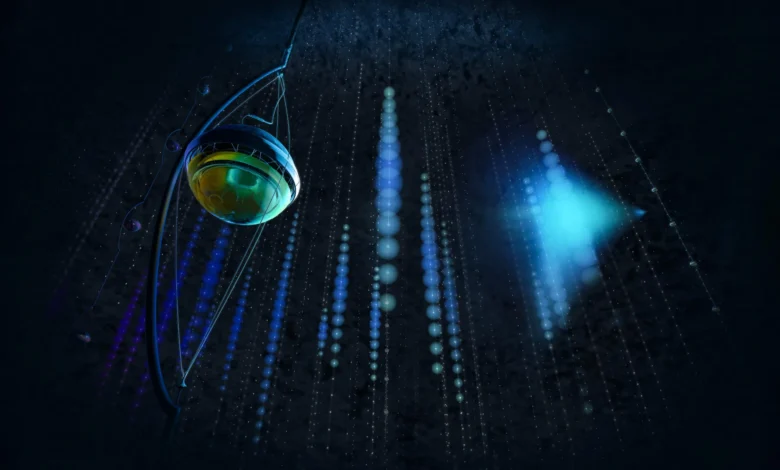
The choice of location was not merely geographic but physical. To detect a neutrino, one must wait for that statistically rare moment when a neutrino strikes an atomic nucleus within a dense medium. When this occurs, it produces a charged secondary particle that, if moving fast enough, creates a faint flash of blue light known as Cherenkov radiation.
IceCube consists of over 5,000 sensitive optical sensors—photomultiplier tubes—lowered into 86 holes drilled as deep as 2.5 kilometers into the Antarctic ice sheet. The pristine, ancient ice serves two purposes: it provides a vast, stable target volume of one cubic kilometer, and its extreme clarity allows the faint Cherenkov flashes to be detected from significant distances. By mapping these flashes, researchers can trace the trajectory of the incoming neutrino back to its source in the deep cosmos.
Data and Implications: Tracking Cosmic Accelerators
While low-energy neutrinos from our own Sun are common, IceCube is calibrated to capture the ultra-high-energy neutrinos that originate from cataclysmic events in the distant universe. These are rare events; the observatory captures only a few dozen such high-energy neutrinos annually. However, each detection is a gold mine of information.
George Fuller, a Distinguished Professor of Physics at the University of California San Diego, notes that the energy levels observed in these particles defy conventional explanation. "Some ultra-high-energy neutrinos detected at IceCube have roughly 10 billion times the energy of a typical neutrino from the Sun," Fuller explains. "We don’t really know where that neutrino came from. The fact that it got here at all may be saying something profound about the universe."
The analysis of these particles provides insights into the nature of cosmic accelerators—the massive, energetic engines in the universe that can propel particles to velocities approaching the speed of light. Because these neutrinos are not deflected by magnetic fields (unlike charged particles), they point directly to their points of origin, functioning as a "neutrino telescope" that can see through dust clouds and nebulae that obscure conventional optical telescopes.
Expanding the Horizon: The Simons Observatory
The search for answers is now diversifying. While IceCube looks for high-energy neutrinos, other projects are investigating the "relic" neutrinos that date back to the very beginning of time. The Simons Observatory, located at an altitude of over 5,000 meters in Chile’s Atacama Desert, represents the next generation of this research.
Led by principal investigator Brian Keating of UC San Diego, the Simons Observatory monitors the cosmic microwave background (CMB)—the residual heat from the Big Bang. Neutrinos played a critical role in the cooling and structure formation of the early universe, and their presence left a subtle imprint on the CMB. By analyzing this ancient light with unprecedented precision, scientists hope to calculate the total mass and number of neutrino types, providing a link between the physics of the subatomic scale and the evolution of the entire cosmos.
A New Era of Astrophysics
The implications of these research programs are profound. By mastering the ability to detect and analyze neutrinos, humanity has effectively added a new sensory organ to its scientific toolkit. We are no longer limited to what we can see with light; we can now observe the "shadows" of the universe’s most extreme environments.
The collaborative efforts between theorists like Fuller and experimentalists like Halzen have created a bridge between particle physics and cosmology. As technology improves and more observatories join the global network, the "ghost particles" of the 20th century are poised to become the primary diagnostic tools of 21st-century astrophysics. Whether it is understanding the dark matter that holds galaxies together or unraveling the precise conditions of the Big Bang, the study of neutrinos remains at the absolute frontier of human knowledge, proving that the most difficult things to see are often the most important to understand.