The Latin Grammy Awards, widely regarded as the most prestigious recognition in the Spanish and Portuguese-language music industries, are set to return to Las Vegas on November 12, 2026. While the ceremony honors established titans, the Best New Artist category remains the evening’s most scrutinized and highly anticipated accolade. This year, the Latin Recording Academy has expanded the field to 11 contenders, signaling a diverse, genre-defying evolution in the global music landscape. This nomination represents more than a career milestone; it is a gateway for artists from the United States, Latin America, and Spain to secure a permanent place in the international cultural consciousness.
The Prestige of the Best New Artist Category
Since its inception, the Best New Artist award has served as a reliable barometer for the future of Latin pop, urban, and alternative music. The list of past winners reads like a historical register of musical icons, including the genre-bending Puerto Rican duo Calle 13, global superstar Karol G, and the introspective Mexican singer-songwriter Silvana Estrada. Recent recipients—such as the Venezuelan prodigy Joaquina, the Bogotá-based pop sensation Ela Taubert, and Mexico City’s alt-star Paloma Morphy—demonstrate the academy’s increasing willingness to reward artists who prioritize narrative depth and sonic experimentation over traditional radio formats.
For the 2026 ceremony, the expansion from ten to eleven nominees reflects an unprecedented volume of high-quality submissions, highlighting the democratic nature of modern music production. As digital distribution platforms lower the barrier to entry, the diversity of the nominee pool has grown significantly, incorporating regional sounds from the Caribbean coast, the American diaspora, and the experimental fringes of the European-Latin fusion scene.
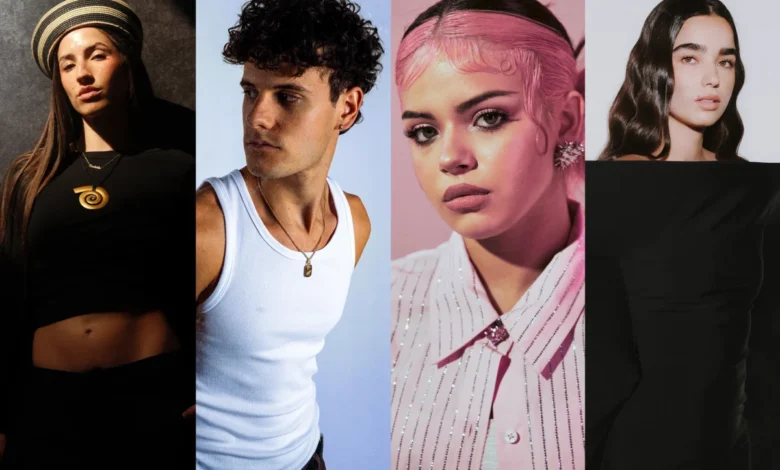
Aria Vega: Bridging Tradition and Modernity
Aria Vega has emerged as a frontrunner by synthesizing the ancestral rhythms of Colombia’s Caribbean coast with a contemporary, mainstream pop aesthetic. Her nomination is viewed as a triumph for the Barranquilla music scene, a city that has long functioned as a cultural epicenter for the region. Vega describes the nomination not as an individual victory, but as a validation of her production team and the creative spirit of her home country.
Vega’s forthcoming debut album, titled Costeñita Core, serves as an exploration of her identity. Her work is characterized by a "chaotic but colorful" sensibility that challenges the polished, hyper-produced aesthetic often associated with mainstream Latin pop. Industry analysts note that her recent high-profile interaction with global icon Shakira in Madrid served as a significant "passing of the torch" moment. Should Vega succeed, it would solidify a new generation of Colombian artists capable of maintaining regional authenticity while achieving global reach.
Delilah: Redefining Música Mexicana
Delilah represents a pivotal shift in música mexicana, a genre that has seen exponential growth in streaming numbers globally over the past three years. Her nomination highlights the influence of the U.S.-Mexico border on contemporary sound. As a bilingual artist raised in a multicultural household, her music functions as a bridge between the traditional corrido and the modern pop-rock soundscape.
Her meteoric rise, punctuated by her performances as the opening act for Natanael Cano at Mexico City’s Estadio GNP Seguros, has been met with critical acclaim. Being the first woman to hold such a prominent position in that specific performance circuit marks a significant milestone in a sector historically dominated by male performers. Delilah emphasizes that her identity as a young woman in the industry is central to her work; she aims to provide a template for female artists to operate without conforming to the restrictive archetypes that have historically governed the genre.
Fabian: A Legacy and a New Trajectory
The nomination of Fabian, the son of Peruvian musical royalty Gian Marco, brings a layer of generational narrative to the 2026 ceremony. However, the industry has noted that Fabian has meticulously avoided relying on his family’s pedigree to secure his position. His musical style—a fusion of Latin pop with Anglo-inspired production techniques—is a direct result of his formative years spent in Los Angeles.
Fabian’s trajectory is a case study in the globalized nature of modern Latin songwriting. By integrating influences from international festival circuits into his Spanish-language compositions, he is effectively creating a new sub-genre of Latin pop designed for a borderless audience. With his debut album slated for a 2027 release, the academy’s recognition of his work suggests that his "album-first" philosophy is resonating with critics who are increasingly concerned about the fragmentation of music consumption in the age of short-form content.
Sofia Monroy: The Avant-Garde Perspective
Sofia Monroy’s inclusion among the nominees marks the most experimental end of the 2026 spectrum. Her work, particularly the album Morena, is a meditative exploration of identity, grief, and the intersection of Mexican and Swedish cultures. Monroy’s music is characterized by its rejection of linear storytelling, opting instead for a multifaceted approach that embraces contradiction and cultural duality.
Morena has been praised by critics for its emotional raw-materiality. By processing the loss of her father and the complexities of her dual heritage, Monroy has tapped into a growing appetite among listeners for vulnerability and intellectual complexity in pop music. Her success suggests that the Latin Recording Academy is continuing its shift toward rewarding "auteur" projects—albums that function as complete, cohesive artistic statements rather than mere collections of singles.
Data Trends and Industry Implications
The 2026 Best New Artist field is defined by several key data trends. First, there is a clear trend toward the "crossover-in-reverse," where artists from the U.S. diaspora are successfully integrating Latin rhythms into American pop frameworks, rather than simply translating English hits into Spanish. Second, there is a marked decrease in reliance on major label backing for the initial stages of a career; most of the nominees developed their fanbases through independent digital grassroots efforts before gaining Academy attention.
The economic impact of these nominations cannot be overstated. Statistically, a Latin Grammy nomination for Best New Artist correlates with a significant uptick in touring revenue and streaming velocity. For the 2026 nominees, this recognition acts as a catalyst for international distribution deals and major festival billings in 2027.
The Road to Las Vegas
The preparations for the November 12 ceremony in Las Vegas involve a complex logistics chain, with the Latin Recording Academy working to ensure that the diverse sounds of the 11 nominees are represented in the production design of the event. While the competition is fierce, the collective sentiment among the nominees is one of community.
As the industry looks toward the ceremony, the focus remains on the changing definition of "Latin music." With artists like Fabian blending Anglo-pop sensibilities, Delilah revitalizing regional Mexican sounds, and Sofia Monroy experimenting with European-fusion, the 2026 Best New Artist category serves as a microcosm of a broader, more inclusive, and technologically sophisticated industry.
Ultimately, the winner of the 2026 Best New Artist award will carry the responsibility of representing a generation that views geography and genre as fluid concepts. Whether the final decision favors the radio-friendly pop of Aria Vega or the introspective artistry of Sofia Monroy, the 2026 class has already succeeded in proving that the next wave of Latin music is as diverse as the cultures that produce it. As these 11 artists converge on Las Vegas, the world will be watching to see which voice emerges as the definitive sound of the next decade.
Related posts: