The 2026 MTV Video Music Awards achieve historic viewership surge as pop culture’s biggest night returns to form

The 2026 MTV Video Music Awards have defied industry expectations, delivering a massive resurgence in viewership that has not been seen in over a decade. According to Nielsen Live+same day fast nationals, the ceremony, which aired Sunday night, pulled in a combined 8.43 million viewers across CBS and MTV. This represents a staggering 51% increase over the 2025 telecast and marks the most-watched iteration of the annual music celebration since 2015.
The event, hosted by hip-hop icon Snoop Dogg, proved that the traditional televised awards show model still holds significant weight in an era increasingly dominated by fragmented streaming platforms and social media clips. While final data is pending, the current figures signal a pivotal moment for MTV and its parent company, Paramount Global, confirming that the "Moon Man" trophy remains a potent cultural symbol.
A Perfect Storm of Scheduling and Star Power
Industry analysts point to several factors that contributed to this year’s ratings windfall. Perhaps the most significant was the fortuitous timing caused by an NFL football overrun on CBS. The game between the Baltimore Ravens and the Dallas Cowboys extended beyond its scheduled window, effectively pushing the start of the VMAs to 7:51 p.m. ET.
While such delays often risk viewer attrition, in this instance, it acted as a massive lead-in. The captive audience waiting for the post-game coverage transitioned directly into the awards show, providing the VMAs with a high-octane launching pad. Even as the show proceeded on a tape-delayed basis in the Pacific Time zone—beginning at 4:30 p.m. PT at the Peacock Theater in Los Angeles—the momentum generated by the afternoon’s sports coverage provided a robust foundation for the evening’s broadcast.
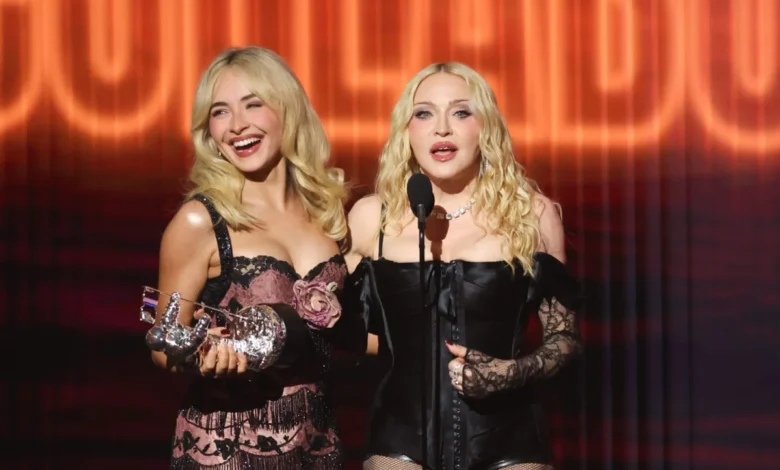
Beyond the logistical boost, the production featured a high-profile lineup that spanned generations of musical influence. The show opened with a historic performance from pop legend Madonna, marking her first appearance on the VMA stage in 23 years. Joined by contemporary powerhouses Sabrina Carpenter and Charli XCX, the opening set served as a bridge between the classic era of MTV dominance and the current digital-native pop landscape.
Decoding the Viewership Metrics
The 8.43 million figure is a comprehensive total, incorporating the primary simulcast on CBS and MTV, alongside the subsequent encore on MTV. To understand the scale of the growth, one must look at the "apples-to-apples" comparison with the 2025 ceremony. Last year, utilizing the same distribution model—CBS, MTV, and an MTV encore—the telecast drew 5.60 million viewers. The jump to 8.43 million represents an objective surge in interest that transcends simple scheduling luck.
Breaking down the numbers by network, the CBS broadcast alone accounted for 7.61 million viewers, a 52% increase over the 5.00 million who tuned into the network last year. MTV’s simulcast contributed an additional 686,000 viewers, up 40% from 2025, while the late-night encore brought in 142,000 viewers, a 31% gain.
The demographic data provides perhaps the most encouraging news for advertisers and stakeholders. The show saw its strongest performance in the key 25–54 age demographic since 2019, with 3.11 million viewers, representing a 34% year-over-year increase. The 18–49 segment, a vital metric for television revenue, hit 2.66 million, the best showing since 2018. Most notably, the 18–34 cohort reached 1.09 million viewers—the highest since 2020 and a 46% increase over the previous year.
A Night of Milestones and Tributes
The 2026 VMAs were defined by a blend of career-defining victories and nostalgic tributes. Taylor Swift continued her dominance in the awards circuit, securing the "Video of the Year" honor and the "Artist Director" award. Swift also utilized the massive platform to debut the music video for her latest single, "Patient Zero," which generated immediate spikes in social media engagement.
The evening also honored the history of the music video medium. Nirvana received the prestigious Video Vanguard Award, a nod to the band’s seismic impact on the visual language of the 1990s. The production also dedicated segments to the legacies of Dolly Parton and George Michael, ensuring that the broadcast appealed to a broad cross-section of music history enthusiasts.
The production itself was a massive collaborative effort. Gunpowder & Sky produced the special, with industry veteran Van Toffler leading the production team. Executive producers included Jesse Ignjatovic of Den of Thieves, Barb Bialkowski, and Bruce Gillmer, working alongside Barry Barclay and Floris Bauer. The integration of Snoop Dogg not only as a host but as an executive producer provided a cohesive creative vision that helped steer the massive, multi-faceted broadcast.
The Digital Footprint
While linear television numbers were the headline, the VMAs also maintained a massive digital presence. CBS reported 31.1 million total interactions and 159 million video views related to the event, an 8% increase over the previous year’s social metrics. This data underscores a critical reality of modern broadcasting: the linear show serves as the "anchor event" that fuels the digital conversation.
The 8% growth in video views, while smaller than the linear viewership surge, indicates that the audience is not just watching the show, but actively participating in the ecosystem surrounding it. For brands and advertisers, this hybrid model—where a high-reach television event feeds a continuous loop of viral social media clips—represents the most effective path forward in a post-cable landscape.
Strategic Implications for the Future of Awards Shows
The success of the 2026 VMAs offers a potential roadmap for other legacy awards shows, many of which have struggled to maintain relevance in the streaming age. By leveraging the reach of a major broadcast network (CBS) while maintaining the brand identity of a cable pioneer (MTV), the ceremony managed to bridge the gap between older demographics and younger audiences who gravitate toward social-first content.
Furthermore, the integration of live music performances with major announcements and exclusive video premieres provides a "must-watch" incentive that pre-recorded content often lacks. The 2026 telecast proved that when a ceremony prioritizes high-energy production and genuine cultural moments, the audience is willing to tune in in record numbers.
The 12.73 million-viewer peak of 2015 remains the benchmark for the modern era, but the 8.43 million figure represents a significant recovery. It suggests that the "death" of the televised music award show has been greatly exaggerated. Instead, the format is undergoing a necessary evolution. By leaning into the synergy between sports, music, and digital engagement, the 2026 VMAs have secured their position as a cornerstone of the annual pop culture calendar for the foreseeable future.
As the industry prepares for the next cycle, the questions will shift from "can linear TV survive?" to "how can this model be replicated?" For now, MTV and CBS can claim a decisive victory, proving that when the right elements align—the right host, the right performers, and the right strategic scheduling—the public remains eager for the communal experience of the music awards show.