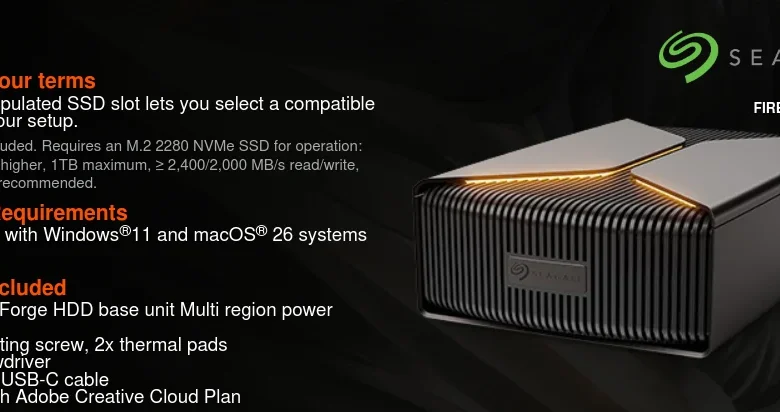
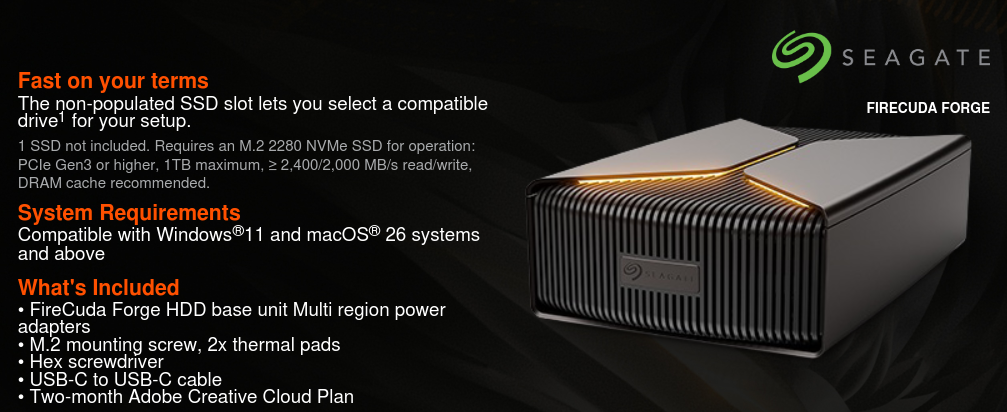
Seagate has officially reintroduced the concept of hybrid storage to the consumer market with the announcement of the FireCuda Forge, a new product line designed to bridge the gap between the massive capacity of mechanical hard disk drives (HDDs) and the high-speed performance of solid-state drives (SSDs). Available in 8TB and 20TB capacities, the FireCuda Forge operates as an external storage enclosure that requires users to install their own M.2 2280 NVMe SSD to function. By combining a high-density platter drive with a user-supplied flash drive, Seagate aims to offer a flexible, cost-effective storage solution for power users and gamers facing the rising costs of pure NAND flash storage.
The hardware is powered by Seagate’s proprietary Alkemi intelligent storage platform, which manages the movement of data between the mechanical and solid-state components. The units are priced at $699 for the 8TB model and $899 for the 20TB version, excluding the cost of the mandatory NVMe SSD. Seagate stipulates that the user-provided SSD must be PCIe Gen3 or higher, with a capacity limit of 1TB, and must meet minimum performance thresholds of 2,400MB/s read and 2,000MB/s write speeds. When properly configured, the system is rated for combined speeds of 2,500MB/s read and 2,000MB/s write, utilizing a USB4 connection and offering native support for Windows 11 and macOS 26 or later.
A Return to Hybrid Roots
The hybrid storage architecture is not a new concept. In the early 2010s, the industry experimented heavily with "tiering" technology. Perhaps the most famous iteration was Apple’s "Fusion Drive," introduced in 2012 alongside the Mac mini. That system functioned by logically binding a physical HDD and an SSD into a single volume, where the operating system would dynamically move frequently accessed data—often referred to as "hot" data—to the faster SSD, while relegating static, archival data to the mechanical platters.
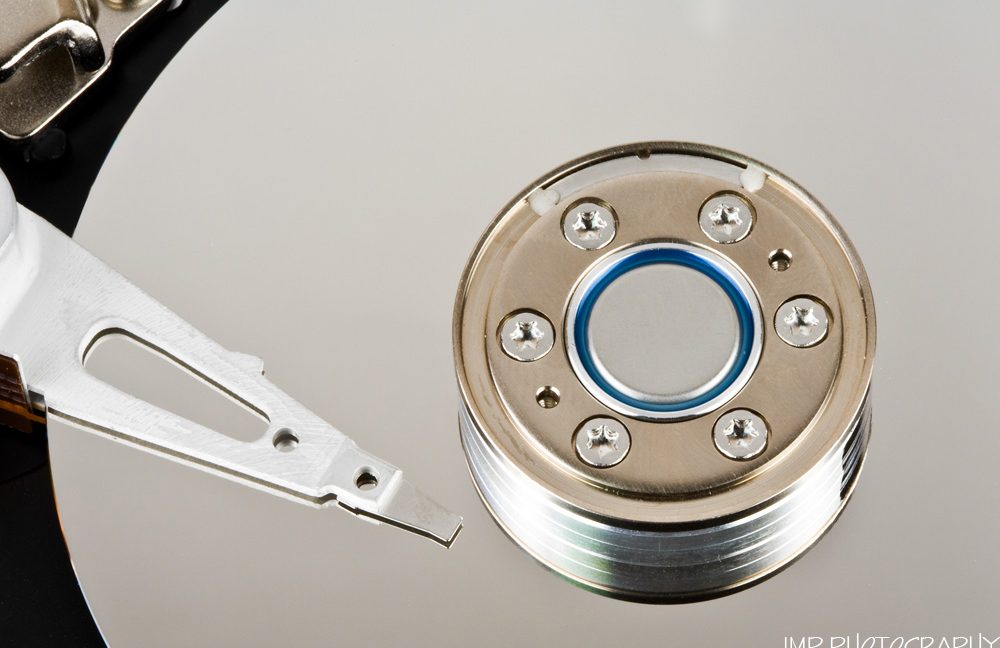
At the time, this was a necessary compromise. SSDs were prohibitively expensive, and mechanical drives offered the only affordable way to store terabytes of data. However, as the price per gigabyte of NAND flash plummeted throughout the mid-2010s, the appeal of hybrid drives waned. Many users opted for pure SSD builds, leading to the gradual phasing out of hybrid configurations in favor of standalone NVMe drives. Seagate’s decision to revive this architecture in 2026 suggests a strategic pivot based on the current volatility of the global storage market.
Economic Drivers and the AI Storage Boom
The resurgence of hybrid storage is fundamentally linked to the shifting economics of hardware manufacturing. Following a decade of falling prices, the cost of storage has experienced a sharp, sustained increase. Industry analysts point to the rapid acceleration of artificial intelligence (AI) development as the primary catalyst. AI training models require massive datasets, leading to an unprecedented demand for NAND flash and high-capacity HDDs.
According to market tracking data from sources like Tom’s Hardware, the cost per terabyte for high-performance SSDs has spiked, with some models retailing for two to three times their 2024 lows. This inflationary pressure extends to mechanical drives as well. Data from PCServerParts indicates that high-capacity enterprise-grade drives, such as the Seagate Exos 24TB, saw their market price jump from approximately $298.99 in mid-2025 to nearly $700 by late 2026. For the average consumer, this renders the purchase of large-scale, all-flash storage arrays financially untenable, creating a market opening for a "middle-ground" solution like the FireCuda Forge.
Understanding the Alkemi Platform
The central innovation in the FireCuda Forge is the Alkemi platform. Unlike the software-managed tiering seen in Apple’s legacy Fusion Drives, which relied on the host operating system to decide where data should reside, Alkemi operates at the enclosure level. Seagate describes Alkemi as an "intelligent storage platform" that learns user habits over time, ensuring that frequently accessed files remain on the SSD while the HDD handles long-term storage.
Despite this explanation, technical details regarding how Alkemi handles data distribution on the first boot remain opaque. It is currently unclear if the system fills the SSD entirely before writing to the HDD, or if it immediately begins active, block-level tiering. Furthermore, the lack of transparency regarding "write-back" modes—where new data is initially written to the faster drive to ensure responsiveness—leaves potential users with lingering questions about the performance ceiling of the device once the 1TB SSD buffer is saturated.
The Problem of Reliability and Data Integrity
Perhaps the most significant criticism leveled at legacy hybrid drives was their inherent fragility. In a traditional two-drive RAID 0 or tiered configuration, the failure of a single drive often resulted in the loss of the entire storage pool. If the HDD failed, the data on the SSD was often rendered inaccessible or incomplete; if the SSD failed, the OS could lose its mapping for the entire file system.
The industry has yet to see documentation on how the Alkemi platform handles physical hardware failure. Seagate has not publicly disclosed whether the system incorporates redundancy or if it is designed as a "striping" solution that prioritizes performance over fault tolerance. Given that the user is responsible for supplying the SSD, there is a legitimate concern regarding what happens when a third-party SSD reaches its end-of-life or suffers a controller failure. Without a clear mechanism for rebuilding or recovering data from a partially failed array, the FireCuda Forge may struggle to win over enterprise users or professionals who prioritize data longevity above all else.
Implications for the Future of Storage
Seagate’s move to market the FireCuda Forge as a premium, high-performance product indicates that the company is targeting creative professionals, gamers, and self-hosted server enthusiasts who require vast amounts of storage but cannot justify the premium of an all-flash 20TB setup. By allowing users to choose their own SSD, Seagate effectively offloads the risk of NAND degradation to the consumer while keeping the core infrastructure—the mechanical drive—as the primary, long-term asset.

If the FireCuda Forge succeeds, it could signal a broader trend of "tiered" hardware returning to the mainstream. As long as the AI-driven demand for flash storage continues to outpace production capacity, consumers will likely continue to face high costs for high-capacity drives. In this environment, the hybrid model serves as a bridge, offering a compromise that was deemed "obsolete" just a few years ago but is now increasingly viewed as a pragmatic necessity.
The success of this product will likely depend on how effectively the Alkemi platform manages the user experience. If the drive performs as a seamless, high-speed unit, it may define a new category of "hybrid-external" storage. However, if the system suffers from the same reliability concerns that plagued the storage industry in 2012, it may serve as a reminder that some solutions were abandoned for good reason. For now, the FireCuda Forge stands as an ambitious, if experimental, attempt to stabilize the costs of modern high-capacity computing. Prospective buyers are advised to wait for independent performance benchmarks and technical post-mortems to determine how the Alkemi system handles long-term file integrity and drive failure scenarios.