The Anatomy of the Engagement
The tactical encounter was initiated by Ukraine’s Defense Intelligence (HUR), which identified a suspicious, low-profile contact traversing the Black Sea. Upon verifying that the craft was an Orcan USV—a Russian-designed, jet-ski-style drone engineered primarily for kamikaze-style ramming attacks—Ukrainian operators dispatched a Sargan-3000 to intercept.
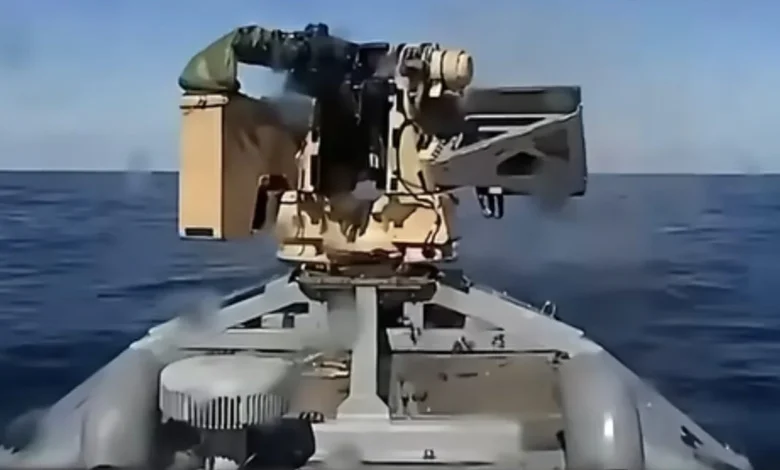
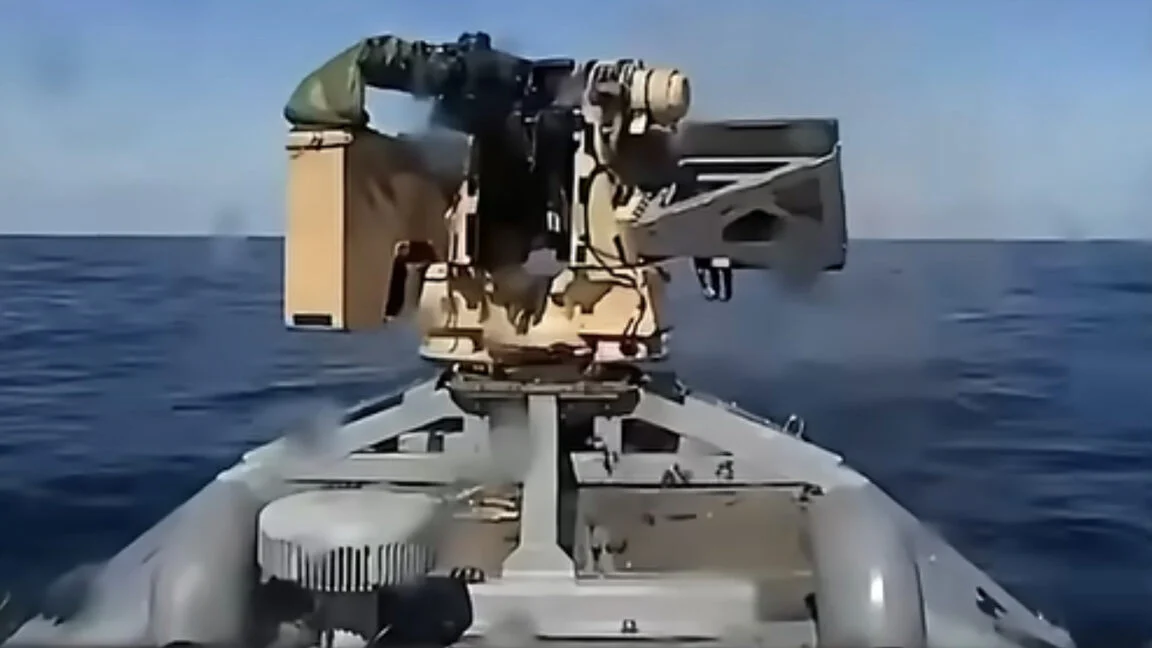
The Ukrainian vessel, a technologically superior platform, utilized a 12.7 mm machine gun integrated into a Kongsberg Remote Weapon Station (RWS). According to footage released by the Ukrainian Navy and corroborated by open-source intelligence analysts, the engagement began at a range of approximately one kilometer. The Ukrainian operator systematically targeted the Russian drone’s communications antenna, effectively blinding the vessel, before delivering a precise barrage of fire that resulted in the complete destruction of the craft.
The Orcan drone, often deployed by Russian forces to strike port infrastructure or military vessels, relies on high-speed water jet propulsion to reach its target. However, in this instance, its lack of defensive armament rendered it entirely vulnerable to the weaponized Sargan-3000. This lopsided victory underscores a growing trend where the modularity of USVs—specifically the ability to mount various sensors and weapon systems—is dictating the rules of engagement in littoral combat zones.
Historical Context: The Evolution of Sea-Based Drone Warfare
The conflict in Ukraine has served as a crucible for the rapid development and deployment of uncrewed systems. Since the early stages of the full-scale invasion in 2022, the Black Sea has evolved from a conventional naval theater into a primary testing ground for maritime robotics.
Early iterations of these vessels were rudimentary, often improvised from commercial off-the-shelf components. Over the past 30 months, these platforms have grown in sophistication. Ukraine’s MAGURA V5 and Sea Baby drones have become household names in military circles, responsible for crippling major assets of the Russian Black Sea Fleet, including the Ivanovets missile corvette and the Sergei Kotov patrol ship.
Conversely, Russia has sought to match this capability by developing its own fleet of explosive USVs, often coordinating these assets with aerial reconnaissance drones like the Geran series. These aerial drones perform a "force multiplier" role, providing targeting telemetry and data-link relay to the surface drones, which often operate under the cover of darkness or in adverse weather conditions to minimize their radar cross-section.
Chronology of Autonomous Escalation
The shift toward autonomous naval combat did not happen in a vacuum. A timeline of the conflict’s maritime drone development illustrates a clear escalation:
- Early 2022: Initial reports of "mysterious" craft washing ashore on the Crimean coast, signaling the early development of Russian and Ukrainian maritime drone prototypes.
- Late 2022: Ukraine successfully utilizes custom-built explosive USVs to harass the Russian Black Sea Fleet at its home port in Sevastopol, forcing a relocation of the fleet’s primary assets.
- 2023: Russia accelerates its indigenous drone production, creating the Orcan series and other jet-ski-derived explosive boats.
- September 2024: The September 12 engagement marks the first confirmed "drone-on-drone" combat, signaling a new phase where drones are now being tasked with "counter-drone" patrol missions.
Technological Implications and Weaponization
The integration of Kongsberg’s remote weapon stations onto USVs represents a significant leap in lethality. By placing a stabilized, remotely operated machine gun on a floating platform, naval forces can effectively police their waters against enemy drones without risking human life.
Analysts at Naval News, specifically HI Sutton, have highlighted that this transition was inevitable. As the density of drones in the Black Sea increases, the necessity for "interceptor" drones becomes as vital as the need for "attack" drones. The Sargan-3000 used in this engagement is designed not just for reconnaissance or sabotage, but as a multi-role combatant capable of defending against other autonomous threats.
The technical challenges inherent in this engagement cannot be overstated. Managing high-speed movement, sensor stabilization, and remote target acquisition in a maritime environment—where sea state and wind speed affect ballistic trajectories—requires highly trained operators and sophisticated latency management for the data links. The success of the Ukrainian operator in this instance speaks to the maturation of the command-and-control infrastructure supporting these units.
Strategic Analysis: The Future of Naval Policing
The destruction of the Russian Orcan drone by a Ukrainian Sargan-3000 introduces a new paradigm in maritime defense: the "robotic picket line." Traditionally, nations maintained naval superiority through large capital ships—destroyers, frigates, and cruisers—which were tasked with patrolling and intercepting threats. In the Black Sea, that role is being outsourced to smaller, cheaper, and expendable autonomous units.
The implications for global navies are profound. If a nation can secure its coastline using a swarm of inexpensive, remote-controlled boats, the cost-to-benefit ratio of conventional naval power projection is fundamentally altered. Countries currently investing in large-scale naval modernization programs are observing the Ukraine conflict closely to determine whether the era of the "big ship" is coming to a close in favor of "distributed lethality" provided by thousands of smaller autonomous assets.
Furthermore, the integration of AI-assisted targeting is likely the next phase. While the September 12 engagement was human-in-the-loop, the transition toward autonomous target identification and engagement is already being explored by several major military powers. This creates a host of ethical and strategic dilemmas, particularly regarding the speed at which autonomous systems might engage one another and the risk of uncontrolled escalation.
Official Responses and Media Coverage
The release of the footage by the Ukrainian Navy served a dual purpose: it demonstrated a significant tactical success and signaled to Russian naval command that the waters of the Black Sea are becoming increasingly inhospitable for their autonomous assets. The Ukrainian government media platform, United24, emphasized the precision of the engagement, noting that the disabling of the Russian drone’s antenna was a deliberate tactical choice to neutralize the threat before total destruction.
While the Russian Ministry of Defense has not issued a formal statement regarding the loss of this specific vessel, the incident has prompted a flurry of analysis from Western observers. Many defense experts, including those at New Scientist, view this as a turning point in warfare. The consensus among military analysts is that we are witnessing the "air war" of the 1940s being transposed onto the surface of the sea.
Conclusion: A New Era of Maritime Conflict
The clash between the Ukrainian Sargan-3000 and the Russian Orcan drone is more than a footnote in the war in Ukraine; it is a preview of the future of global naval engagement. The technology used in this skirmish—remote weapon stations, satellite-linked drone platforms, and high-speed autonomous hulls—is becoming standard equipment for modern militaries.
As both sides continue to iterate on these designs, the Black Sea will remain a laboratory for the next generation of maritime warfare. The "drone-on-drone" duel has validated the theory that whoever controls the autonomous domain will likely control the sea. For navies worldwide, the lesson is clear: the threat from the horizon is no longer just from ships or aircraft, but from the silent, unmanned machines patrolling the waves. The September 12 engagement has closed the book on the age of traditional naval engagement and opened a new, more automated chapter in the history of human conflict.