JetBlue Airways has officially announced the introduction of BlueFirst, a dedicated domestic first-class product designed to reshape the carrier’s narrowbody short- and medium-haul network. Breaking away from a nearly 26-year operational history that relied primarily on a single-cabin economy layout—aside from its acclaimed transcontinental Mint business class—the carrier is rolling out a specialized premium offering. Scheduled for its inaugural commercial flight on December 8, 2025, BlueFirst represents a calculated evolution for the airline as it positions itself to capture higher-yielding leisure and corporate travelers on domestic and near-international routes.
The initiative addresses a long-standing gap in JetBlue’s network architecture. While competitors such as Delta Air Lines, United Airlines, and American Airlines have successfully monetized domestic first-class cabins for decades, JetBlue historically relied on its "Even More Space" extra-legroom economy seats to cater to passengers seeking enhanced comfort. With the debut of BlueFirst, the carrier is pivoting toward a standardized, dedicated premium cabin configuration across its non-Mint fleet, aiming to meet evolving consumer expectations without abandoning its signature un-stuffy brand identity.
Cabin Configuration and Seating Engineering
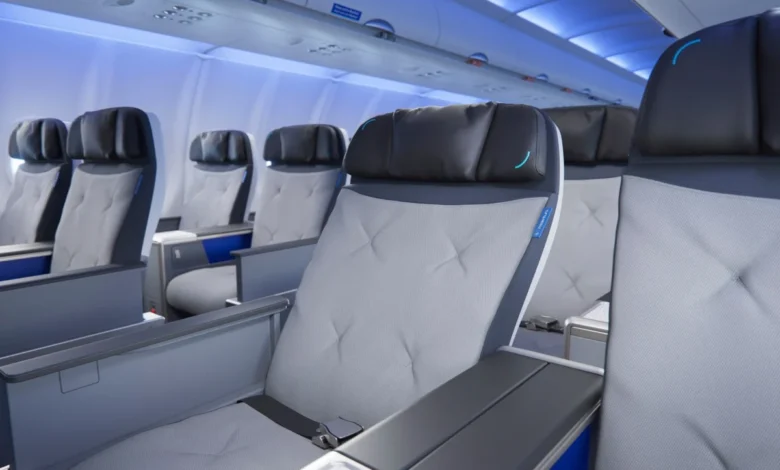
The BlueFirst cabin occupies the first three rows of targeted aircraft, configured in a two-by-two layout that completely eliminates middle seats. This physical design choice immediately sets the product apart from standard domestic coach configurations, offering enhanced privacy and ease of movement. Each seat features a width approximately three inches greater than standard economy seating, alongside a substantial increase in overall spatial footprint. Passengers benefit from up to seven additional inches of pitch compared to JetBlue’s regular Main cabin seats, providing ample legroom and generous floor clearance for personal items and electronic devices.

To ensure long-haul comfort on short-haul hops, JetBlue partnered with mattress manufacturer Tuft & Needle to engineer proprietary seat cushions utilizing T&N Flex foam. The material is formulated to adapt dynamically to passenger weight distribution and posture shifts across both the base cushion and the articulating backrest. Additionally, the seats incorporate a five-inch mechanical recline mechanism alongside adjustable headrests featuring foldable side wings designed to provide lateral head support during flight.
Unlike traditional first-class cabins separated by heavy physical barriers or restrictive curtains, BlueFirst maintains a more open aesthetic. Senior Vice President of Marketing and Brand Stephanie Evans Greene characterized the philosophy behind the product as "premium, but not pretentious," aligning with JetBlue’s historical aversion to overly rigid airline hierarchies.
Comprehensive Service and Passenger Perks
The BlueFirst experience extends far beyond the physical seat, encompassing a multi-tiered suite of priority airport services and onboard amenities. Passengers traveling in the new cabin receive priority check-in privileges, access to expedited security lanes at more than 30 participating airports, and Group 1 boarding status. Baggage allowances are also significantly enhanced: most BlueFirst fare tiers include two complimentary checked bags, with the entry-level BlueFirst Base fare including at least one checked bag.
Onboard the aircraft, every BlueFirst seat is equipped with a 13.3-inch high-definition personal entertainment screen featuring Bluetooth audio pairing for personal headphones. Connectivity needs are fully addressed via integrated USB-A, USB-C, and standard AC power outlets, supplemented by JetBlue’s signature complimentary high-speed inflight Wi-Fi. Overhead bin space directly above the first three rows is strictly reserved for BlueFirst passengers, eliminating the traditional pre-departure struggle for carry-on storage.

Amenity offerings are tailored for comfort and wellness, featuring specially curated kits that include socks, disposable earbuds, mouthwash, and a selection of Osea Malibu skincare products, such as hand cream, lip balm, and calming pulse point oils. Tray tables feature built-in secure stands designed to hold tablets and smartphones at optimal viewing angles for inflight streaming or productivity tasks.
Culinary Program and Innovative Mixology
Dining and beverage services in BlueFirst are structured around flight distance and operational constraints. On flights spanning 899 miles or more, passengers receive a bento-style dining box featuring a curated main entrée, side dish, and dessert. Menus rotate seasonally and by route, incorporating cold or room-temperature items due to the absence of onboard ovens.
Breakfast selections range from hazelnut-ricotta crepes to sweet potato and bean bowls accompanied by guacamole, hot sauce, poached pears, and blueberry chia pudding. Lunch and dinner options feature items such as tortellini pasta salads with marinated olives, pastrami sandwiches with citrus cabbage slaw, and sesame noodles with crispy wontons. Special dietary requirements are accommodated through pre-ordered vegan, vegetarian, kosher, and gluten-free box options. Dessert items include moist carrot cakes with caramel icing, colorful French macarons, and pistachio chocolate cakes. In addition to the primary meal service, passengers have access to an expanded premium snack basket featuring artisanal items from brands like Sockerbit, Tosi, and Wholesome Bakery.
The beverage program introduces an interactive element unique to domestic U.S. aviation. Through the seatback entertainment screen, passengers can utilize "Mixologist Mode" to construct custom cocktails or mocktails. Travelers select a primary spirit, soft drink, mixer, or coffee base and combine up to four total ingredients from an extensive menu. Flight attendants then deliver the components to a dedicated pop-out cocktail tray, allowing passengers to mix their drinks tableside.

All alcoholic and specialty beverages are served in authentic glassware supplied by Fable, resting on handmade watercolor coasters designed by New York-based illustrator Danielle Rose Fisher. Non-alcoholic offerings include specialty wines from Parcelle, coffee from Cometeer and Joe Coffee, and artisan teas from Smith Teamaker.
Fleet Integration Timeline and Rollout Strategy
The implementation of BlueFirst will occur in distinct operational phases across JetBlue’s narrowbody aircraft fleet. The retrofit program specifically targets aircraft that currently lack the transcontinental Mint business class cabin, ensuring that Mint and BlueFirst remain mutually exclusive products deployed on entirely separate route networks.
The official rollout chronology is structured as follows:
- December 8, 2025: Official commercial debut of the BlueFirst product.
- Early December 2025: Initial deployment on high-frequency daily routes, starting with Boston (BOS) to Fort Lauderdale (FLL), followed closely by Fort Lauderdale (FLL) to New York LaGuardia (LGA).
- January 2026: Expansion of the retrofit fleet to incorporate key leisure routes from New York John F. Kennedy International Airport (JFK) to destinations including Cancún, Liberia (Costa Rica), and San Juan (Puerto Rico).
- Throughout 2026: Gradual fleet induction covering more than 30 domestic and near-international routes, with just over a dozen aircraft fully retrofitted by the end of the year.
- End of 2027: Targeted completion date for the fleet-wide retrofit program, encompassing all JetBlue aircraft outside of the Mint-equipped sub-fleet.
Because the retrofit process is gradual, JetBlue has noted that initial availability will depend heavily on specific aircraft assignments. Not every flight on an inaugural route will feature a BlueFirst-equipped cabin immediately, and schedule adjustments or operational aircraft swaps may occur based on maintenance and fleet utilization needs. Travelers are advised to verify cabin configurations at the time of booking during the transitional deployment phase.

Strategic Implications for the U.S. Domestic Market
The launch of BlueFirst marks a structural maturation of JetBlue’s business model. For over two decades, the airline differentiated itself primarily through low-cost, high-amenity economy travel, disrupting legacy carrier pricing structures. However, shifting macroeconomic trends and increasing corporate demand for premium leisure travel have forced carriers to optimize revenue per available seat mile (RASM).
By introducing a dedicated domestic first-class product, JetBlue can better compete for corporate contracts and high-spending leisure travelers who previously bypassed the airline in favor of legacy network carriers offering traditional first-class seating. Analysts suggest that the move will strengthen JetBlue’s competitive standing in key East Coast focus cities such as Boston and New York, where premium demand remains robust.
At the same time, the decision to avoid heavy galley infrastructure—such as onboard ovens—allows JetBlue to maintain operational efficiency and turn times without incurring the substantial weight penalties and maintenance overhead typical of traditional legacy airline first-class setups. As the multi-year retrofit progresses through 2027, BlueFirst is poised to become a central pillar of JetBlue’s financial and operational strategy, redefining the passenger experience across its extensive short-haul network.